Have you ever stopped while writing and wondered whether “suprise” or “surprise” is correct? You’re not alone. This is one of the most common spelling mistakes in English, and many native speakers make it too. Because the words sound similar when spoken quickly, it’s easy to see why confusion happens.
If you’ve searched for “suprise or surprise,” you’re likely looking for the correct spelling, meaning, usage, and examples.
In this guide, you’ll learn the difference, discover common mistakes to avoid, and gain confidence using the word correctly in both formal and casual writing.
Quick Answer
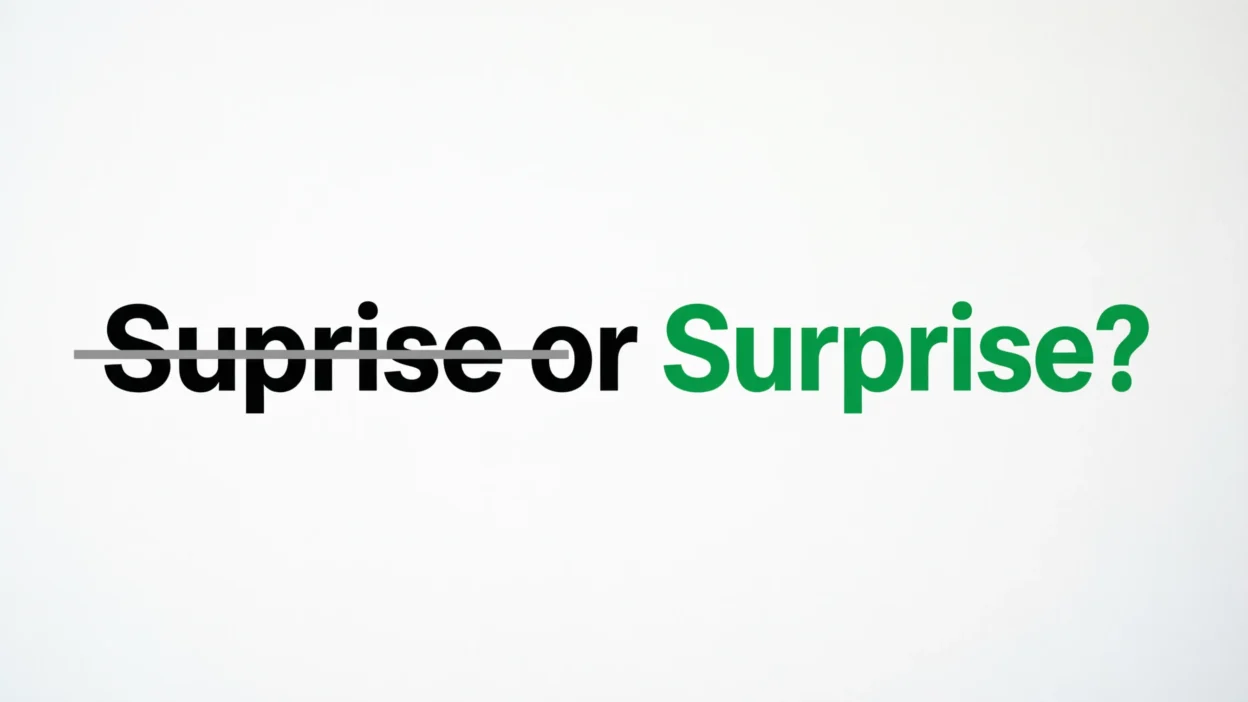
The correct spelling is “surprise.”
❌ Suprise – Incorrect spelling
✅ Surprise – Correct spelling
The word surprise can be used as both a noun and a verb. It refers to an unexpected event, feeling, or action.
Example:
- I received a wonderful surprise on my birthday.
- Her visit will surprise everyone.
What Does “Surprise” Mean?
The word surprise refers to something unexpected that causes astonishment, excitement, confusion, or delight.
As a noun, it means an unexpected event or occurrence.
Example:
- The party was a complete surprise.
As a verb, it means to catch someone off guard or do something unexpected.
Example:
- The announcement surprised the entire team.
Simple Definition
Surprise: Something unexpected that causes a reaction.
Why Is “Suprise” Incorrect?
The misspelling suprise occurs because many people accidentally leave out the first “r” in the word.
The correct spelling follows the traditional English form:
S-U-R-P-R-I-S-E
Many English words contain letter combinations that are not obvious from pronunciation alone. Since the first “r” is often subtle in speech, writers may mistakenly omit it.
Memory Trick
Think of this pattern:
SUR + PRISE = SURPRISE
Remember that the word contains two “r” sounds, even if one is less noticeable when spoken.
Examples of “Surprise” in Sentences
Here are some everyday examples showing the correct usage:
As a Noun
- The gift was a pleasant surprise.
- What a surprise to see you here!
- Her success came as no surprise to her family.
- The ending of the movie was a huge surprise.
As a Verb
- The results may surprise you.
- They surprised their parents with a vacation.
- His honesty surprised everyone.
- The sudden rainstorm surprised the hikers.
Common Mistakes People Make
Many writers confuse the spelling because of pronunciation habits and fast typing.
Mistake 1: Writing “Suprise”
❌ The news came as a suprise.
✅ The news came as a surprise.
Mistake 2: Mixing Up Noun and Verb Usage
❌ The surprise me yesterday.
✅ They surprised me yesterday.
Mistake 3: Capitalization Errors
❌ what a Surprise!
✅ What a surprise!
Unless it begins a sentence or is part of a title, “surprise” is generally not capitalized.
Suprise vs Surprise Comparison Table
| Feature | Suprise | Surprise |
|---|---|---|
| Correct English spelling | ❌ No | ✅ Yes |
| Accepted in dictionaries | ❌ No | ✅ Yes |
| Suitable for academic writing | ❌ No | ✅ Yes |
| Suitable for professional communication | ❌ No | ✅ Yes |
| Common spelling mistake | ✅ Yes | ❌ No |
American vs British English
Good news: there is no spelling difference between American English and British English for this word.
| American English | British English |
|---|---|
| Surprise | Surprise |
Unlike words such as color/colour or organize/organise, the spelling surprise remains the same in both varieties of English.
Pronunciation Differences
While pronunciation may vary slightly depending on accent, the spelling remains identical.
Synonyms of Surprise
Using synonyms can improve your writing and help avoid repetition.
Common synonyms include:
- Astonishment
- Shock
- Wonder
- Amazement
- Revelation
- Unexpected event
- Eye-opener
- Bombshell
- Startle
- Stun
Example
Instead of saying:
- The announcement was a surprise.
You could write:
- The announcement was an astonishment.
- The announcement came as a shock.
- The announcement was completely unexpected.
Related Words and Phrases
Here are some commonly used phrases connected with surprise:
- Pleasant surprise
- Big surprise
- Complete surprise
- Surprise visit
- Surprise party
- Surprise announcement
- Surprise gift
- To surprise someone
- Unexpected outcome
- Caught by surprise
Examples
- We organized a surprise party for her birthday.
- The company made a surprise announcement.
- I was caught by surprise when the lights went out.
Why Correct Spelling Matters
Using the correct spelling helps you:
- Improve credibility
- Communicate clearly
- Avoid grammar and spelling errors
- Perform better in academic writing
- Create a professional impression
Search engines, teachers, employers, and readers often notice spelling mistakes. Writing surprise correctly demonstrates attention to detail and strong language skills.
How to Remember the Correct Spelling
Try these simple techniques:
Visual Method
Write the word several times:
- Surprise
- Surprise
- Surprise
Repeated exposure strengthens memory.
Word Breakdown
Separate it into parts:
Sur + prise
This makes the spelling easier to recall.
Sentence Practice
Create your own examples:
- The surprise made everyone smile.
- I want to surprise my friend.
- The ending was a surprise.
Frequently Asked Questions
Is “suprise” a real word?
No. Suprise is not a recognized English word. It is simply a common misspelling of surprise.
What is the correct spelling: suprise or surprise?
The correct spelling is surprise.
Why do people spell surprise as suprise?
Many people accidentally omit the first r because the pronunciation can make it less noticeable.
Is surprise a noun or a verb?
It can be both.
Noun: The gift was a surprise.
Verb: They surprised us yesterday.
Is surprise spelled differently in British English?
No. Both American and British English use the spelling surprise.
What are some synonyms for surprise?
Common synonyms include astonishment, amazement, shock, wonder, revelation, and unexpected event.
How can I remember the spelling of surprise?
Remember that the word contains two “r” letters:
S-U-R-P-R-I-S-E
Practicing the spelling and using it in sentences can help.
Can surprise be used in formal writing?
Yes. The word is appropriate for academic, business, professional, and casual communication.
Final Thoughts
When comparing suprise or surprise, the answer is straightforward: surprise is the only correct spelling. Although “suprise” is a common mistake, it is not accepted in standard English dictionaries, academic writing, or professional communication. Learning the correct spelling helps improve your writing accuracy and confidence.
Whether you’re writing an email, essay, social media post, or business document, using surprise correctly ensures your message appears polished and professional. Remember the simple spelling pattern, practice it regularly, and you’ll never confuse these two forms again.
Actionable Takeaway
The next time you’re unsure about suprise or surprise, choose surprise every time. Save the spelling pattern S-U-R-P-R-I-S-E, use it in everyday sentences, and proofread your writing for this common error. Small spelling improvements can make a big difference in how your writing is perceived.