Choosing between beside or besides can be confusing because the words look almost identical. However, they have different meanings and grammatical functions. Using the wrong one can change the meaning of your sentence and make your writing less accurate.
If you’ve ever paused while writing an email, essay, or social media post wondering which word is correct, you’re not alone.
This guide explains the difference between beside and besides in simple language, with easy examples, common mistakes, and practical tips to help you use both words confidently.
Quick Answer
The difference is simple:
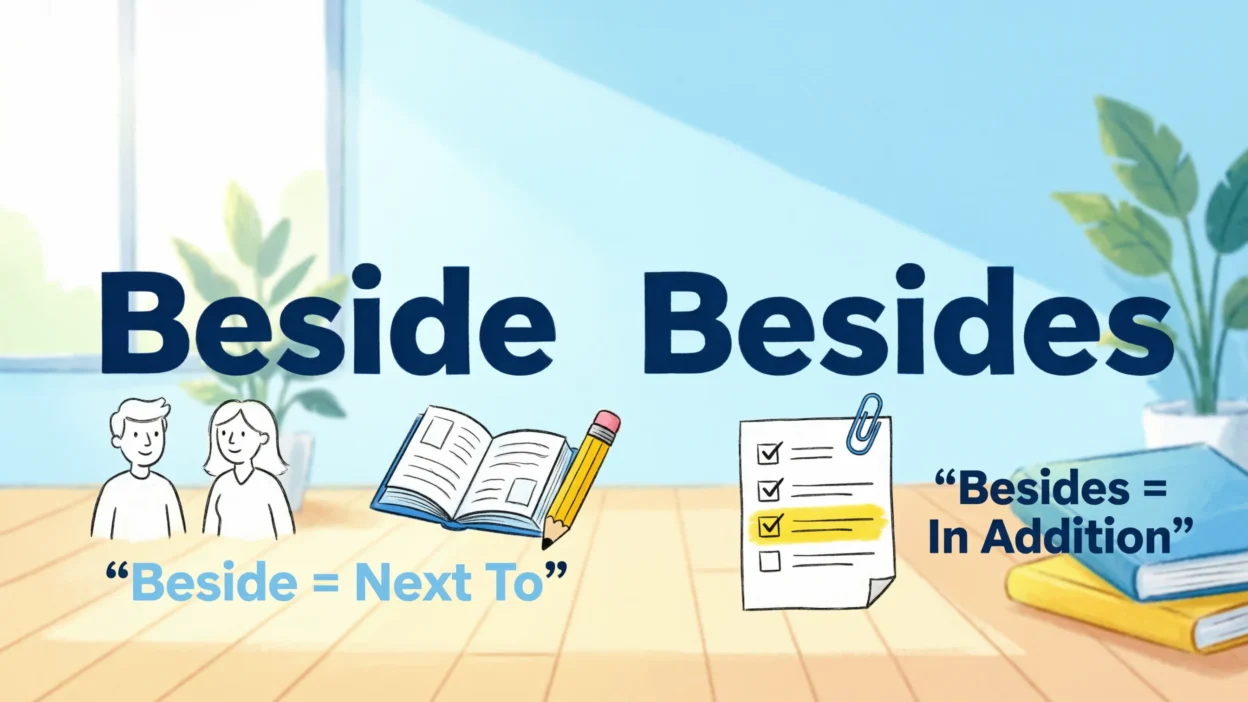
- Beside means next to or at the side of.
- Besides means in addition to or apart from.
Examples:
- The dog slept beside the fireplace.
- Besides English, she also speaks Spanish.
Remember this easy trick:
- Beside = by the side
- Besides = plus or also
What Does “Beside” Mean?
Beside is a preposition that describes location. It tells us that one person or object is next to another.
Examples of “Beside”
- She sat beside her grandmother.
- The lamp is beside the bed.
- Please park your bicycle beside the fence.
- I stood beside my best friend during the ceremony.
In every example, beside refers to physical position.
Synonyms of Beside
- Next to
- By
- Alongside
- At the side of
- Adjacent to
What Does “Besides” Mean?
Besides is usually a preposition or an adverb. It means in addition to, also, or apart from.
Examples of “Besides”
- Besides coffee, we also serve tea.
- She enjoys reading besides writing.
- I don’t want to go. Besides, it’s already late.
- Besides his full-time job, he runs a small business.
Here, besides adds extra information rather than describing location.
Synonyms of Besides
- Also
- Moreover
- In addition
- Furthermore
- Apart from
- As well as
Beside vs Besides: Comparison Table
| Feature | Beside | Besides |
|---|---|---|
| Meaning | Next to | In addition to |
| Part of Speech | Preposition | Preposition or Adverb |
| Shows | Position | Addition or Extra Information |
| Example | Sit beside me. | Besides math, I love science. |
| Easy Memory Tip | Side | Plus |
When Should You Use “Beside”?
Use beside whenever you’re talking about physical location.
Correct Examples
- The teacher stood beside the whiteboard.
- My keys are beside the laptop.
- She walked beside her brother.
- A beautiful garden sits beside the river.
Incorrect Example
❌ Besides the river stood a tree.
✅ Beside the river stood a tree.
The sentence talks about location, so beside is correct.
When Should You Use “Besides”?
Use besides when you mean also, in addition, or apart from.
Correct Examples
- Besides football, he enjoys basketball.
- We need milk. Besides, we should buy eggs.
- Besides being talented, she’s incredibly kind.
- Nobody knew the answer besides Sarah.
These sentences introduce additional information instead of describing where something is.
Common Mistakes with Beside and Besides
Many English learners accidentally interchange these two words because they differ by only one letter.
Mistake 1: Using “Besides” for Location
❌ My chair is besides the window.
✅ My chair is beside the window.
Mistake 2: Using “Beside” for Addition
❌ Beside English, she speaks French.
✅ Besides English, she speaks French.
Mistake 3: Forgetting That “Besides” Can Start a Sentence
Correct:
- Besides, I don’t have enough time.
- Besides, it wouldn’t solve the problem.
Here, besides works like moreover or anyway.
Easy Memory Trick
A simple way to remember the difference:
- Beside contains the word side, reminding you of next to someone or something.
- Besides ends with s, which can remind you of something extra or something added.
Think of it this way:
Side = Position
S = Something More
Everyday Examples
Here are more real-life examples.
Using Beside
- My phone is beside my wallet.
- She placed the flowers beside the window.
- He sat beside me during the movie.
- The hotel is beside the beach.
Using Besides
- Besides pizza, we ordered pasta.
- Besides being affordable, the product is durable.
- Besides, nobody asked for my opinion.
- Besides work, she enjoys gardening.
Grammar Tip
Although both words are prepositions, besides can also function as an adverb.
As a Preposition
- Besides science, she studies history.
As an Adverb
- I don’t want to leave. Besides, it’s raining.
Beside only functions as a preposition.
Formal and Informal Usage
Both beside and besides are appropriate in formal writing, business communication, academic essays, and everyday conversations.
In very formal writing, words like moreover, furthermore, or in addition may sometimes replace besides, but besides remains grammatically correct.
American vs British English
There is no significant difference between American English and British English when using beside and besides. Both varieties follow the same meanings and grammar rules.
Whether you’re writing in the United States, the United Kingdom, Canada, Australia, or other English-speaking countries:
- Beside always refers to location.
- Besides always means in addition to or apart from.
The spelling and usage remain consistent across major English dialects.
Related Words and LSI Keywords
If you’re learning this topic, you may also come across these related grammar terms:
- Beside meaning
- Besides meaning
- Beside vs besides
- Difference between beside and besides
- English grammar rules
- Common English mistakes
- Prepositions in English
- Grammar examples
- Word usage
- Correct English writing
- English vocabulary
- Confusing English words
- Grammar tips
- Writing improvement
Frequently Asked Questions
1. What is the main difference between beside and besides?
Beside means next to, while besides means in addition to or also.
2. Is “besides” grammatically correct?
Yes. Besides is completely correct and commonly used as both a preposition and an adverb.
3. Can “besides” mean “except”?
Yes. In some contexts, besides can mean apart from or except for.
Example:
Besides John, everyone attended the meeting.
4. Can “beside” start a sentence?
Yes.
Example:
Beside the lake stood an old cabin.
5. Is “besides” more formal than “also”?
Not necessarily. Both are acceptable, but besides often introduces additional supporting information more naturally.
6. Is there any spelling difference between British and American English?
No. Both spell and use beside and besides the same way.
7. Can I replace “besides” with “moreover”?
Often, yes.
Example:
Besides, we were already late.
Moreover, we were already late.
Both are correct, though moreover sounds slightly more formal.
8. How can I remember which word to use?
Remember:
- Beside = next to
- Besides = also or in addition
This simple rule works in nearly every situation.
Summary
Although beside and besides differ by only one letter, they serve very different purposes. Beside describes physical position, meaning next to or at the side of, while besides introduces additional information and means also, in addition to, or apart from. Understanding this distinction makes your writing clearer and more precise.
Whenever you’re unsure, ask yourself whether you’re talking about location or adding information. If it’s about where something is, choose beside. If you’re introducing something extra, use besides. Practicing these examples in everyday writing will quickly make the correct choice feel natural.
Actionable Takeaway
The next time you write, use this quick check:
- Beside = next to
- Besides = also, moreover, in addition
Keeping this simple rule in mind will help you avoid one of the most common English grammar mistakes and improve your writing with confidence.