Many English learners and even native speakers get confused between lifes or lives. Since English has many irregular plural nouns, it’s easy to wonder whether the plural of life is lifes or lives. Using the wrong form can make your writing look less polished, especially in academic, professional, or everyday communication.
If you’ve ever typed “lifes” and questioned whether it was correct, you’re in the right place. This guide explains the difference between lifes or lives, provides grammar rules, real-life examples, common mistakes, and simple memory tricks to help you use the correct word every time.
Quick Answer
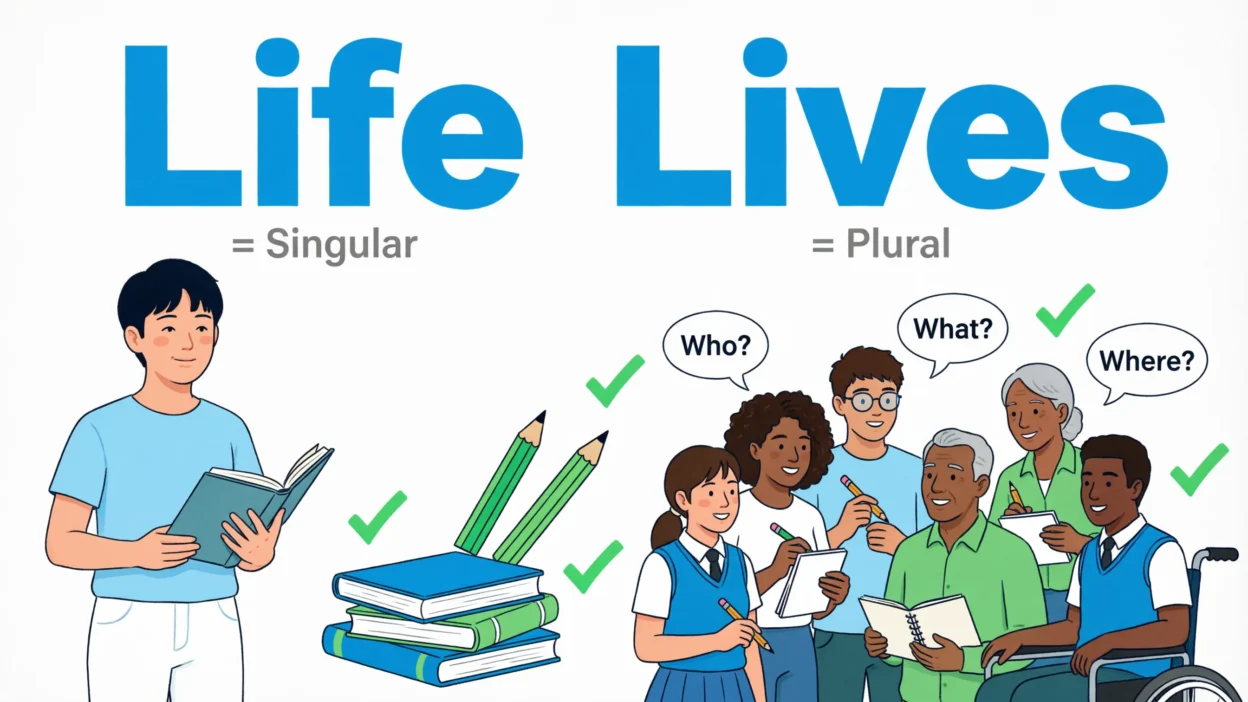
The correct plural of life is lives.
- Life = One person, animal, or thing’s existence.
- Lives = More than one life.
- Lifes is not a correct English word.
Examples:
- She lived a happy life.
- The firefighters saved many lives.
- ❌ Many lifes were changed.
- ✅ Many lives were changed.
What Does “Life” Mean?
Life is a singular noun that refers to the existence of a person, animal, plant, or living organism. It can also describe someone’s experiences, lifestyle, or lifetime.
Examples of “Life”
- She enjoys her life in the countryside.
- Every life is valuable.
- He started a new life after moving abroad.
- A healthy diet leads to a better life.
What Does “Lives” Mean?
Lives is the plural form of life. It refers to two or more lives.
English has several irregular plural nouns where words ending in -fe change to -ves when made plural.
Examples of “Lives”
- Doctors save countless lives every year.
- Their lives changed after graduation.
- Animals’ lives depend on clean habitats.
- The accident affected many lives.
Lifes vs Lives: Comparison Table
| Feature | Lifes | Lives |
|---|---|---|
| Correct Spelling | ❌ No | ✅ Yes |
| Meaning | Not an English word | Plural of life |
| Grammar | Incorrect | Correct |
| Usage | Never use | Use for two or more lives |
| Example | ❌ Many lifes | ✅ Many lives |
Why Is the Plural “Lives” Instead of “Lifes”?
English contains many irregular plural nouns. Words ending in -f or -fe often change to -ves when they become plural.
Examples include:
| Singular | Plural |
|---|---|
| Life | Lives |
| Knife | Knives |
| Wife | Wives |
| Leaf | Leaves |
| Wolf | Wolves |
| Shelf | Shelves |
However, not every word ending in -f follows this rule.
For example:
- Roof → Roofs
- Chef → Chefs
- Belief → Beliefs
That’s why it’s important to memorize irregular plurals like life → lives.
When Should You Use “Life”?
Use life whenever you’re referring to one person, one animal, or one existence.
Correct Examples
- Her life changed forever.
- Every life deserves respect.
- His life story inspired everyone.
- A balanced life is important.
When Should You Use “Lives”?
Use lives whenever you’re referring to more than one life.
Correct Examples
- Teachers positively influence many lives.
- The rescue team saved several lives.
- Our decisions affect future lives.
- Technology has improved millions of lives.
Common Mistakes
Many learners make these common errors.
Mistake 1: Writing “Lifes”
❌ Many lifes were lost.
✅ Many lives were lost.
Mistake 2: Using “Life” for More Than One
❌ Many life were affected.
✅ Many lives were affected.
Mistake 3: Confusing “Lives” as a Noun and a Verb
The word lives can also be the third-person singular form of the verb “live.”
Examples:
- She lives in Canada. (Verb)
- Many lives were saved. (Plural noun)
The meaning depends on the sentence.
Easy Memory Trick
Here’s a simple trick:
If you’re talking about one, use life.
If you’re talking about many, remember that life changes F to V, giving you lives.
Think of these examples:
- Knife → Knives
- Wife → Wives
- Life → Lives
This pattern makes the correct spelling much easier to remember.
Grammar Tip
Life and lives are both nouns, but lives can also function as a verb.
As a Noun
- Their lives improved after the program.
As a Verb
- She lives near the beach.
Pay attention to the sentence structure to determine which meaning is intended.
Formal vs Informal Usage
Both life and lives are appropriate in all types of English.
You can use them in:
- Academic writing
- Business communication
- News articles
- Books
- Everyday conversations
- Professional documents
There is no difference in correctness between formal and informal contexts.
American vs British English
There is no difference between American English and British English regarding life and lives.
Both varieties of English follow the same grammar rule:
- Life = Singular
- Lives = Plural
The spelling and pronunciation remain consistent across both dialects.
Related Words (LSI Keywords)
If you’re learning about lifes or lives, you may also encounter these related terms:
- Life meaning
- Lives meaning
- Plural of life
- Irregular plural nouns
- English grammar rules
- Singular and plural nouns
- Common spelling mistakes
- English vocabulary
- Grammar examples
- Correct English usage
- Noun forms
- English writing tips
- Life vs lives
- Plural spelling rules
Frequently Asked Questions
1. Is “lifes” a correct word?
No. Lifes is not a correct English word. The correct plural of life is lives.
2. What is the plural of life?
The plural of life is lives.
3. Why does life become lives?
Because life is an irregular noun ending in -fe, which changes to -ves in the plural.
4. Is “lives” a noun or a verb?
It can be both.
- Lives (noun): The plural of life.
- Lives (verb): Third-person singular of live.
5. Can I ever use “lifes”?
No. Standard English does not recognize lifes as the plural of life.
6. Is the rule the same in American and British English?
Yes. Both use lives as the correct plural.
7. What are similar irregular plural nouns?
Some examples include:
- Knife → Knives
- Wife → Wives
- Wolf → Wolves
- Leaf → Leaves
- Shelf → Shelves
8. How can I remember the correct spelling?
Remember this simple rule:
Life changes F to V before adding -es, becoming lives.
Summary
The difference between lifes or lives is straightforward once you know the grammar rule. Life is the singular noun, while lives is its correct plural form. The word lifes is not accepted in standard English and should always be avoided in writing and speech.
Whenever you’re talking about more than one life, choose lives. Also remember that lives can function as both a plural noun and a verb, depending on the sentence. Mastering this irregular plural will help make your English more accurate and natural.
Actionable Takeaway
Keep this quick rule in mind whenever you write:
- Life = One
- Lives = More than one
- Lifes = Incorrect
Whenever you see a word ending in -fe, check whether it follows the -ves plural pattern. This simple habit will help you avoid one of the most common English spelling mistakes.