If you’ve ever written the word useable and wondered whether it should actually be usable, you’re not alone. This spelling question frequently appears in business writing, academic papers, website content, and everyday communication.
The confusion exists because both useable and usable appear in dictionaries and online sources. However, one spelling is far more common and widely accepted in modern English. Understanding the difference can help you write more professionally and confidently.
Quick Answer
Both useable and usable are correct spellings.
However:
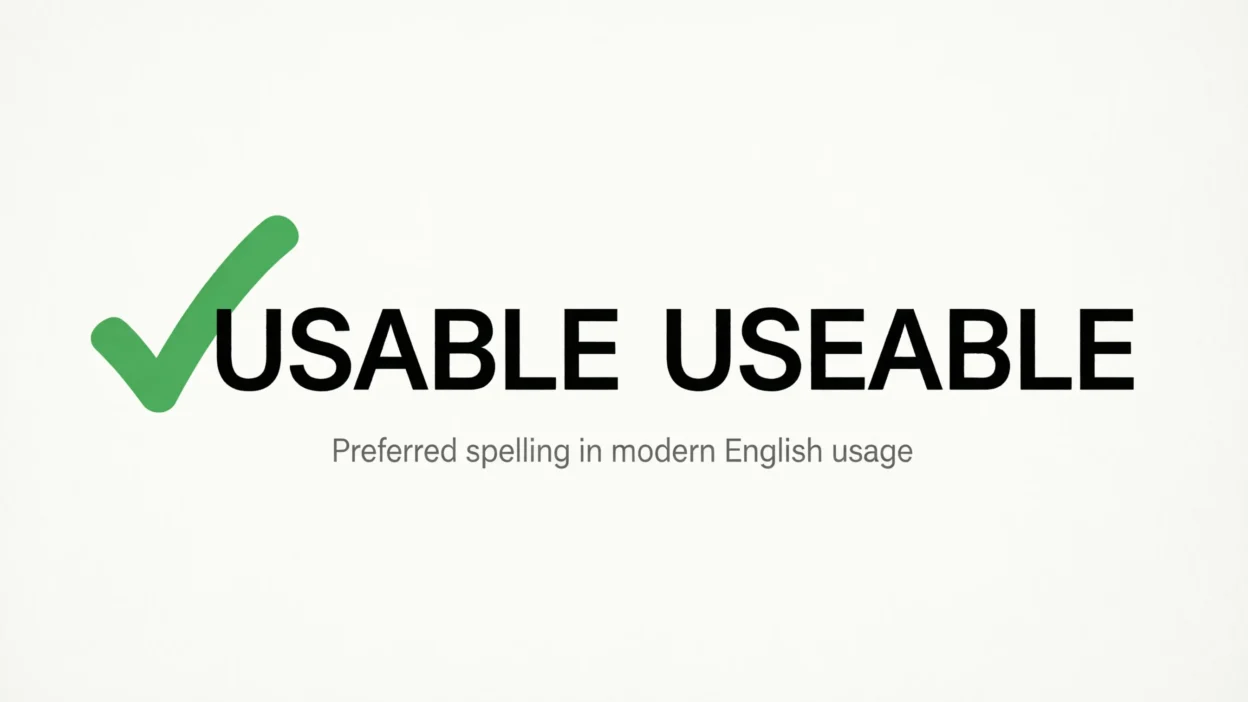
- Usable is the preferred and much more common spelling.
- Useable is considered a variant spelling and is used less frequently.
- Most style guides, dictionaries, and professional writers recommend usable.
Examples:
- This software is easy to use and highly usable.
- The old building is still useable, although it needs repairs.
In most situations, usable is the better choice.
What Do Useable and Usable Mean?
Both useable and usable mean:
- Capable of being used
- Fit for a particular purpose
- Functional and practical
- In a condition that allows use
The two spellings have exactly the same meaning.
Examples
- The equipment is still usable after years of service.
- The chair is old but remains useable.
- We need a usable solution for the problem.
- The data was not usable due to formatting errors.
In everyday English, the word describes something that can still serve its intended function.
Useable or Usable Explained
The word comes from the verb use.
Historically, both spellings developed as acceptable forms:
- Use + able → Useable
- Over time, usable became the preferred simplified spelling.
Today, major dictionaries recognize both versions, but usable dominates modern writing.
Because it is shorter and more widely accepted, usable appears far more often in:
- Business documents
- Academic writing
- News articles
- Marketing content
- Technical documentation
Useable vs Usable: What’s the Difference?
| Feature | Useable | Usable |
|---|---|---|
| Meaning | Capable of being used | Capable of being used |
| Pronunciation | Same | Same |
| Correct Spelling | Yes | Yes |
| Frequency of Use | Less common | Much more common |
| Preferred in Modern Writing | Rarely | Yes |
| Dictionary Recognition | Yes | Yes |
The difference is not meaning but preference.
Most writers and editors choose usable.
When Should You Use Usable?
Use usable in nearly all professional and everyday writing situations.
Examples
- The website has a highly usable interface.
- We need a usable plan before moving forward.
- The software remains usable on older devices.
- This room is small but still usable.
Common Contexts
- User experience (UX)
- Technology
- Business reports
- Academic writing
- Product reviews
Because it is the standard modern spelling, usable is generally the safest choice.
When Should You Use Useable?
Use useable only if:
- A specific style guide prefers it
- You’re following historical writing conventions
- You’re matching existing brand or organizational preferences
Examples
- The equipment remained useable despite its age.
- The warehouse is still useable after renovations.
While correct, many readers may view useable as unusual because they encounter usable far more often.
Common Examples of Usable and Useable
Example 1: Technology
- The application has a usable design.
- The software remains useable after updates.
Example 2: Furniture
- The desk is old but still usable.
- The table is scratched yet useable.
Example 3: Data and Information
- The report contains usable information.
- The file format is not usable for our system.
Example 4: Property
- The building remains usable after repairs.
- The room is small but completely usable.
Common Mistakes People Make
Mistake 1: Thinking Useable Is Wrong
❌ Useable is incorrect.
✅ Both usable and useable are correct.
Explanation: Major dictionaries recognize both spellings.
Mistake 2: Using Both Spellings in the Same Document
❌ The software is usable and the interface is useable.
✅ The software is usable and the interface is usable.
Explanation: Consistency is important in professional writing.
Mistake 3: Choosing the Less Common Form Unnecessarily
❌ This website has a very useable design.
✅ This website has a very usable design.
Explanation: Most readers expect the standard spelling usable.
Mistake 4: Confusing Usable with Useful
❌ The software is useful because it is usable.
✅ The software is useful because it helps users work efficiently.
Explanation: Usable means capable of being used, while useful means beneficial or helpful.
Usable vs Useful
Many people confuse these words.
| Feature | Usable | Useful |
|---|---|---|
| Meaning | Can be used | Provides benefit |
| Focus | Functionality | Value |
| Example | A usable chair | A useful chair |
Example
- The chair is usable because it isn’t broken.
- The chair is useful because it has built-in storage.
Something can be usable without being particularly useful.
British English vs American English
Unlike many spelling differences, both British and American English strongly favor usable.
| British English | American English |
|---|---|
| Usable (preferred) | Usable (preferred) |
| Useable (accepted variant) | Useable (accepted variant) |
There is no major regional difference.
Both countries overwhelmingly prefer usable in modern writing.
Tips to Remember the Correct Spelling
Here are a few easy tricks:
Choose the Common Form
If you’re unsure, use usable.
Think About Modern Usage
Most websites, books, newspapers, and style guides use usable.
Keep It Consistent
Once you choose a spelling, use it throughout the entire document.
Simple Memory Trick
Think:
Usable = Usual Choice
Since usable is the usual choice, it’s easier to remember.
Why Is Usable Important in Modern Writing?
The word appears frequently in:
- User experience (UX) design
- Web development
- Product reviews
- Business communication
- Academic research
- Technical documentation
For example, usability is a major factor in website and software design.
Companies want products that are:
- Easy to understand
- Easy to navigate
- Functional
- User-friendly
As a result, usable has become an important term across many industries.
Frequently Asked Questions
1. Is useable a correct word?
Yes. Useable is a correct but less common spelling.
2. Is usable a correct word?
Yes. Usable is the preferred and most widely used spelling.
3. Which spelling is more common?
Usable is significantly more common in modern English.
4. Do useable and usable have different meanings?
No. Both words have exactly the same meaning.
5. Which spelling should I use in professional writing?
Most editors and style guides recommend usable.
6. Is useable outdated?
Not completely, but it is much less common than usable today.
7. Do British and American English use different spellings?
No. Both generally prefer usable.
8. Is usable better for SEO?
Yes. Since usable is searched and used more frequently, it is usually the better choice for SEO-focused content.
Summary
The choice between useable or usable is primarily a matter of spelling preference rather than meaning. Both forms are correct and recognized by major dictionaries. They both describe something that is capable of being used, functional, or fit for purpose. However, usable has become the dominant spelling in modern English and is the version most readers expect to see.
For professional writing, academic work, business communication, and online content, usable is generally the best choice. It aligns with modern language standards, improves readability, and helps maintain consistency across your writing. While useable remains acceptable, it is far less common and may appear unusual to some readers.
Actionable Takeaway
When deciding between useable and usable, choose usable unless a specific style guide requires otherwise. It’s the preferred spelling in both British and American English and the version most readers recognize instantly.