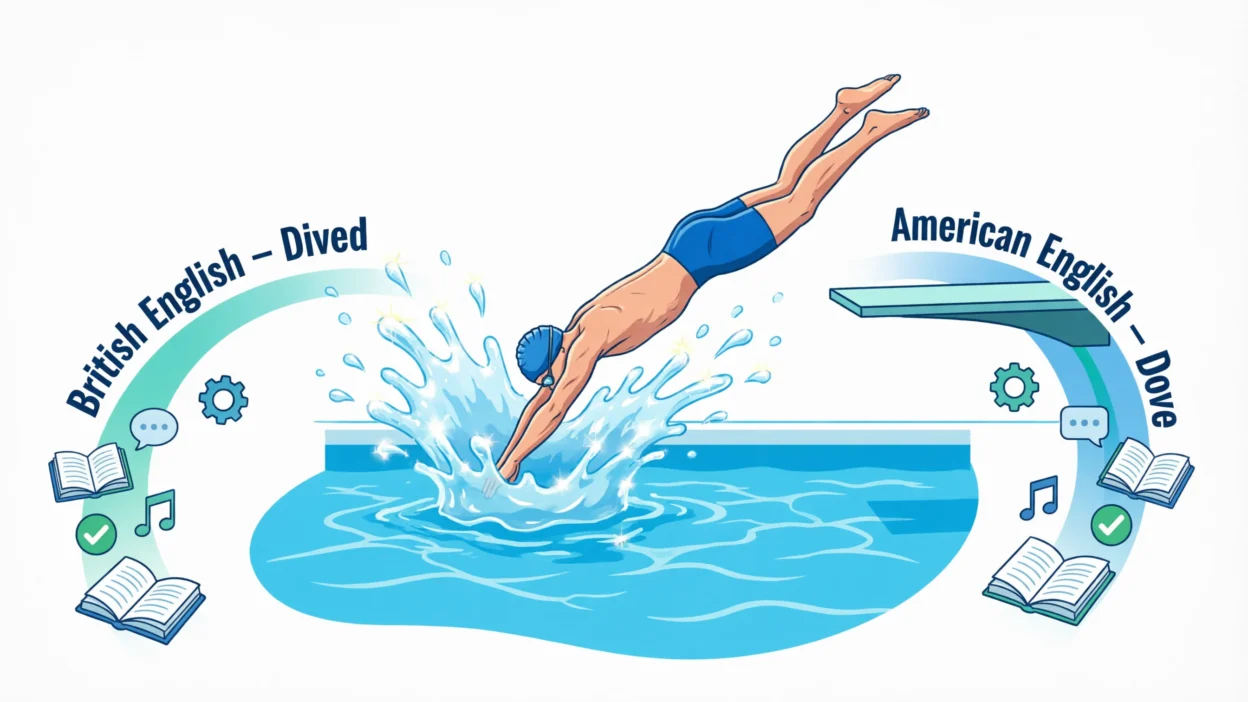
If you’ve ever wondered whether to write dived or dove, you’re not alone. Both words are used as the past tense of dive, but their usage depends on the variety of English and the style of writing. This often leads to confusion among students, writers, and English learners.
The good news is that both “dived” and “dove” are correct in many situations. However, knowing when to use each one can make your writing sound more natural and appropriate for your audience.
This guide explains the difference between dived or dove, provides examples, highlights common mistakes, and covers American vs British English usage.
Quick Answer
Both dived and dove are correct past tense forms of dive, but they are used differently.
- Dived is the standard past tense in British English and is also accepted in American English.
- Dove is primarily used in American English.
- In formal international writing, dived is often the safer choice.
Examples:
- She dived into the pool. ✅
- She dove into the pool. ✅ (especially in American English)
What Does “Dive” Mean?
Dive is a verb that means to jump headfirst into water or to move quickly downward. It can also be used figuratively to describe starting something enthusiastically.
Examples of “Dive”
- The children love to dive into the swimming pool.
- He decided to dive into his new project.
- Birds often dive into the water to catch fish.
- She watched the diver dive from the platform.
What Does “Dived” Mean?
Dived is the traditional past tense and past participle of dive. It is the preferred form in British English and is widely accepted around the world.
Examples of “Dived”
- He dived into the lake without hesitation.
- The goalkeeper dived to stop the penalty.
- She dived beneath the waves.
- The bird dived toward its prey.
What Does “Dove” Mean?
Dove is an alternative past tense of dive. It is commonly used in American English but is rarely used in British English.
Examples of “Dove”
- The athlete dove into the water perfectly.
- He dove behind the wall for safety.
- The dog dove into the river after the ball.
- She dove straight into the conversation.
Dived vs Dove: Comparison Table
| Feature | Dived | Dove |
|---|---|---|
| Meaning | Past tense of dive | Past tense of dive |
| Correct? | ✅ Yes | ✅ Yes |
| British English | Preferred | Rare |
| American English | Accepted | Common and preferred by many speakers |
| Formal International Writing | Recommended | Less common |
| Example | She dived into the sea. | She dove into the sea. |
When Should You Use “Dived”?
Use dived when:
- Writing in British English.
- Following traditional grammar.
- Writing for an international audience.
- Preparing academic or formal documents.
Correct Examples
- The swimmer dived gracefully into the pool.
- Rescue workers dived into the river.
- He dived underwater to retrieve the keys.
- The football goalkeeper dived to make an incredible save.
When Should You Use “Dove”?
Use dove when:
- Writing in American English.
- Matching the style of American publications.
- Writing conversational or informal American content.
Correct Examples
- She dove off the diving board.
- The child dove into the deep end.
- He dove into his homework immediately.
- The firefighter dove through the smoke to rescue the family.
Common Mistakes
Here are some common errors involving dived and dove.
Mistake 1: Thinking One Form Is Always Wrong
❌ Only dived is correct.
✅ Both dived and dove are correct, depending on the variety of English.
Mistake 2: Mixing Styles in the Same Document
❌ He dove into the pool, and later another swimmer dived into the water.
✅ Choose one style and stay consistent throughout your writing unless quoting or matching a specific source.
Mistake 3: Using the Wrong Past Participle
❌ She has dove into the lake. (In formal writing, this may sound incorrect to many readers.)
✅ She has dived into the lake.
Although some American speakers use has dove, has dived is more widely accepted in formal grammar.
Easy Memory Trick
A simple way to remember:
- Dived = Default choice everywhere
- Dove = Mainly American English
If you’re writing for an international audience or you’re unsure which form to use, dived is usually the safest option.
Grammar Tip
Dive is an irregular verb because it has two accepted past tense forms.
| Verb Form | Example |
|---|---|
| Base Verb | Dive |
| Past Tense | Dived / Dove |
| Past Participle | Dived |
In formal writing, dived is generally preferred as the past participle.
Formal vs Informal Usage
Formal Writing
- Academic papers
- Business communication
- News articles
- International publications
Preferred form:
- Dived
Informal Writing
- Everyday conversations
- American blogs
- Social media
- Casual storytelling
Both dived and dove are acceptable, though dove is especially common in the United States.
American vs British English
This is one of the clearest differences between American and British English.
American English
Both forms are accepted, but dove is more common in everyday speech and writing.
Examples:
- He dove into the ocean.
- She dove for the ball.
British English
Dived is the standard and preferred form.
Examples:
- He dived into the sea.
- The goalkeeper dived to his left.
If you’re writing for a global audience, dived is generally the more universally accepted choice.
Related Words (LSI Keywords)
If you’re researching dived or dove, you may also come across these related terms:
- Dive past tense
- Dived meaning
- Dove meaning
- Dive grammar
- Irregular verbs
- English verb forms
- Past tense of dive
- British vs American English
- Grammar rules
- Verb conjugation
- Correct English usage
- English writing tips
- Common grammar mistakes
- Dive examples
Frequently Asked Questions
1. Which is correct: dived or dove?
Both are correct. Dived is preferred in British English, while dove is more common in American English.
2. Is “dove” grammatically correct?
Yes. Dove is an accepted past tense of dive, especially in American English.
3. What is the past participle of “dive”?
The standard past participle is dived.
Example:
- She has dived before.
4. Which form should I use in formal writing?
For formal or international writing, dived is generally recommended.
5. Does British English use “dove”?
Rarely. British English strongly prefers dived.
6. Does American English accept “dived”?
Yes. Americans understand and use dived, although dove is often more common in everyday speech.
7. Can I use both forms in the same article?
It’s better to choose one form and remain consistent unless you’re specifically discussing the difference between them.
8. How can I remember which one to use?
Remember:
- Dived = International and British standard
- Dove = Mostly American English
Summary
The choice between dived or dove depends mainly on the variety of English you’re using. Dived is the traditional past tense and is preferred in British English, formal writing, and many international contexts. Dove is also correct and is especially common in American English.
If you’re unsure which form to use, dived is the safest option because it is widely accepted across English-speaking countries. However, if you’re writing specifically for an American audience, dove is perfectly natural and grammatically correct.
Actionable Takeaway
Use this simple rule whenever you write:
- Dived = Preferred in British English and formal writing
- Dove = Common in American English
- Both are correct, but stay consistent throughout your writing.
Following this guideline will help your writing match your audience and sound more polished.