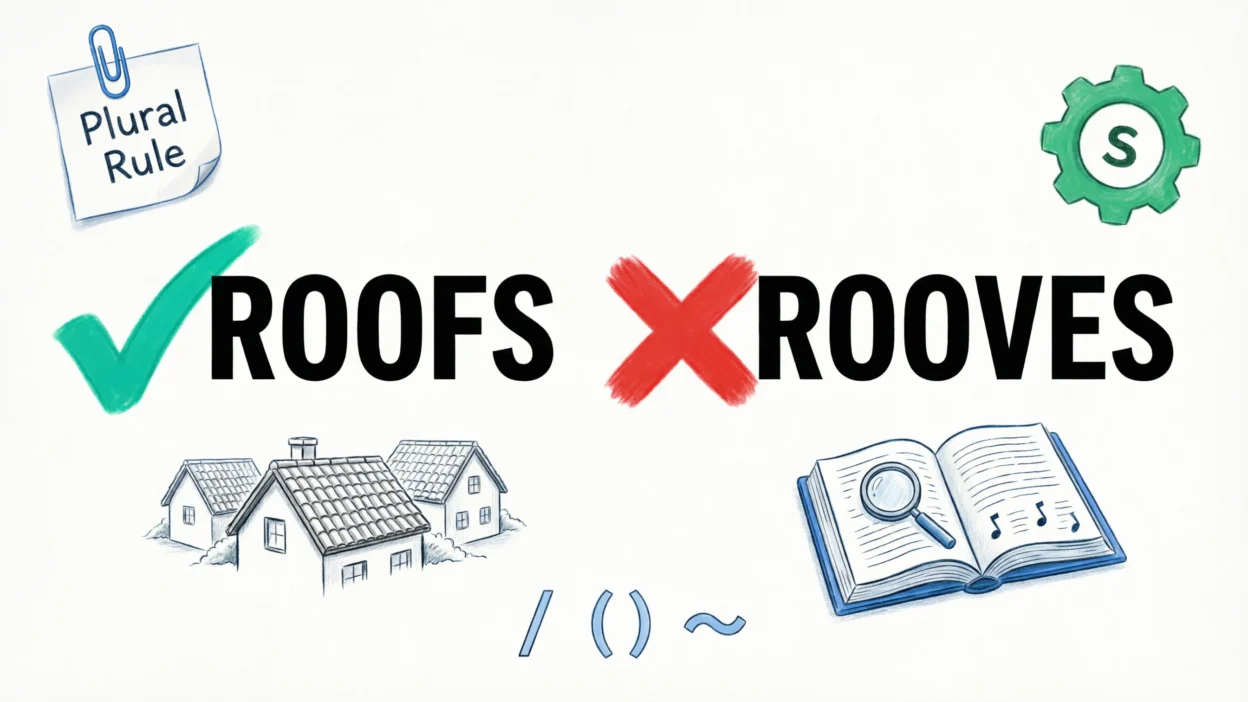
English is full of words that seem straightforward until you need to write them in plural form. One common example is roofs or rooves. If you’ve ever wondered which spelling is correct, you’re not alone. Many writers, students, and English learners pause when deciding whether to add -s or change the word to -ves.
The confusion comes from the fact that several English nouns ending in -f become plural with -ves, such as wolf/wolves and leaf/leaves. However, not every word follows that pattern. Understanding the difference between roofs and rooves will help you write with confidence and avoid a common spelling mistake.
Quick Answer
Roofs is the standard and correct plural form of roof in modern English.
Rooves exists historically and appears occasionally in older texts, but it is considered nonstandard and is rarely used today.
Correct Example:
- The houses in the neighborhood have red roofs.
Generally Incorrect for Modern Usage:
- The houses in the neighborhood have red rooves.
For almost all writing situations, use roofs.
What Does Roof Mean?
A roof is the upper covering of a building, vehicle, or structure that protects it from weather and external elements.
Definition
A roof is the top structure that covers and shelters a building.
Examples of Roof
- The roof needs repairs after the storm.
- Snow accumulated on the roof overnight.
- The workers installed a new roof on the house.
- Birds were nesting on the roof of the garage.
The word is commonly used in construction, architecture, real estate, and everyday conversation.
What Is the Plural of Roof?
The standard plural form of roof is roofs.
Examples
- The city skyline was filled with rooftops and roofs.
- Heavy rain damaged several roofs in the area.
- Solar panels were installed on the roofs of schools.
- The roofs of the cottages were covered with snow.
This is the accepted plural form in modern American English and British English.
Roofs vs Rooves: Key Differences
Although both forms have appeared in English, only one is widely accepted today.
| Feature | Roofs | Rooves |
|---|---|---|
| Modern Standard English | Yes | No |
| Dictionary Acceptance | Yes | Rarely listed as variant |
| Everyday Usage | Very common | Extremely rare |
| Academic Writing | Accepted | Generally avoided |
| Business Writing | Accepted | Avoided |
| Historical Usage | Present | Older variant |
| Recommended Choice | Yes | No |
The simple rule is:
- Roof → Roofs ✅
- Roof → Rooves ❌ (for most modern writing)
Why People Confuse Roofs and Rooves
The confusion comes from English pluralization patterns.
Similar Words Use -ves
Many nouns ending in -f change to -ves when pluralized.
Examples:
- Wolf → Wolves
- Leaf → Leaves
- Knife → Knives
- Shelf → Shelves
- Calf → Calves
Because of these examples, people naturally assume roof should become rooves.
English Has Inconsistent Rules
English evolved from multiple languages and historical influences. As a result, plural forms don’t always follow one predictable pattern.
Historical Usage of Rooves
Centuries ago, some writers used rooves. Over time, roofs became the dominant and accepted standard.
Today, major style guides and dictionaries overwhelmingly prefer roofs.
Why Is Roof Different from Wolf?
This is one of the most frequently asked questions.
English nouns ending in -f generally fall into two categories:
Words That Change to -ves
- Wolf → Wolves
- Life → Lives
- Knife → Knives
- Leaf → Leaves
- Shelf → Shelves
Words That Simply Add -s
- Roof → Roofs
- Chief → Chiefs
- Belief → Beliefs
- Proof → Proofs
- Cliff → Cliffs
Unfortunately, there is no universal rule that works for every word. The plural form must often be learned individually.
Common Mistakes and Corrections
Incorrect
- The storm damaged several rooves.
- New rooves were installed last year.
- The houses had colorful rooves.
Correct
- The storm damaged several roofs.
- New roofs were installed last year.
- The houses had colorful roofs.
Explanation
Modern English recognizes roofs as the standard plural form. Using rooves may appear outdated or incorrect to most readers.
Examples of Roofs in Sentences
Here are some examples showing proper usage.
- Workers inspected the roofs after the hailstorm.
- Many roofs were covered with solar panels.
- The roofs of the historic buildings were restored.
- Birds perched on the roofs of nearby homes.
- Snow piled up on the roofs during winter.
These examples reflect how the word is used in contemporary English.
Is Rooves Ever Correct?
Technically, rooves has historical legitimacy because it appeared in older English usage.
However, modern dictionaries and grammar references generally consider it:
- Archaic
- Rare
- Obsolete in most contexts
- Nonstandard for contemporary writing
You might encounter rooves in:
- Historical literature
- Poetry
- Older documents
- Dialect writing
For professional, academic, business, and online content, roofs is the preferred choice.
American vs British English Differences
Unlike some English spelling differences, there is little variation between American and British English regarding this word.
American English
- Preferred plural: roofs
- Rooves is rarely used.
British English
- Preferred plural: roofs
- Rooves is considered uncommon and largely outdated.
Both varieties overwhelmingly favor roofs.
When Should You Use Roofs?
Use roofs whenever you need the plural form of roof.
Examples
- The roofs were repaired after the storm.
- Inspectors checked the roofs for damage.
- Solar panels covered the roofs of several buildings.
- The roofs were painted a bright red color.
In virtually every modern writing situation, roofs is the correct choice.
When Might You Encounter Rooves?
You may see rooves in limited situations such as:
- Historical novels
- Classic literature
- Regional dialects
- Archived documents
- Poetic writing
Example
- The ancient village’s rooves glistened in the moonlight.
While understandable, this spelling feels old-fashioned to modern readers.
Related Words and Synonyms
If you’re writing about roofs, these related terms may be useful.
Related Construction Terms
- Rooftops
- Shingles
- Ceilings
- Attics
- Structures
- Buildings
- Housing
- Architecture
Synonyms Depending on Context
- Covering
- Shelter
- Canopy
- Overhead structure
- Protective covering
These terms can improve readability and support SEO relevance in construction and home-improvement content.
FAQs
Is roofs or rooves correct?
Roofs is the correct and standard plural form in modern English.
Why isn’t the plural of roof rooves?
English does not apply the -ves pattern to every word ending in -f. Roof belongs to the group that simply adds -s.
Is rooves a real word?
Yes, it has historical usage, but it is rarely used and generally considered outdated.
Do dictionaries recognize rooves?
Some dictionaries mention it as an archaic or alternative historical form, but roofs remains the preferred spelling.
Is roofs used in both American and British English?
Yes. Both American and British English use roofs as the standard plural form.
What are other words like roof?
Words such as chief, belief, proof, and cliff also form their plurals by adding -s.
Can I use rooves in formal writing?
It is not recommended. Most editors and style guides prefer roofs.
Which form should students use on exams?
Students should always use roofs unless specifically discussing historical language usage.
Summary
The debate between roofs or rooves has a clear answer in modern English. The standard and widely accepted plural form of roof is roofs. While rooves appeared in some historical contexts, it is now considered uncommon and largely outdated.
Understanding this distinction helps improve spelling accuracy and ensures your writing aligns with modern English conventions. Whether you’re writing an essay, business report, blog post, or everyday message, roofs is the form readers expect to see.
Actionable Takeaway
Remember this simple rule:
Roof becomes roofs, not rooves.
If you’re writing for modern readers, schools, workplaces, websites, or publications, always choose roofs. Save rooves only for discussions of historical language or literary style.