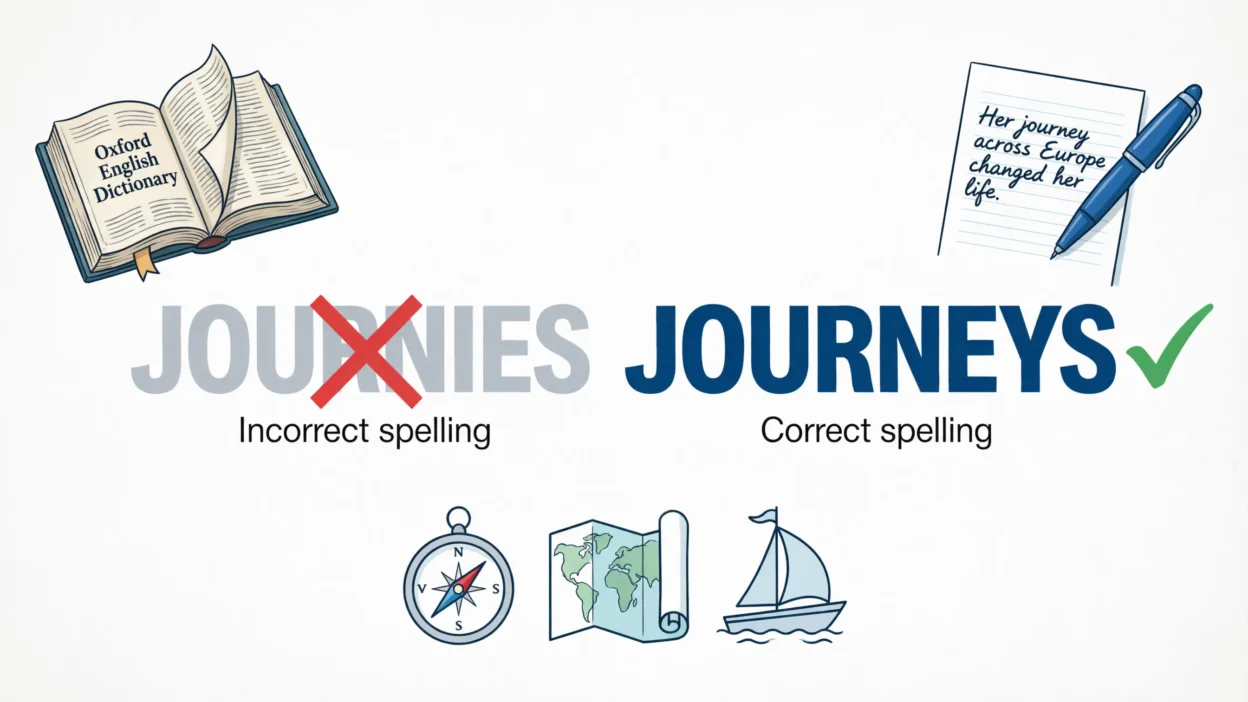
Have you ever typed journies and wondered whether it was the correct spelling? You’re not alone. Many English learners, students, and even experienced writers get confused when pluralizing the word journey. Since English spelling rules can sometimes seem inconsistent, it’s easy to make mistakes.
The good news is that the answer is simple. Only one spelling is correct in standard English. Understanding the rule behind it will help you avoid errors and improve your writing confidence in both personal and professional communication.
Quick Answer
Journeys is the correct spelling.
❌ Journies
✅ Journeys
The word journeys is the plural form of journey. The spelling journies is incorrect and is not recognized in standard English dictionaries.
What Does Journey Mean?
The word journey refers to traveling from one place to another. It can also describe a personal experience, process, or period of growth.
Definition
Journey (noun):
An act of traveling from one place to another, especially over a considerable distance.
Synonyms
Some common synonyms include:
- Trip
- Voyage
- Expedition
- Tour
- Excursion
- Trek
- Adventure
- Passage
These related words are often used in similar contexts, although each may carry a slightly different meaning.
Journies vs Journeys: The Correct Spelling
The main difference is simple:
| Word | Correct? | Meaning |
|---|---|---|
| Journeys | ✅ Yes | Plural form of journey |
| Journies | ❌ No | Incorrect spelling |
When making journey plural, you add -s, resulting in journeys.
Correct Examples
- Their journeys across Europe were unforgettable.
- We shared stories about our life journeys.
- The travelers documented their journeys online.
- Many successful journeys begin with a single step.
Incorrect Examples
- ❌ Their journies across Europe were unforgettable.
- ❌ We enjoyed reading about their journies.
- ❌ The book describes several journies around the world.
Why Is Journeys Correct?
The confusion usually comes from English words ending in -y.
Many words ending in y change to -ies when pluralized:
- Baby → Babies
- City → Cities
- Lady → Ladies
However, there is an important rule.
The Plural Rule for Words Ending in Y
If a word ends with:
Consonant + Y
→ Change Y to IES
Examples:
- Party → Parties
- Country → Countries
- Story → Stories
If a word ends with:
Vowel + Y
→ Simply add S
Examples:
- Boy → Boys
- Toy → Toys
- Key → Keys
- Journey → Journeys
Since journey ends with the vowel e followed by y, the correct plural form is journeys.
Examples of Journeys in Sentences
Here are some examples showing the correct usage.
Travel Context
- Their journeys through Asia lasted several months.
- The magazine featured inspiring journeys around the world.
- Long journeys often require careful planning.
Personal Growth Context
- Everyone experiences different journeys in life.
- Her journeys toward self-improvement inspired many people.
- The book explores emotional and spiritual journeys.
Educational Context
- Students shared their learning journeys during the presentation.
- Career journeys rarely follow a straight path.
- These journeys helped shape their future goals.
Common Uses of Journeys
1. Physical Travel
The most traditional meaning refers to traveling.
Examples:
- Road journeys
- Train journeys
- International journeys
2. Personal Development
The word is frequently used metaphorically.
Examples:
- Fitness journeys
- Recovery journeys
- Leadership journeys
3. Business and Marketing
Companies often discuss customer experiences using the term.
Examples:
- Customer journeys
- User journeys
- Buyer journeys
4. Education and Career Growth
Many organizations use the word to describe progress and achievement.
Examples:
- Learning journeys
- Career journeys
- Professional development journeys
Common Mistakes People Make
Many writers accidentally use journies because they apply the wrong pluralization rule.
Mistake 1: Assuming All Y Endings Become IES
Incorrect:
- Journey → Journies
Correct:
- Journey → Journeys
Remember that words ending in a vowel plus y simply take s.
Mistake 2: Copying Informal Online Usage
Sometimes incorrect spellings appear on social media or forums.
Always verify spelling using trusted dictionaries and grammar resources.
Mistake 3: Confusing Similar Words
People often compare journey with words like:
- Story → Stories
- Country → Countries
These words follow a different rule because they end in a consonant before the y.
How to Remember the Difference
A simple memory trick can help.
Journey Contains a Vowel Before Y
Look at the ending:
Journey = E + Y
Since a vowel comes before the y, simply add s.
Journey → Journeys
Quick Memory Formula
Vowel + Y = Add S
Examples:
- Key → Keys
- Toy → Toys
- Boy → Boys
- Journey → Journeys
This rule works every time.
American vs British English
Unlike some words that have different spellings in American and British English, there is no variation here.
| American English | British English |
|---|---|
| Journey | Journey |
| Journeys | Journeys |
Both American and British English use journeys as the correct plural form.
The spelling journies is incorrect in both varieties of English.
Related Words and Terms
Understanding related vocabulary can improve your writing.
LSI Keywords
- Journey meaning
- Journey plural
- Travel experiences
- Personal journey
- Life journey
- Customer journey
- Career journey
- Learning journey
- Travel adventure
- Voyage
Related Phrases
- A journey of discovery
- Personal growth journey
- Customer journey mapping
- Life-changing journey
- Educational journey
- Professional journey
Using these terms naturally can make your writing richer and more engaging.
Frequently Asked Questions
Is journeys or journies correct?
Journeys is correct. Journies is an incorrect spelling.
Why is journeys spelled with -eys instead of -ies?
Because journey ends with a vowel plus y. Words with this pattern usually form plurals by adding s.
Is journies a real word?
No. Journies is considered a spelling mistake and does not appear as a standard dictionary word.
What is the plural form of journey?
The plural form of journey is journeys.
Do British and American English spell journeys differently?
No. Both use journeys.
How do I remember the correct spelling?
Remember that journey ends in ey, so you simply add s to create journeys.
Can journeys be used figuratively?
Yes. It often describes personal growth, learning, recovery, and life experiences.
Is “life journeys” grammatically correct?
Yes. The phrase life journeys is commonly used when referring to multiple people’s life experiences or paths.
Summary
When comparing journies or journeys, the correct spelling is always journeys. The word journies is a common spelling mistake caused by misunderstanding English pluralization rules. Since journey ends with a vowel followed by y, you simply add s to form the plural.
Whether you’re discussing travel adventures, personal development, customer experiences, or career growth, journeys is the only correct plural form. Using the proper spelling improves clarity, professionalism, and credibility in your writing.
Actionable Takeaway
Whenever you’re unsure, check the letter before the y. If it’s a vowel, simply add s. For journey, that means the correct plural is journeys, never journies. Applying this simple rule will help you avoid similar spelling mistakes in the future.