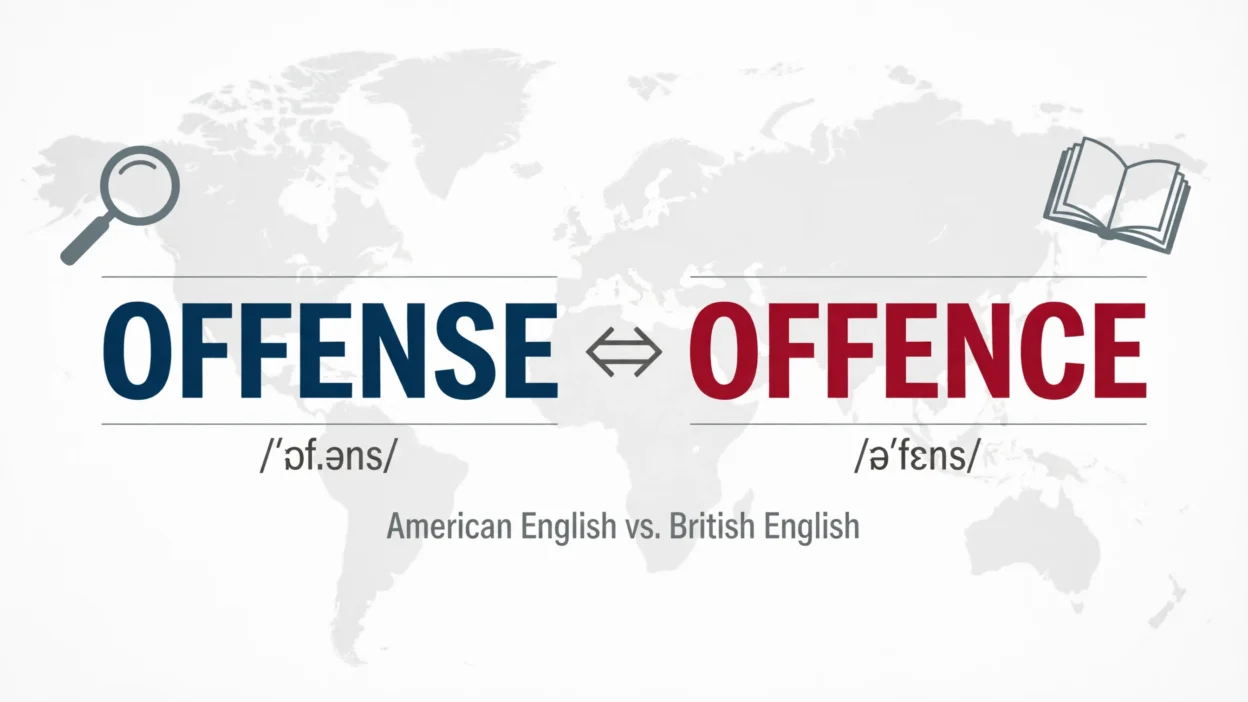
Have you ever paused while writing and wondered whether offense or offence is the correct spelling? You’re not alone. This is one of the most common spelling differences between American and British English, and it often causes confusion for students, professionals, writers, and English learners.
The good news is that both spellings are correct. The choice depends mainly on the version of English you’re using. Understanding when to use each spelling can help improve your writing, maintain consistency, and ensure your content matches the expectations of your audience.
Quick Answer
Offense and offence have the same meaning.
- Offense is the preferred spelling in American English.
- Offence is the preferred spelling in British English, as well as in many countries that follow British spelling conventions, including Canada, Australia, and New Zealand.
If you’re writing for a U.S. audience, use offense. If you’re writing for a UK audience, use offence.
What Does Offense or Offence Mean?
The words offense and offence refer to:
- An act that breaks a law or rule
- Something that causes hurt feelings, annoyance, or insult
- An attacking side in sports or military contexts
Regardless of spelling, the meaning remains exactly the same.
Definition
Offense/Offence (noun):
An illegal act, a violation, an insult, or an action that causes displeasure.
Synonyms
Some common synonyms include:
- Crime
- Violation
- Wrongdoing
- Misconduct
- Insult
- Affront
- Breach
- Transgression
These related terms can help enrich your vocabulary and improve your writing.
Offense vs Offence: The Key Difference
The only real difference between offense and offence is spelling.
| Aspect | Offense | Offence |
|---|---|---|
| English Variant | American English | British English |
| Meaning | Same | Same |
| Pronunciation | Same | Same |
| Usage | United States | United Kingdom, Australia, New Zealand |
| Correctness | Correct | Correct |
There is no difference in pronunciation or meaning. The distinction exists purely because of regional spelling conventions.
Why Are There Two Different Spellings?
Many spelling differences between American and British English developed during the 18th and 19th centuries.
American English often simplified certain spellings. As a result:
- Defence became defense
- Licence became license
- Pretence became pretense
- Offence became offense
British English generally retained the traditional spellings ending in -ce, while American English favored -se endings for many nouns.
This historical difference explains why both forms continue to exist today.
Examples of Offense in American English
If you’re writing for an American audience, these examples are correct:
- Speeding is a traffic offense in many states.
- He took no offense at the comment.
- The team’s offense scored three touchdowns.
- The company considered the violation a serious offense.
In American publications, newspapers, and academic writing, offense is the standard spelling.
Examples of Offence in British English
If you’re writing in British English, use offence:
- Theft is a criminal offence.
- She meant no offence by her remarks.
- The player was charged with a disciplinary offence.
- No offence was intended during the discussion.
British dictionaries and publications consistently prefer offence.
Common Uses of Offense or Offence
1. Legal Context
The word frequently appears in legal and criminal discussions.
Examples:
- Drug possession is a serious offense.
- The offence carries a maximum penalty of five years.
2. Personal Feelings
It can describe emotional hurt or insult.
Examples:
- I hope you don’t take offense.
- No offence, but I disagree with your opinion.
3. Sports
In sports, the term refers to the attacking team or strategy.
Examples:
- Their offense dominated the game.
- The offence struggled to create scoring opportunities.
4. Military Usage
It may describe an attack or aggressive action.
Examples:
- The army launched an offense at dawn.
- The military planned a major offence.
Common Mistakes People Make
Many writers accidentally mix American and British spellings within the same document.
Mistake 1: Mixing Language Styles
Incorrect:
- The defense committed an offence.
- The defense committed an offense.
Correct British English:
- The defence committed an offence.
Mistake 2: Assuming One Spelling Is Wrong
Some people believe one version is incorrect.
Reality:
Both spellings are correct when used in the appropriate language variety.
Mistake 3: Ignoring Audience Location
Writers often use their preferred spelling without considering readers.
For best results:
- Use offense for U.S. audiences.
- Use offence for UK and many international audiences.
How to Remember the Difference
A simple trick can help:
Offense = United States
Think of:
- S in offense
- S in States
Offence = British English
Think of:
- C in offence
- Traditional British spelling patterns
This memory aid makes choosing the correct version much easier.
Offense or Offence in Professional Writing
Consistency matters more than the spelling itself.
When creating:
- Blog posts
- Academic papers
- Business reports
- Marketing content
- Legal documents
Choose one spelling style and use it throughout the document.
Many organizations follow style guides such as:
- American English Style Guide → offense
- British English Style Guide → offence
Maintaining consistency improves professionalism and readability.
Related American and British English Spelling Differences
The offense/offence distinction is part of a broader pattern.
| American English | British English |
|---|---|
| Offense | Offence |
| Defense | Defence |
| License | Licence |
| Pretense | Pretence |
| Practice (noun/verb) | Practice (noun), Practise (verb) |
Understanding these patterns can help you write more naturally for different audiences.
Frequently Asked Questions
Is offense or offence correct?
Both are correct. Offense is American English, while offence is British English.
Which spelling is used in the United States?
The United States uses offense.
Which spelling is used in the United Kingdom?
The United Kingdom uses offence.
Do offense and offence have different meanings?
No. They have exactly the same meaning and pronunciation.
Is “no offense” correct?
Yes. In American English, “no offense” is the standard spelling.
Is “no offence” correct?
Yes. In British English, “no offence” is the standard spelling.
Which spelling should I use for SEO?
Use the spelling that matches your target audience. For U.S. readers, optimize for offense. For UK readers, optimize for offence. If targeting global audiences, you can naturally include both forms.
Can I use both spellings in one article?
It’s generally better to choose one style and remain consistent throughout the content.
Summary
The debate between offense or offence comes down to regional spelling preferences rather than meaning. Offense is the accepted spelling in American English, while offence is preferred in British English and many other English-speaking countries. Both words refer to a crime, insult, violation, or attacking action and are pronounced the same way.
When deciding which spelling to use, focus on your audience and maintain consistency throughout your writing. If your readers are primarily in the United States, choose offense. If your audience is in the United Kingdom or follows British English conventions, use offence. A consistent approach improves readability, professionalism, and SEO performance.
Actionable Takeaway
Before publishing any content, identify your target audience’s preferred English style. Then use either offense or offence consistently across headings, body text, metadata, and keywords. This simple step helps create polished, professional, and reader-friendly content that aligns with user expectations.