Have you ever stopped while writing an email or formal document and wondered whether inquire or enquire is the correct spelling? You’re not alone. These two words look similar, sound nearly identical, and often appear to mean the same thing, which creates confusion for many writers.
The good news is that both inquire and enquire are correct. However, the preferred spelling often depends on whether you’re using American or British English, as well as the context of your writing. This guide explains the difference, provides examples, highlights common mistakes, and helps you choose the right word with confidence.
Quick Answer
✅ Inquire and enquire are both correct.
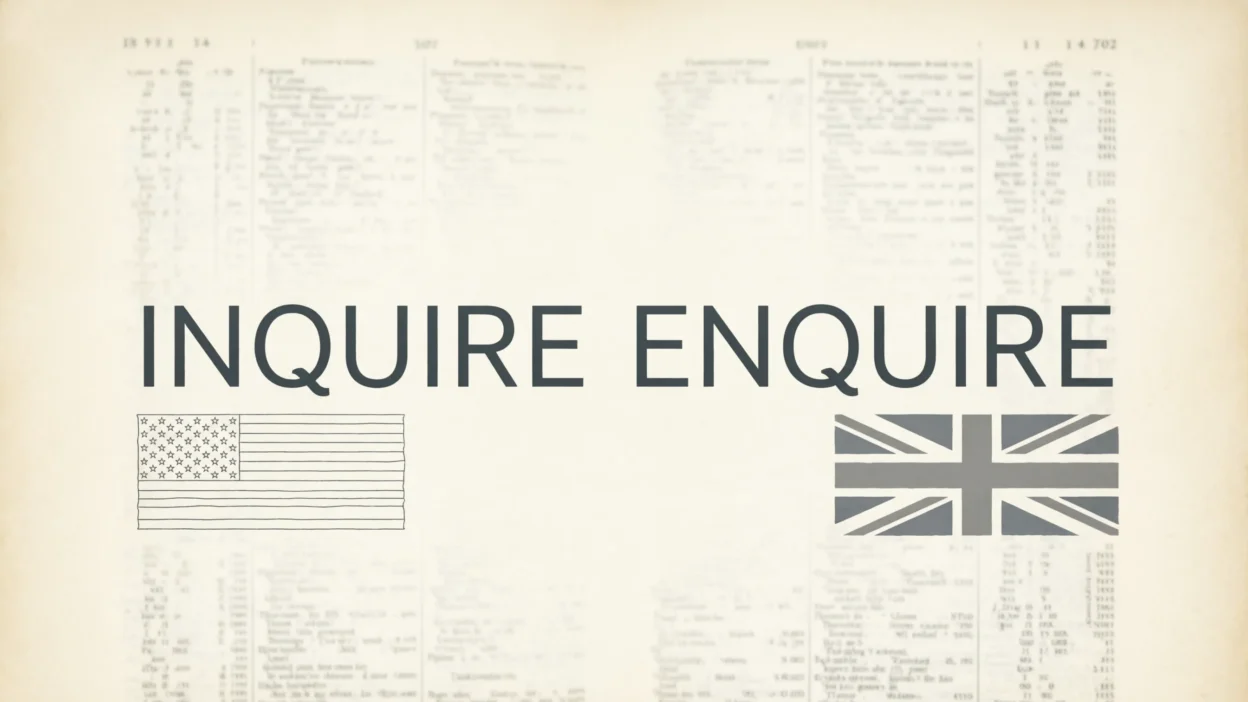
🇺🇸 Inquire is the preferred spelling in American English.
🇬🇧 Enquire is more commonly used in British English.
In modern English, both words generally mean to ask for information, investigate, or seek knowledge about something.
What Do Inquire and Enquire Mean?
Both words function as verbs and share the same basic meaning.
Definition
Inquire / Enquire (verb): To ask for information, seek clarification, investigate, or make a formal request.
Synonyms
- Ask
- Question
- Investigate
- Examine
- Explore
- Probe
- Seek information
- Request details
- Look into
- Research
Antonyms
- Ignore
- Overlook
- Dismiss
- Neglect
- Disregard
Inquire vs Enquire: What’s the Difference?
Historically, some style guides attempted to distinguish the two words.
- Enquire was often used for general questions.
- Inquire was used for formal investigations or official inquiries.
Today, that distinction has largely disappeared, and most dictionaries treat them as interchangeable.
| Word | Correct? | Common Usage |
|---|---|---|
| Inquire | ✅ Yes | Preferred in American English |
| Enquire | ✅ Yes | Preferred in British English |
| Inquiry | ✅ Yes | American noun form |
| Enquiry | ✅ Yes | British noun form |
For most modern writing, the choice depends more on regional spelling conventions than meaning.
Why Do People Get Confused Between Inquire and Enquire?
Several factors contribute to the confusion.
1. They Mean the Same Thing
Unlike many word pairs, inquire and enquire have nearly identical meanings.
2. Regional Spelling Differences
American and British English often use different spellings for the same word.
Examples include:
- Color vs Colour
- Organize vs Organise
- Theater vs Theatre
- Inquire vs Enquire
3. Older Grammar Rules
Some traditional grammar guides taught a distinction between informal questions and formal investigations. Modern usage has largely abandoned this difference.
4. Similar Pronunciation
Both words are pronounced almost exactly the same in everyday speech.
Examples of Inquire in Sentences
Everyday Examples
- I called to inquire about the delivery status.
- She wanted to inquire about the course schedule.
- Please inquire at the front desk for assistance.
Professional Examples
- The customer wrote to inquire about pricing options.
- Investors frequently inquire about future growth plans.
- The committee will inquire into the matter further.
Creative Examples
- He stopped to inquire about the old mansion on the hill.
- Travelers often inquire about local traditions.
Examples of Enquire in Sentences
Everyday Examples
- She called to enquire about available appointments.
- Visitors may enquire at reception.
- I decided to enquire about membership fees.
Professional Examples
- Applicants can enquire about admission requirements.
- Customers are encouraged to enquire before booking.
- The agency invited residents to enquire about community programs.
Creative Examples
- Curious tourists would often enquire about the castle’s history.
- He paused to enquire whether the train was delayed.
Common Mistakes
Mistake #1: Thinking One Is Incorrect
❌ Enquire is wrong.
✅ Both enquire and inquire are correct.
Mistake #2: Mixing American and British English
❌ The company encourages customers to enquire about our services. (American publication)
✅ The company encourages customers to inquire about our services.
Consistency matters more than the specific choice.
Mistake #3: Mixing Inquiry and Enquiry
❌ Thank you for your enquiry. (American business website)
✅ Thank you for your inquiry.
American English generally prefers inquiry, while British English often prefers enquiry.
Easy Memory Trick
A simple way to remember the difference:
Inquire = America
Enquire = England
Both begin with the same sound, but the starting letter can help you match the spelling to the region.
Think:
- I = Inquire = United States preference
- E = Enquire = England preference
American vs British English
This is where the biggest difference appears.
| American English | British English |
|---|---|
| Inquire ✅ | Enquire ✅ |
| Inquiry ✅ | Enquiry ✅ |
| Inquiring ✅ | Enquiring ✅ |
| Inquired ✅ | Enquired ✅ |
While British writers may occasionally use inquire, enquire remains more traditional in the UK.
American English overwhelmingly favors inquire.
Related Words and Forms
Verb Forms
- Inquire
- Enquire
Past Tense
- Inquired
- Enquired
Present Participle
- Inquiring
- Enquiring
Noun Forms
- Inquiry
- Enquiry
Synonyms
- Ask
- Investigate
- Examine
- Explore
- Probe
- Question
- Research
When Should You Use Inquire?
Use inquire when:
- Writing in American English.
- Creating content for U.S. audiences.
- Drafting business documents in the United States.
- Following American style guides.
- Writing professional emails for American readers.
When Should You Use Enquire?
Use enquire when:
- Writing in British English.
- Creating content for UK audiences.
- Following British publishing standards.
- Maintaining consistency with British spelling conventions.
- Writing formal communications in the UK.
FAQs
1. Is inquire or enquire correct?
Both are correct. The preferred spelling depends on whether you’re using American or British English.
2. What is the difference between inquire and enquire?
Today, there is little difference in meaning. The main distinction is regional spelling preference.
3. Is inquire American English?
Yes. Inquire is the standard spelling in American English.
4. Is enquire British English?
Yes. Enquire is more commonly used in British English.
5. Which spelling should I use in business writing?
Use the spelling that matches your audience’s English variety and remain consistent throughout the document.
6. Are inquiry and enquiry different?
They have the same meaning, but inquiry is preferred in American English while enquiry is preferred in British English.
7. Can I use inquire and enquire interchangeably?
In most contexts, yes. However, it’s best to follow the spelling convention of your target audience.
8. Which spelling is more common worldwide?
Inquire tends to be more common globally because of the widespread influence of American English, although enquire remains common in the UK and some Commonwealth countries.
Summary
When comparing inquire and enquire, it’s important to understand that both spellings are correct and share the same meaning. They both refer to asking questions, seeking information, or investigating a matter. The primary difference is regional usage rather than definition.
For American English, inquire is the standard choice. For British English, enquire is generally preferred. The most important rule is consistency. Once you choose one spelling style, use it throughout your writing to maintain professionalism and clarity.
Actionable Takeaway
Before publishing content, identify whether your audience uses American or British English. Use inquire for American readers and enquire for British readers, then apply that spelling consistently throughout the entire piece.