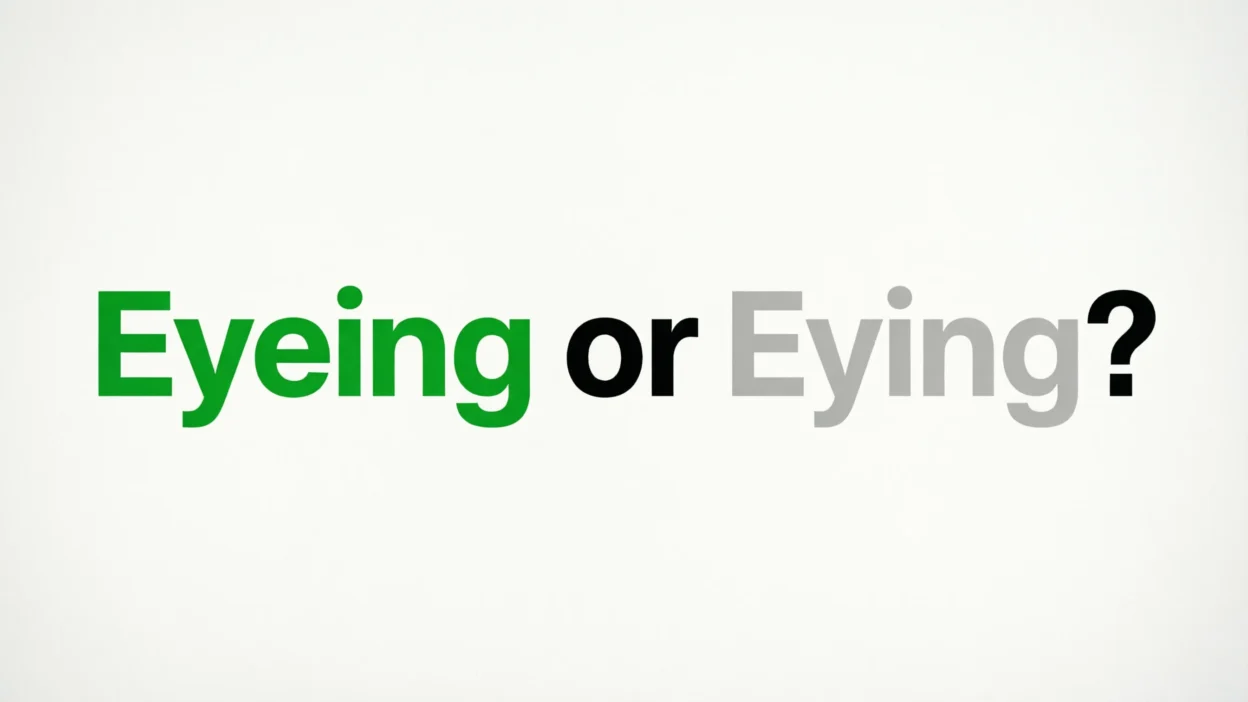
If you’ve ever paused while writing and wondered whether “eying” or “eyeing” is the correct spelling, you’re not alone.
This common spelling question confuses writers, students, professionals, and even native English speakers. Since both forms appear online, it’s easy to assume they’re equally correct.
The good news is that understanding the difference is simple. In this guide, you’ll learn the correct spelling, the meaning of the word, examples of proper usage, common mistakes to avoid, and whether American and British English treat these spellings differently.
By the end, you’ll know exactly when to use eyeing and when eying may be acceptable.
Quick Answer
Eyeing is the standard and most widely accepted spelling of the verb “eye” in both American and British English.
Eying is a less common alternative spelling that appears occasionally, especially in some dictionaries and style guides, but eyeing is generally preferred in modern writing.
Example:
✔ She was eyeing the last slice of pizza.
✔ The company is eyeing new markets for expansion.
What Does “Eyeing” Mean?
The word eyeing comes from the verb eye, which means:
- To look at something carefully
- To observe with interest
- To watch closely
- To consider or evaluate something
When someone is eyeing something, they are usually looking at it with attention, curiosity, desire, suspicion, or interest.
Simple Definition
Eyeing = looking at, watching, considering, or examining carefully.
Why Is There Confusion Between Eying and Eyeing?
The confusion comes from English spelling rules.
Normally, when a verb ends in e, the final e is dropped before adding -ing:
- Make → Making
- Write → Writing
- Drive → Driving
Following this rule, some people assume:
- Eye → Eying
However, the word eye is unusual because removing the final e creates a spelling that looks awkward and can be harder to recognize.
As a result, the spelling eyeing became the preferred form in standard English usage.
Eyeing vs Eying: Comparison Table
| Feature | Eyeing | Eying |
|---|---|---|
| Standard spelling | Yes | Less common |
| Widely accepted | Yes | Sometimes accepted |
| Used in modern publications | Very common | Rare |
| Recommended for formal writing | Yes | Usually no |
| American English preference | Eyeing | Rare |
| British English preference | Eyeing | Rare |
| Reader familiarity | High | Lower |
Examples of Eyeing in Sentences
Here are some examples showing how eyeing is used in everyday English.
Looking with Interest
- She was eyeing the beautiful necklace in the store window.
- The child kept eyeing the birthday cake.
Considering Something
- The company is eyeing a merger with a competitor.
- Investors are eyeing opportunities in renewable energy.
Watching Carefully
- The security guard was eyeing the crowd.
- The cat sat quietly, eyeing the bird outside.
Expressing Desire
- He was eyeing the latest smartphone model.
- Many travelers are eyeing discounted vacation packages.
Is Eying Ever Correct?
Technically, eying is not necessarily wrong.
Some dictionaries recognize it as an alternative spelling of eyeing. However, it appears far less frequently in modern English and can look unfamiliar to many readers.
Because clarity and readability matter, most editors, publishers, and style guides recommend using eyeing instead.
Example
Less common:
- She was eying the dessert menu.
Preferred:
- She was eyeing the dessert menu.
In professional, academic, business, and online writing, eyeing is usually the safer choice.
American vs British English
Unlike many spelling differences between American and British English, there is very little variation here.
American English
American writers overwhelmingly prefer:
- Eyeing
Examples:
- The company is eyeing expansion.
- She is eyeing a new apartment.
British English
British publications also generally prefer:
- Eyeing
Examples:
- The government is eyeing new reforms.
- He was eyeing the football match schedule.
Conclusion
Both American and British English predominantly use eyeing. The alternative spelling eying remains uncommon in both varieties.
Common Mistakes to Avoid
1. Assuming Eying Is More Grammatically Correct
Many writers think:
- Eye → Eying
because of standard spelling rules.
While the logic seems reasonable, eyeing remains the preferred spelling.
2. Switching Between Both Spellings
Avoid inconsistency within the same document.
Incorrect:
- The company is eyeing growth opportunities.
- Investors are eying the market carefully.
Correct:
- The company is eyeing growth opportunities.
- Investors are eyeing the market carefully.
3. Using Eying in Formal Content
Since many readers are unfamiliar with eying, it can appear unusual or incorrect.
For professional communication, choose eyeing.
Synonyms for Eyeing
Using related words can improve writing variety and SEO relevance.
Depending on context, eyeing can mean:
- Looking at
- Watching
- Observing
- Examining
- Inspecting
- Considering
- Evaluating
- Studying
- Monitoring
- Checking out
- Viewing
- Assessing
Example
Original:
- She was eyeing the painting.
Alternative:
- She was examining the painting.
- She was observing the painting carefully.
When Should You Use Eyeing?
Use eyeing whenever you want to describe someone:
- Looking closely at something
- Showing interest in something
- Considering an option
- Watching carefully
- Evaluating a possibility
Business Context
- The startup is eyeing international expansion.
- Management is eyeing new investment opportunities.
Personal Context
- He is eyeing a new car.
- She is eyeing a career change.
Sports Context
- Several teams are eyeing the championship title.
- Scouts are eyeing talented young players.
SEO and Content Writing Tip
If you’re creating blog posts, articles, or website content, use eyeing rather than eying.
Reasons:
- Higher reader familiarity
- Better readability
- More common in search results
- Preferred by editors
- Stronger alignment with standard English usage
For SEO purposes, it’s useful to mention both spellings naturally because many users search for:
- eyeing or eying
- eying meaning
- eyeing meaning
- eyeing vs eying
- correct spelling of eyeing
- is eying a word
Frequently Asked Questions
1. Which is correct: eyeing or eying?
Eyeing is the standard and preferred spelling in modern English. Eying is an alternative form but is much less common.
2. Is eying a real word?
Yes. Some dictionaries recognize eying as a valid alternative spelling, though it is rarely used compared to eyeing.
3. Why is eyeing more common than eying?
Writers and publishers generally prefer eyeing because it is easier to recognize and aligns with established usage patterns.
4. Is eyeing used in American English?
Yes. Eyeing is the dominant spelling in American English.
5. Is eyeing used in British English?
Yes. British English also commonly uses eyeing.
6. What does eyeing someone mean?
It means looking at someone carefully, attentively, suspiciously, or with interest.
7. Can eyeing mean considering something?
Yes. It often means evaluating or thinking about a future action or decision.
Example:
- The company is eyeing a new acquisition.
8. Should I use eyeing in formal writing?
Yes. Eyeing is the recommended choice for professional, academic, and business writing.
Summary
When comparing eying or eyeing, the clear winner is eyeing. Although eying exists as an alternative spelling, it is far less common and may appear unfamiliar to readers. In both American and British English, eyeing is the spelling most people expect to see.
Whether you’re describing someone looking closely at an object, considering a major decision, or evaluating an opportunity, eyeing is the safest and most widely accepted choice. Using the standard spelling improves readability, professionalism, and overall communication.
Actionable Takeaway
Whenever you’re unsure whether to write eying or eyeing, choose eyeing. It is the preferred spelling in modern English, recognized by readers worldwide, and suitable for both formal and informal writing.
Rule to remember: If you’re talking about looking at, watching, considering, or evaluating something, write eyeing for the clearest and most professional result.