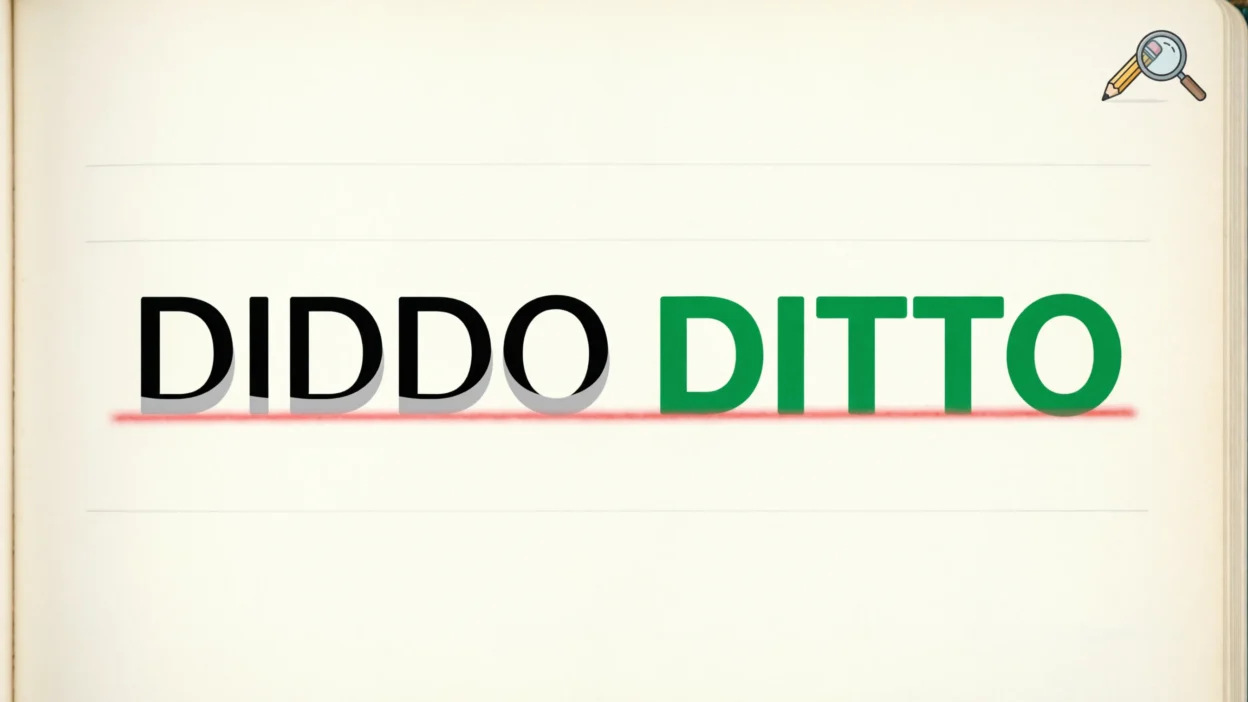
If you’ve ever agreed with someone’s opinion or wanted to repeat what was already said, you’ve probably heard the word ditto.
However, many people wonder whether the correct spelling is diddo or ditto, especially because both words sound very similar when spoken.
The good news is that the answer is straightforward. While ditto is a recognized English word with a specific meaning, diddo is generally considered a misspelling.
Understanding the difference can help you avoid common writing mistakes and communicate more clearly in both casual and professional settings.
Quick Answer
Ditto is the correct spelling.
Diddo is not a standard English word and is usually a spelling mistake of ditto.
Correct: I agree with your opinion—ditto.
Incorrect: I agree with your opinion—diddo.
What Does “Ditto” Mean?
The word ditto is used to indicate that the same thing applies again without repeating it.
It can mean:
- The same as previously stated
- I agree with that
- Repetition of information
- Likewise
- Same here
Definition of Ditto
Ditto means “the same as before” or “the same thing again.”
It is commonly used in conversations, writing, accounting records, lists, and informal communication.
Examples of Ditto
- “I love this movie.”
“Ditto.” - Sarah ordered a coffee, and John said, “Ditto.”
- The first item costs $20; ditto for the second item.
- I feel exactly the same—ditto.
In each example, ditto prevents unnecessary repetition.
Is “Diddo” a Real Word?
In standard English, diddo is not recognized as a correct spelling of the word ditto.
Most dictionaries do not list diddo as a standard English word.
Why Do People Write Diddo?
Several factors contribute to this common mistake:
- Similar pronunciation
- Typing errors
- Mishearing the word
- Lack of familiarity with its spelling
- Informal online communication
Since ditto is often spoken casually, some people mistakenly assume it is spelled diddo.
Diddo vs Ditto: Key Differences
| Feature | Diddo | Ditto |
|---|---|---|
| Standard English Word | No | Yes |
| Dictionary Recognition | No | Yes |
| Accepted in Formal Writing | No | Yes |
| Meaning | None in standard English | Same as previously stated |
| Correct Usage | Incorrect | Correct |
For virtually all writing situations, ditto is the correct choice.
How to Use Ditto Correctly
The word ditto can be used in several ways depending on context.
To Express Agreement
One of the most common uses is to show that you share someone’s opinion or feeling.
Examples:
- “I’m excited about the trip.”
“Ditto!” - “I enjoyed the presentation.”
“Ditto.” - “That restaurant is amazing.”
“Ditto.”
To Avoid Repetition
Ditto can replace repeated information in lists and records.
Examples:
- Apples – $2
- Ditto – $2
- Meeting Room A – Reserved
- Ditto – Reserved
Historically, this usage was very common in bookkeeping and administrative records.
To Mean “Same Here”
Examples:
- “Have a great day!”
“Ditto.” - “Good luck on your exam.”
“Ditto.”
This informal use remains popular in everyday conversations.
The Origin of the Word Ditto
The word ditto has an interesting history.
It comes from the Italian word detto, meaning “said” or “stated.”
Over time, English speakers adopted the term to indicate that something previously mentioned should be repeated without writing it again.
This practical use eventually became common in:
- Business records
- Accounting documents
- Correspondence
- Everyday conversation
Today, ditto remains a widely recognized English word.
Common Mistakes With Diddo and Ditto
Mistake #1: Spelling Ditto as Diddo
Incorrect:
- Diddo, I agree.
Correct:
- Ditto, I agree.
Mistake #2: Assuming Diddo Is an Alternative Spelling
Incorrect belief:
- Diddo is just another version of ditto.
Reality:
- Standard English recognizes only ditto.
Mistake #3: Overusing Ditto in Formal Writing
Although correct, ditto can sometimes sound too casual.
Formal alternative:
- Likewise
- The same applies
- I agree
- Similarly
Choose the wording that best fits your audience.
American vs British English
There is no significant difference between American and British English regarding this word.
American English
Uses:
- Ditto
Example:
- “I feel the same.”
“Ditto.”
British English
Uses:
- Ditto
Example:
- “I completely agree.”
“Ditto.”
Neither variety uses diddo as the standard spelling.
Synonyms and Related Words
Depending on the context, you can use:
- Likewise
- Same here
- Me too
- Agreed
- Similarly
- The same
- Identically
- As well
- Also
- Correspondingly
Examples
Instead of:
- Ditto.
You might say:
- Likewise.
- Same here.
- I agree.
- Me too.
These alternatives can add variety to your writing and speech.
Easy Memory Trick
A simple trick can help you remember the correct spelling.
Think of the double T in ditto.
DiTTo = Two T’s
The word has two T’s in the middle, making it easier to remember.
Whenever you’re unsure, remember:
Ditto = Double T
Not:
Diddo = Double D
Everyday Examples
At Work
- The manager approved the proposal.
- The director said, “Ditto.”
At School
- “Math is my favorite subject.”
- “Ditto.”
With Friends
- “That was a great movie.”
- “Ditto.”
In Online Chats
- Person A: “I’m exhausted today.”
- Person B: “Ditto.”
These examples show how naturally the word appears in everyday communication.
Why Correct Spelling Matters
Using the correct spelling improves:
- Professional writing
- Academic assignments
- Emails and reports
- Online communication
- Reader confidence
Although many people understand what diddo is intended to mean, using ditto demonstrates accuracy and attention to detail.
Correct spelling helps ensure your message appears polished and credible.
Frequently Asked Questions
1. Is diddo a real word?
No. In standard English, diddo is generally considered a misspelling of ditto.
2. Which is correct: diddo or ditto?
Ditto is the correct spelling.
3. What does ditto mean?
It means “the same as previously stated” or “I agree.”
4. Can I use ditto in formal writing?
Yes, although more formal alternatives such as “likewise” or “similarly” may sometimes be preferred.
5. Why do people spell ditto as diddo?
The mistake usually occurs because of pronunciation similarities and typing errors.
6. Is diddo accepted in British English?
No. British English uses ditto, just like American English.
7. Where did the word ditto come from?
It originated from the Italian word detto, meaning “said” or “stated.”
8. What is another word for ditto?
Common alternatives include likewise, same here, me too, and agreed.
Summary
When choosing between diddo or ditto, the correct spelling is ditto. It is a recognized English word used to indicate agreement, repetition, or that the same information applies again. The spelling diddo is generally considered an error and should be avoided in both formal and informal writing.
Because ditto is widely used in conversation, business communication, and everyday writing, learning its correct spelling can help improve your language skills and professionalism. Remember that the word contains a double T, making it easy to distinguish from the incorrect spelling diddo.
Actionable Takeaway
Whenever you want to say “same here,” “I agree,” or “the same as above,” use ditto with two T’s and avoid the common misspelling diddo.