Have you ever seen the words wont and won’t and wondered if they mean the same thing? At first glance, they look nearly identical, but a single apostrophe completely changes their meaning. This confusion is common among English learners and even native speakers.
Understanding the difference between wont vs won’t can help you avoid grammar mistakes in writing and improve your communication. In this guide, you’ll learn the meanings, examples, common errors, and the correct way to use each word confidently.
Quick Answer
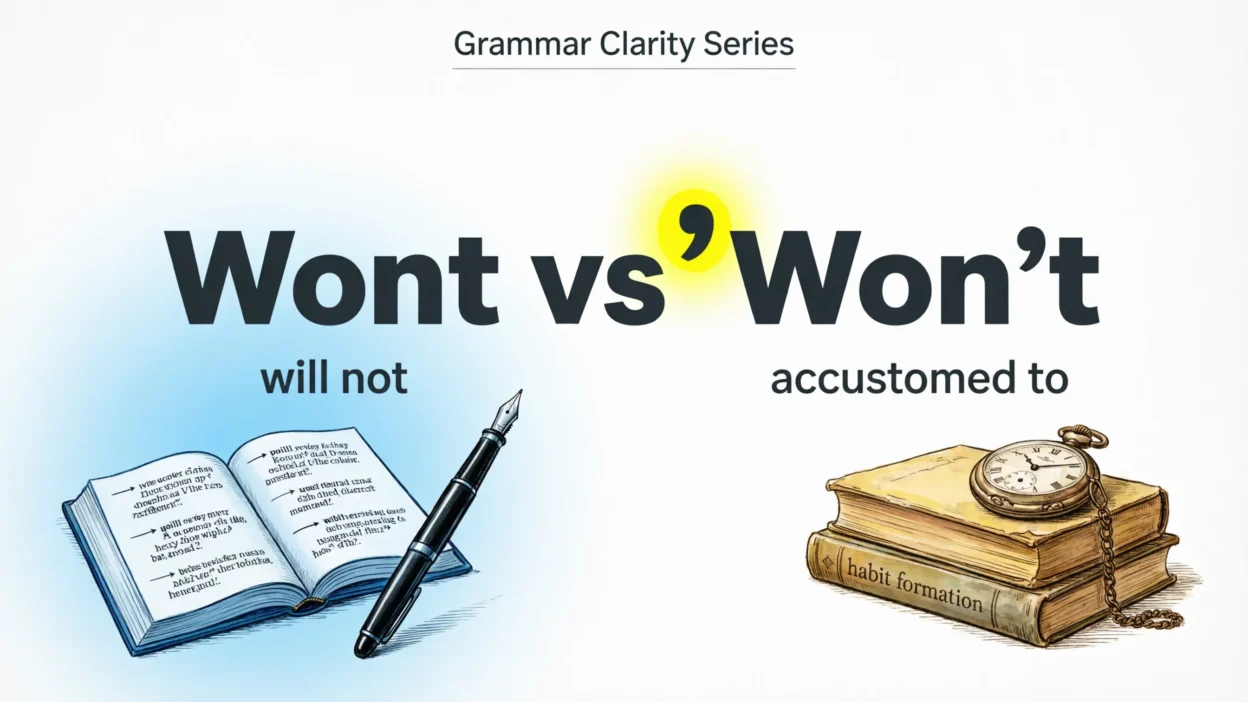
Won’t is a contraction of will not and is commonly used to express future refusal, unwillingness, or something that will not happen.
Wont (without an apostrophe) is a less common adjective meaning accustomed to, used to, or habitually doing something.
Examples:
- I won’t attend the meeting tomorrow.
- She was wont to take a morning walk before work.
In modern English, won’t is extremely common, while wont is mostly found in formal or literary writing.
What Does Won’t Mean?
Won’t is the shortened form of will not. It is one of the most frequently used contractions in English.
People use won’t to talk about future actions that will not happen or to express refusal.
Examples of Won’t
- I won’t be late today.
- They won’t agree to the proposal.
- The store won’t open until 10 a.m.
- She won’t answer my calls.
In everyday conversation and writing, won’t is the version you’ll encounter most often.
What Does Wont Mean?
Wont is a completely different word. It is an adjective that means accustomed to, used to, or having a habit of doing something.
Although correct, this word is relatively rare in modern English and appears mostly in literature, historical texts, or formal writing.
Examples of Wont
- He was wont to read before bedtime.
- The professor was wont to arrive early.
- They were wont to spend summers by the sea.
In these examples, wont means the person regularly or habitually performed the action.
Wont vs Won’t: Key Differences
The biggest difference is that these words serve completely different grammatical purposes.
| Feature | Wont | Won’t |
|---|---|---|
| Meaning | Accustomed to; habitually doing | Will not |
| Part of Speech | Adjective | Contraction |
| Common Usage | Rare, formal, literary | Very common |
| Modern English | Uncommon | Extremely common |
| Example | She was wont to exercise daily. | She won’t exercise today. |
Easy Memory Trick
- Won’t contains an apostrophe because it is a contraction of will not.
- Wont has no apostrophe because it is a standalone word meaning accustomed to.
If you mean will not, always use won’t.
Why People Confuse Wont and Won’t
The confusion happens because the words look almost identical when written.
Common reasons include:
- Missing the apostrophe while typing.
- Not knowing that wont is a real word.
- Assuming both spellings mean “will not.
- Autocorrect errors.
Fortunately, checking whether you can replace the word with will not usually solves the problem.
Test Yourself
Sentence:
- I _____ be attending the conference.
Correct answer:
- I won’t be attending the conference.
You cannot replace it with “accustomed to,” so wont would be incorrect.
Examples of Won’t in Sentences
Here are common everyday examples:
- We won’t forget your kindness.
- The computer won’t start.
- He won’t admit he was wrong.
- They won’t arrive before noon.
- I won’t give up.
In all these cases, won’t means will not.
Examples of Wont in Sentences
Although less common, wont is still used correctly in some contexts.
- She was wont to write letters every Sunday.
- The king was wont to consult his advisors.
- He was wont to rise before dawn.
- They were wont to gather by the fireplace.
Notice that wont often appears after forms of the verb to be.
Common Mistakes to Avoid
Mistake 1: Using Wont Instead of Won’t
Incorrect:
- I wont be there tomorrow.
Correct:
- I won’t be there tomorrow.
Mistake 2: Assuming Wont Is a Typo
Incorrect assumption:
- Wont is not a real word.
Correct:
- Wont is a legitimate English word with a different meaning.
Mistake 3: Forgetting the Apostrophe
Incorrect:
- She wont help us.
Correct:
- She won’t help us.
The missing apostrophe changes the meaning entirely.
Mistake 4: Using Won’t for Habitual Behavior
Incorrect:
- He was won’t to arrive early.
Correct:
- He was wont to arrive early.
American English vs British English
The distinction between wont and won’t is the same in both American and British English.
American English
- Frequently uses won’t in speech and writing.
- Rarely uses wont outside academic or literary contexts.
British English
- Uses won’t just as commonly.
- May encounter wont slightly more often in traditional literature and formal writing.
Regardless of the variety of English, the meanings remain identical.
Related Words and Synonyms
Synonyms for Won’t
Depending on context:
- Will not
- Refuse to
- Decline to
- Be unwilling to
Synonyms for Wont
Depending on context:
- Accustomed
- Habituated
- Used to
- Familiar with
- Inclined to
These related terms can help expand your vocabulary and improve writing variety.
When Should You Use Won’t?
Use won’t when:
- Talking about the future.
- Expressing refusal.
- Indicating something will not happen.
- Writing casual or professional English.
Examples:
- I won’t miss the deadline.
- They won’t participate.
- The train won’t stop here.
When Should You Use Wont?
Use wont when:
- Referring to habitual behavior.
- Writing formally or literarily.
- Describing something someone is accustomed to doing.
Examples:
- She was wont to volunteer her time.
- He was wont to speak softly.
In modern everyday English, many writers replace wont with accustomed to because it is easier to understand.
Frequently Asked Questions (FAQs)
Is wont a real word?
Yes. Wont is a real English word meaning accustomed to or habitually doing something.
Is won’t the same as will not?
Yes. Won’t is the standard contraction of will not.
Why is won’t spelled differently from will not?
English contractions developed historically, and won’t became the accepted shortened form of will not.
Can I use wont without an apostrophe?
Yes, but only when you mean accustomed to or habitually doing something.
Which is more common: wont or won’t?
Won’t is far more common in modern English.
Is wont old-fashioned?
It can sound formal or literary in contemporary writing, but it is still correct.
How do I know which word to use?
If you can replace it with will not, use won’t. If you mean accustomed to, use wont.
Is the difference the same in American and British English?
Yes. Both varieties of English use the same meanings and rules.
Conclusion
The difference between wont vs won’t comes down to meaning and usage. Won’t is the contraction of will not and is one of the most common words in everyday English. Wont, on the other hand, is a less common adjective meaning accustomed to or habitually doing something.
Because won’t appears so frequently, most instances of confusion involve accidentally leaving out the apostrophe. Remember that if you’re expressing future refusal or saying something will not happen, won’t is almost always the correct choice. Reserve wont for formal or literary contexts where you mean someone is accustomed to a particular behavior.
Actionable Takeaway
Whenever you’re unsure, try replacing the word with will not. If the sentence still makes sense, use won’t. If you’re describing a habit or customary behavior, use wont.