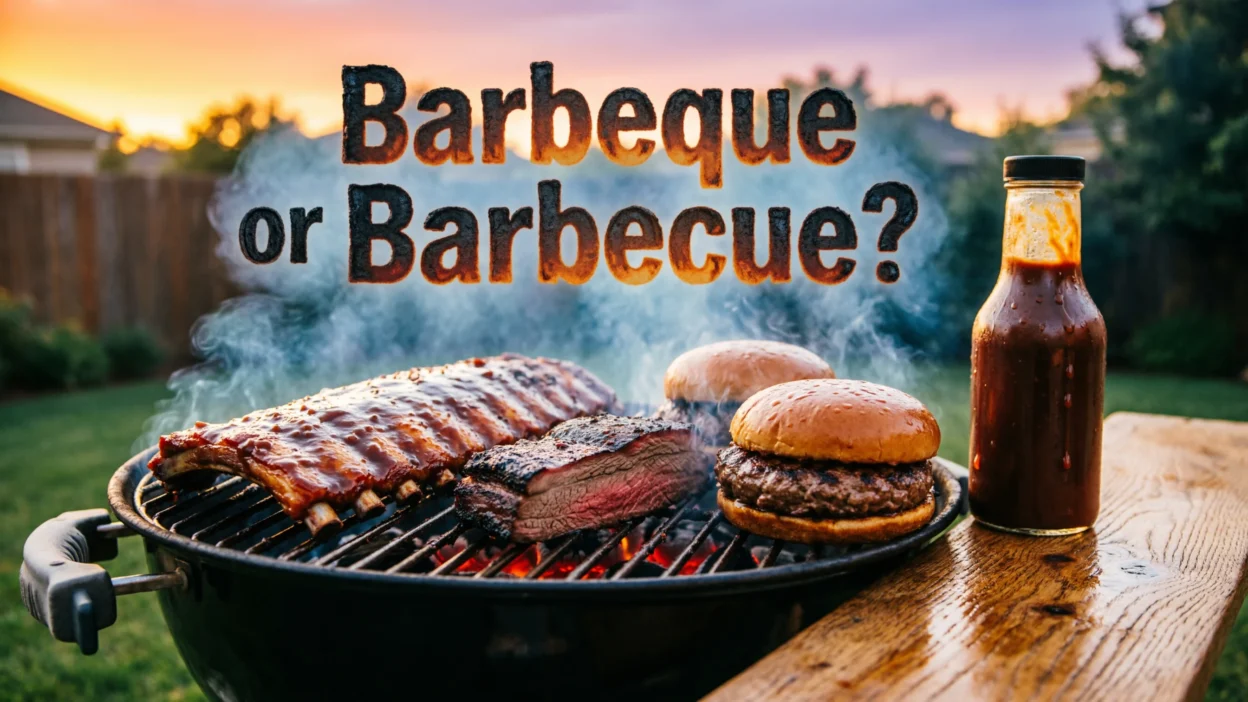
If you’ve ever wondered whether barbeque or barbecue is the correct spelling, you’re not alone. The two words appear everywhere—from restaurant signs and cookout invitations to recipes and food blogs. While they refer to the same delicious cooking tradition, many people are unsure which version is considered correct.
Understanding the difference between barbeque and barbecue can help improve your writing, avoid common spelling mistakes, and ensure you’re using the preferred form in professional or academic contexts.
In this guide, you’ll learn the meaning, origins, examples, spelling differences, and when to use each version confidently.
Quick Answer
Barbecue is the standard and officially accepted spelling in English dictionaries.
Barbeque is an alternative spelling that is commonly used in branding, restaurant names, product labels, and informal writing.
In most situations, especially formal writing, barbecue is the preferred spelling.
What Does Barbecue Mean?
The word barbecue refers to both:
- A cooking method that uses low heat and smoke.
- A social gathering where grilled or smoked food is served.
- The equipment used for grilling food.
Barbecue is deeply connected to outdoor cooking traditions around the world, especially in the United States, where regional barbecue styles have become part of local culture.
Examples of Barbecue in Sentences
- We hosted a family barbecue last weekend.
- Texas barbecue is famous for its smoked brisket.
- He bought a new barbecue grill for the backyard.
- The restaurant specializes in traditional barbecue dishes.
Is “Barbeque” Correct?
Yes, barbeque is technically correct, but it is considered a variant spelling of barbecue.
Many businesses prefer “barbeque” because:
- It looks shorter and more casual.
- It fits better in logos and branding.
- It creates a distinctive style.
However, major dictionaries and language guides typically list barbecue as the primary spelling.
Examples of Barbeque in Sentences
- We ordered barbeque ribs from a local restaurant.
- The barbeque sauce had a sweet and smoky flavor.
- Their company specializes in barbeque catering services.
Although these examples are understandable, many editors would replace “barbeque” with “barbecue” in formal content.
Barbeque vs Barbecue: Comparison Table
| Feature | Barbecue | Barbeque |
|---|---|---|
| Dictionary Standard | Yes | Alternative spelling |
| Formal Writing | Recommended | Less common |
| Academic Use | Preferred | Rare |
| Business Branding | Sometimes used | Frequently used |
| Meaning | Same | Same |
| Pronunciation | Same | Same |
| SEO Preference | Stronger | Secondary |
Which Spelling Should You Use?
For most situations, use barbecue.
Choose barbecue when writing:
- Blog posts
- Academic papers
- Business communications
- Professional websites
- News articles
- Recipes
You may see barbeque used in:
- Restaurant names
- Food packaging
- Product branding
- Informal social media posts
If consistency matters, stick with barbecue throughout your content.
Origin of the Word Barbecue
The word barbecue has a fascinating history.
It is believed to have originated from the Caribbean word barbacoa, used by Indigenous peoples to describe a wooden structure for cooking meat over a fire.
Spanish explorers adopted the term, and it eventually entered English as barbecue.
Over time, the word evolved beyond a cooking method to represent an entire food culture centered around smoked meats, outdoor gatherings, and regional traditions.
American vs British English Differences
Unlike many English words, there is no major difference between American and British English regarding the preferred spelling.
American English
- Barbecue is the standard spelling.
- Common abbreviation: BBQ.
Examples:
- American barbecue traditions vary by region.
- BBQ competitions attract thousands of visitors.
British English
- Barbecue is also the preferred spelling.
- BBQ is widely recognized and commonly used.
Examples:
- We are planning a barbecue this weekend.
- The weather is perfect for a BBQ party.
In both varieties of English, barbecue remains the dominant spelling.
Common Related Terms
When discussing barbecue, several related words frequently appear.
BBQ
A shortened form of barbecue.
Examples:
- BBQ sauce
- BBQ chicken
- Backyard BBQ
Grill
A cooking device or cooking method using direct heat.
Smoked Meat
Meat cooked slowly with wood smoke to develop flavor.
Cookout
An outdoor gathering focused on grilled or barbecued food.
Barbecue Sauce
A flavorful sauce often used for marinating, glazing, or dipping meats.
Common Mistakes People Make
Many writers accidentally misuse or misspell the word.
Mistake 1: Assuming Barbeque Is the Official Spelling
Many people believe “barbeque” is the standard version.
Correct:
- Barbecue
Less preferred:
- Barbeque
Mistake 2: Mixing Spellings
Incorrect:
- We had a barbecue, and the barbeque sauce was excellent.
Better:
- We had a barbecue, and the barbecue sauce was excellent.
Mistake 3: Confusing Grilling with Barbecue
Although related, grilling and barbecue are not identical.
Grilling:
- High heat
- Fast cooking
Barbecue:
- Low heat
- Slow cooking
- Smoke flavor
Mistake 4: Overusing BBQ in Formal Writing
While BBQ is widely accepted informally, full spelling is usually preferred in professional content.
Formal:
- barbecue
Informal:
- BBQ
Why the Word Matters for SEO
If you run a food blog, restaurant website, or recipe platform, choosing the right spelling can affect search visibility.
Search engines recognize both spellings, but barbecue generally has stronger authority because it is the standard dictionary form.
For SEO purposes:
- Use barbecue as the primary keyword.
- Include barbeque naturally as a secondary variation.
- Add related keywords such as BBQ, smoked meat, grilling, barbecue sauce, cookout, and outdoor cooking.
This approach helps capture a broader range of search queries.
Popular Barbecue Styles
Barbecue traditions vary significantly around the world.
Texas Barbecue
Known for:
- Smoked brisket
- Beef ribs
- Oak wood smoke
Kansas City Barbecue
Known for:
- Sweet barbecue sauce
- Burnt ends
- Variety of meats
Carolina Barbecue
Known for:
- Pulled pork
- Vinegar-based sauces
Memphis Barbecue
Known for:
- Dry-rub ribs
- Slow smoking techniques
Each style contributes to the rich culture surrounding barbecue.
Frequently Asked Questions
1. Is barbecue or barbeque correct?
Both are correct, but barbecue is the standard and preferred spelling.
2. Why do some restaurants use barbeque?
Many businesses use “barbeque” for branding and stylistic purposes.
3. Which spelling should I use in professional writing?
Use barbecue because it is the accepted dictionary form.
4. Is BBQ the same as barbecue?
Yes. BBQ is simply a shortened abbreviation of barbecue.
5. Is there a difference in meaning between barbecue and barbeque?
No. Both words have the same meaning and pronunciation.
6. Do Americans use barbecue or barbeque more often?
Americans overwhelmingly use barbecue in formal and standard writing.
7. Is barbecue a cooking method or an event?
It can be both. It refers to a cooking style and a social gathering centered around food.
8. Which spelling is better for SEO?
Barbecue is generally stronger because it is the standard spelling, though including both variations can broaden search reach.
Summary
The debate between barbeque or barbecue is largely a matter of spelling preference rather than meaning. Both words refer to the same cooking technique, food tradition, and social gathering. However, barbecue is the officially recognized spelling found in major dictionaries and style guides, making it the best choice for formal writing, websites, recipes, and professional communication.
While barbeque remains popular in restaurant branding and casual use, most writers, editors, and SEO professionals recommend using barbecue as the primary spelling. Understanding this distinction helps ensure clarity, consistency, and stronger search visibility while allowing you to recognize both forms when you encounter them.
Actionable Takeaway
When writing content, recipes, menus, or blog posts, use barbecue as your main spelling and include barbeque occasionally as a secondary variation for broader search coverage. This simple approach improves readability, aligns with language standards, and supports better SEO performance.