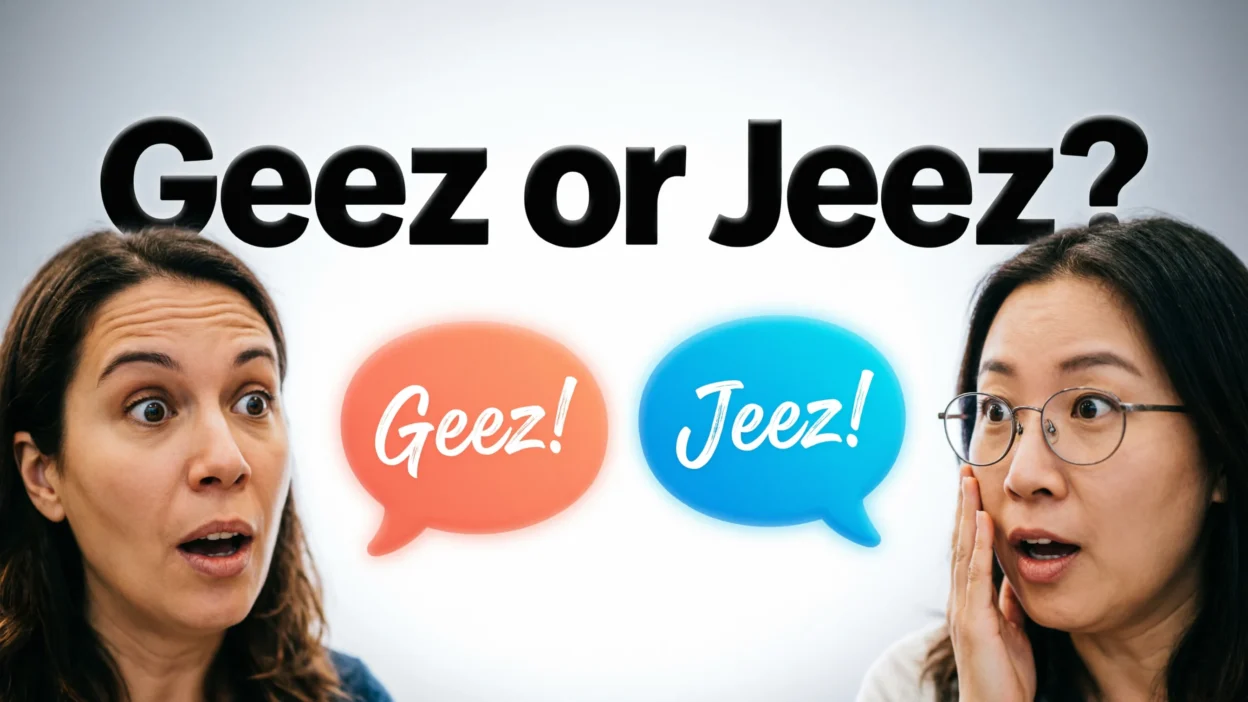
Have you ever wondered whether geez or jeez is the correct spelling? These two expressions often appear in conversations, social media posts, text messages, and informal writing.
Because they sound identical when spoken, many people are unsure which version to use and whether there is any difference between them.
The good news is that both geez and jeez are widely understood and accepted in modern English. However, their origins, usage, and preferred contexts can differ slightly.
This guide explains the meaning of each term, how they’re used, common mistakes to avoid, and which spelling may be more appropriate depending on your audience.
Quick Answer
- Both geez and jeez are correct spellings.
- They are informal exclamations used to express surprise, frustration, annoyance, or disbelief.
- Jeez is generally more common in modern English.
- Geez is an alternative spelling that is also widely recognized.
What Does Geez or Jeez Mean?
Geez and jeez are mild exclamations used to express emotions such as:
- Surprise
- Frustration
- Annoyance
- Impatience
- Amazement
- Disbelief
The expressions are often considered softened versions of the name “Jesus” and developed as less offensive alternatives in everyday speech.
People commonly use them when reacting to unexpected situations or emphasizing strong feelings without using profanity.
Examples
- Jeez, that movie was longer than I expected.
- Geez, can you turn the music down?
- Jeez, I didn’t know the test would be so difficult.
- Geez, that’s an expensive cup of coffee.
In all these examples, either spelling could usually be used without changing the meaning.
Examples of Geez and Jeez in Everyday Use
These expressions are especially common in casual conversation.
Expressing Surprise
- Jeez, I can’t believe you won!
- Geez, that’s incredible news.
Showing Frustration
- Jeez, this traffic is terrible.
- Geez, why is the internet so slow today?
Reacting to Disbelief
- Jeez, are you serious?
- Geez, that actually happened?
Expressing Annoyance
- Jeez, give me a minute.
- Geez, stop interrupting me.
Both spellings function the same way grammatically.
Geez vs Jeez: Comparison Table
| Feature | Geez | Jeez |
|---|---|---|
| Meaning | Surprise, frustration, disbelief | Surprise, frustration, disbelief |
| Pronunciation | Same | Same |
| Informal Usage | Yes | Yes |
| Modern Popularity | Less common | More common |
| Dictionary Recognition | Yes | Yes |
| Social Media Usage | Common | Very common |
| Formal Writing | Generally avoided | Generally avoided |
Which One Should You Use?
For most modern writing, jeez is the preferred choice because it appears more frequently in contemporary English.
Use jeez when:
- Writing dialogue
- Creating casual content
- Posting on social media
- Writing conversational blog content
Use geez when:
- Mimicking a specific style
- Reflecting regional preferences
- Reproducing quoted speech
Since both spellings are acceptable, consistency matters more than choosing one over the other.
Origin and History
The expressions geez and jeez developed as euphemisms for the name “Jesus.”
Throughout English-speaking history, speakers often created softened substitutes for religious terms to avoid sounding offensive or disrespectful.
Other examples include:
- Gosh
- Gee
- Darn
- Heck
Over time, jeez became especially popular in American English and spread through movies, television, and popular culture.
Today, most speakers use the expression without thinking about its religious origins.
American vs British English Differences
American English
In American English, both forms are understood, but jeez is more common.
Examples:
- Jeez, that’s a huge mistake.
- Jeez, what happened here?
American media frequently uses “jeez” in dialogue because it sounds natural and conversational.
British English
British speakers also understand both versions, although the expression is somewhat less common than in American English.
Examples:
- Jeez, that’s unfortunate.
- Geez, I wasn’t expecting that.
There is no significant spelling rule that separates American and British English for these terms.
Common Related Terms
Several expressions are closely related to geez and jeez.
Gee
A shorter and older exclamation expressing surprise.
Example:
- Gee, thanks for helping.
Gosh
A mild expression of surprise.
Example:
- Gosh, that’s amazing.
Darn
A softer alternative to stronger expressions of frustration.
Example:
- Darn, I forgot my keys.
Heck
Used to express confusion, surprise, or emphasis.
Example:
- What the heck happened?
Wow
A positive or neutral expression of surprise.
Example:
- Wow, that’s impressive.
Common Mistakes People Make
Mistake 1: Thinking One Spelling Is Completely Wrong
Many people assume either geez or jeez is incorrect.
Correct:
- Geez!
- Jeez!
Both are acceptable informal spellings.
Mistake 2: Using Them in Formal Writing
These expressions are conversational and informal.
Less Appropriate:
- The report findings were, jeez, unexpected.
Better:
- The report findings were unexpected.
Mistake 3: Assuming They Have Different Meanings
Some writers believe geez and jeez express different emotions.
In reality, they carry essentially the same meaning.
Mistake 4: Overusing Exclamations
Too many exclamations can make writing appear unprofessional.
Example:
- Jeez! That’s wild! Jeez! I can’t believe it! Jeez!
Use them sparingly for maximum impact.
Why It Matters
Understanding the difference between geez or jeez helps improve writing accuracy and confidence.
Writers, bloggers, students, and content creators often encounter these expressions when creating conversational content. Knowing that both spellings are acceptable allows you to focus on consistency and audience expectations.
From an SEO perspective, users search for both spellings, making it useful to understand how they relate and why they are often used interchangeably.
Additional Relevant Information
Because these words are exclamations, punctuation can influence their tone.
Examples:
- Jeez!
- Jeez?
- Jeez…
Each version communicates a slightly different emotional reaction.
Writers often use these expressions in:
- Fiction dialogue
- Text messages
- Social media posts
- Blog content
- Casual conversations
However, they are generally avoided in academic, legal, and professional documents.
Frequently Asked Questions
1. Is geez or jeez correct?
Both spellings are correct and widely understood.
2. Which spelling is more common?
Jeez is generally more common in modern English.
3. Do geez and jeez mean different things?
No. They have essentially the same meaning and usage.
4. Is jeez considered rude?
Usually not. It is considered a mild and relatively harmless exclamation.
5. Can I use geez in professional writing?
It’s best to avoid both geez and jeez in formal or professional documents.
6. Where did the word jeez come from?
It developed as a softened alternative to the name “Jesus.”
7. Is geez older than jeez?
The shorter form “gee” appeared earlier, and both spellings evolved over time from similar origins.
8. Which spelling should I choose?
Most writers prefer jeez, but either spelling is acceptable if used consistently.
Summary
The debate over geez or jeez is not really about right versus wrong. Both spellings are accepted informal exclamations used to express surprise, frustration, annoyance, or disbelief. They sound identical when spoken and carry nearly the same meaning in everyday communication.
While jeez tends to be more common in modern writing and popular culture, geez remains a valid alternative. The most important consideration is consistency and understanding your audience. For casual writing, either option works well, while formal writing generally calls for more neutral language.
Actionable Takeaway
If you’re unsure which spelling to use, choose jeez because it is slightly more common in contemporary English. However, don’t worry if you prefer geez—both are correct, widely recognized, and understood by readers.