Have you ever wondered whether you should write mold or mould? If you’ve seen both spellings online, in books, or on product packaging, you’re not alone.
Many English learners, writers, and even native speakers get confused because both words are correct—but their usage depends on where English is being used.
Understanding the difference between mold and mould can help you write more accurately, communicate professionally, and avoid common spelling mistakes.
In this guide, you’ll learn the meaning of the word, when to use each spelling, examples, common errors, and the key differences between American and British English.
Quick Answer
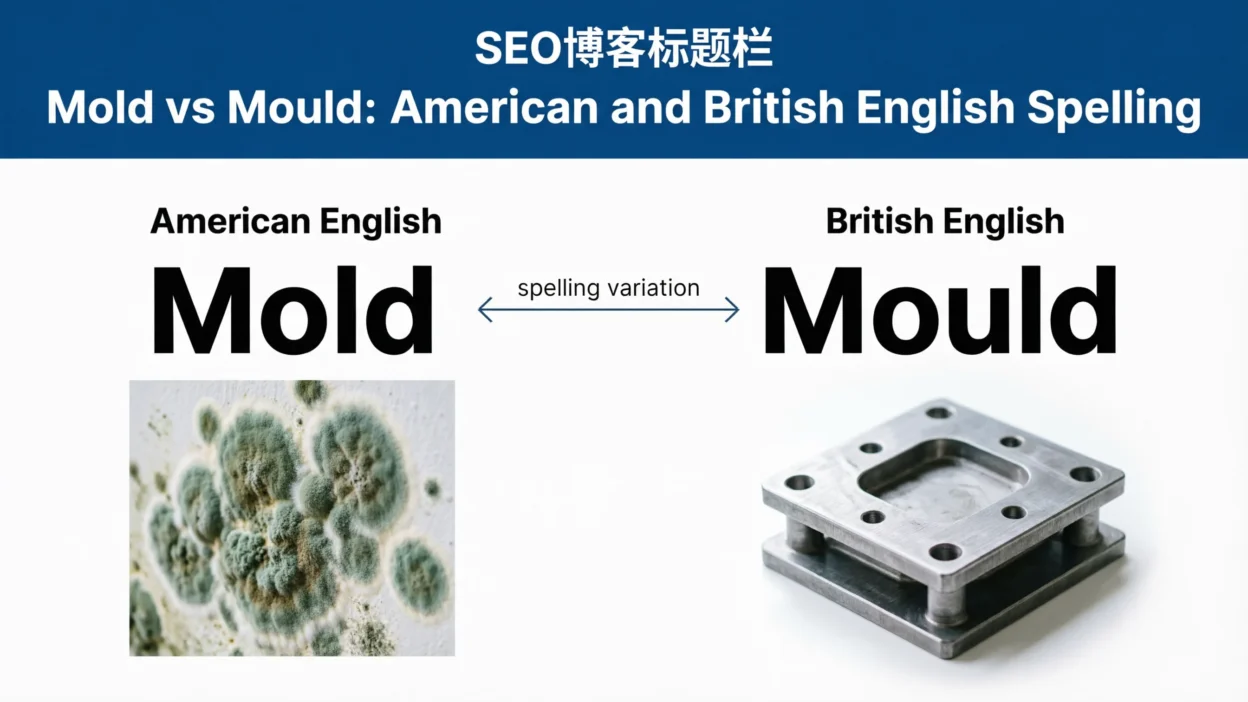
Mold and mould have the same meaning. The difference is purely regional:
- Mold is the preferred spelling in American English.
- Mould is the preferred spelling in British English, Australian English, and most other varieties of English.
Example:
- American English: There is mold growing on the bathroom ceiling.
- British English: There is mould growing on the bathroom ceiling.
Both sentences mean exactly the same thing.
What Does Mold or Mould Mean?
The word mold (or mould) has several meanings depending on the context.
1. A Type of Fungus
The most common meaning refers to a fungus that grows in damp or humid environments.
Examples:
- Mold can develop on food that has been left out too long.
- Black mold may cause health concerns in some buildings.
- Mould often appears on walls with moisture problems.
2. A Shape or Form
The word can also refer to the shape of something or the process of forming it.
Examples:
- The artist created a mold for the sculpture.
- Chocolate is poured into a mould to create different shapes.
- Manufacturers use molds to produce identical products.
3. To Shape or Influence
As a verb, it means to shape, form, or influence something.
Examples:
- Parents help mold their children’s values.
- Education can mould a person’s future.
- Life experiences often mold our perspectives.
Mold vs Mould: American and British English
The difference between these spellings follows a common pattern found in many English words.
| American English | British English |
|---|---|
| Mold | Mould |
| Color | Colour |
| Favor | Favour |
| Honor | Honour |
| Labor | Labour |
In the United States, spelling reforms simplified many words by removing silent letters. As a result, mold became the standard American spelling.
In the United Kingdom and many Commonwealth countries, the traditional spelling mould remained in use.
Where Each Spelling Is Common
Use “mold” in:
- United States
- American publications
- U.S.-based websites
- American academic writing
Use “mould” in:
- United Kingdom
- Australia
- New Zealand
- Ireland
- South Africa
- Most Commonwealth countries
Examples of Mold and Mould in Sentences
Seeing both spellings in context makes the difference easier to understand.
Examples Using “Mold”
- The bread developed mold after several days.
- Experts inspected the house for mold damage.
- The company created a mold for the plastic component.
- Good teachers can mold young minds.
Examples Using “Mould”
- The bathroom wall was covered with mould.
- The baker used a mould to shape the cake.
- Damp conditions encourage mould growth.
- Experiences can mould a person’s character.
Common Mistakes People Make
Even though the meanings are identical, writers often make a few avoidable mistakes.
Mixing Spellings in One Document
Choose one spelling style and stay consistent.
Incorrect:
- The house had mold in the basement, and mould on the ceiling.
Correct (American):
- The house had mold in the basement and on the ceiling.
Correct (British):
- The house had mould in the basement and on the ceiling.
Using the Wrong Regional Version
If you’re writing for an American audience, use mold.
If you’re writing for a British audience, use mould.
Assuming One Spelling Is Incorrect
Many people believe one version is wrong.
In reality:
- Mold = Correct
- Mould = Correct
The preferred choice simply depends on regional English standards.
How to Remember the Difference
A simple memory trick can help.
- Mold = America likes shorter spellings.
- Mould = Britain keeps the extra “u.”
Think of:
- Color → Colour
- Honor → Honour
- Mold → Mould
The extra “u” often signals British English.
Is Mold or Mould Better for SEO?
When creating online content, choosing the correct keyword can improve search visibility.
For U.S. Audiences
Use:
- Mold removal
- Black mold
- Mold inspection
- Mold remediation
For U.K. Audiences
Use:
- Mould removal
- Black mould
- Mould treatment
- Mould prevention
For Global Audiences
You can naturally include both spellings in your content.
Example:
“Whether you call it mold or mould, controlling moisture is the key to preventing fungal growth.”
This approach helps reach readers from different English-speaking regions.
Related Words and Synonyms
Depending on context, these words may be related:
Fungus-Related Terms
- Fungus
- Mildew
- Spores
- Damp growth
- Microbial growth
- Black mold
- Surface contamination
Shape-Related Terms
- Form
- Pattern
- Cast
- Template
- Framework
- Structure
Influence-Related Terms
- Shape
- Guide
- Influence
- Develop
- Form
- Train
Using these related terms can improve readability and strengthen SEO relevance.
When Should You Use Mold?
Use mold when:
- Writing for American readers
- Following U.S. style guides
- Creating content targeted at U.S. search traffic
- Publishing in American media
Example:
“Professional mold inspection can identify hidden moisture problems.”
When Should You Use Mould?
Use mould when:
- Writing for British readers
- Following UK spelling conventions
- Publishing in Commonwealth countries
- Targeting UK search traffic
Example:
“Regular cleaning helps prevent mould from forming in bathrooms.”
Frequently Asked Questions (FAQs)
1. Is mold the same as mould?
Yes. Mold and mould have exactly the same meaning. The difference is only regional spelling.
2. Which spelling is correct: mold or mould?
Both are correct. Use mold in American English and mould in British English.
3. Why does British English use mould?
British English retains the traditional spelling with the letter “u,” while American English simplified many words.
4. Is black mold different from black mould?
No. They refer to the same type of fungal growth. The spelling changes based on regional English.
5. Can I use both spellings in one article?
It’s best to remain consistent. Choose one style unless you’re specifically discussing the spelling differences.
6. Which spelling is more common worldwide?
Globally, both spellings are widely recognized. However, mold dominates in American content, while mould is common throughout the UK and Commonwealth countries.
7. Does Google understand both spellings?
Yes. Search engines recognize mold and mould as spelling variants of the same word.
8. Which spelling should businesses use?
Businesses should use the spelling that matches their target audience and location.
Summary
The debate between mold or mould is not about right versus wrong. Both spellings are correct and carry the same meanings, whether referring to fungus growth, a shaping tool, or the act of influencing something. The only real difference lies in regional language preferences. American English favors mold, while British English and many Commonwealth countries prefer mould.
Choosing the correct spelling helps maintain consistency, professionalism, and audience trust. If you’re writing for a specific region, follow that area’s standard spelling. For international audiences, understanding both forms ensures clear communication and broader reach.
Actionable Takeaway
Before publishing any content, identify your target audience. Use mold for American readers and mould for British or Commonwealth audiences.
Stay consistent throughout your writing, and if you’re targeting a global audience, naturally mention both spellings where appropriate to maximize clarity and SEO performance.