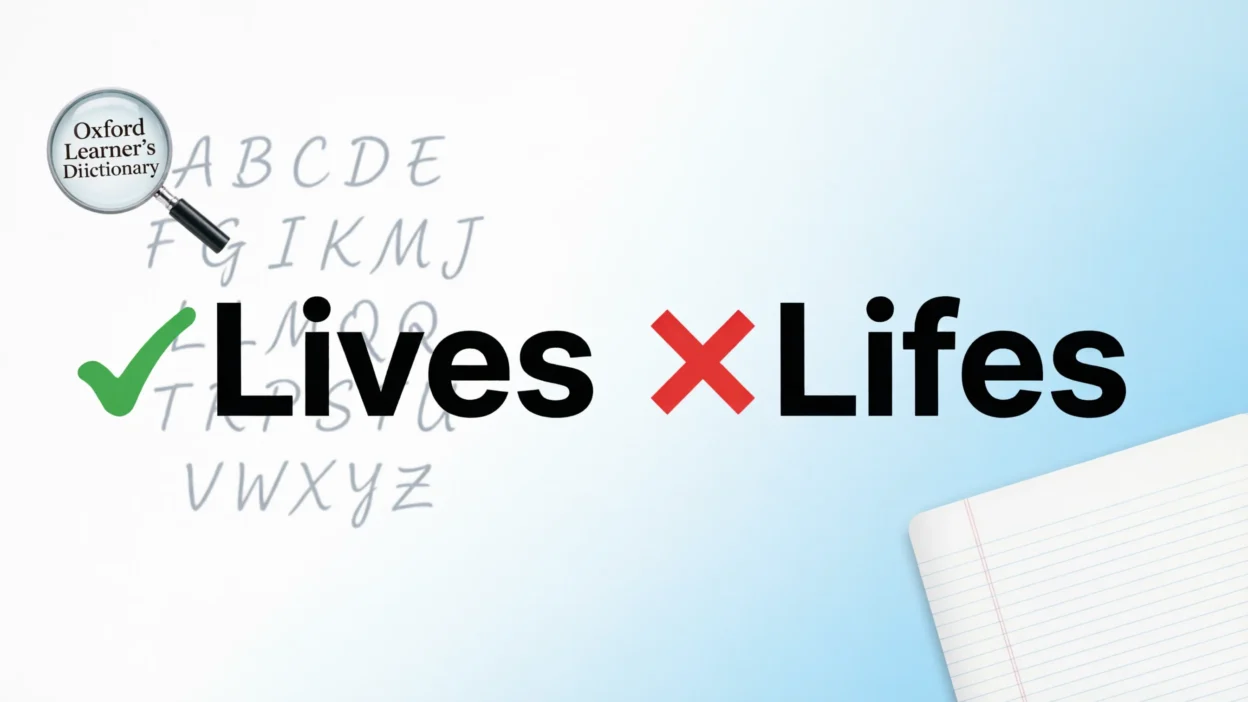
Have you ever paused while writing and wondered whether “lives” or “lifes” is correct? You’re not alone. This is one of the most common English spelling questions because many plural nouns simply add -s, while others follow different rules.
Understanding the difference between lives and lifes can instantly improve your writing, whether you’re creating content, writing emails, completing school assignments, or communicating professionally.
In this guide, you’ll learn the correct usage, meaning, examples, common mistakes, and simple grammar rules so you never get confused again.
Quick Answer
“Lives” is correct. “Lifes” is incorrect.
The singular noun life becomes lives when referring to more than one life.
✅ One life
✅ Two lives
❌ Two lifes
Example:
- The firefighters saved many lives during the rescue operation.
- She changed countless lives through her charity work.
What Does “Lives” Mean?
The word lives is the plural form of life.
A life refers to the existence of a person, animal, or living thing. When discussing multiple people or multiple existences, English grammar requires the plural form lives.
Examples:
- Many lives were affected by the storm.
- Our choices shape our lives.
- Cats are said to have nine lives.
- Technology has improved millions of lives worldwide.
The word can also refer to different lifestyles or experiences.
Examples:
- The documentary explored the lives of artists.
- Their private lives remained hidden from the public.
Why Is “Lifes” Incorrect?
Many English learners assume that the plural of life should be lifes, similar to words like:
- Book → Books
- Car → Cars
- House → Houses
However, life follows a special pluralization rule.
When certain nouns ending in -fe become plural, the -fe changes to -ves.
Therefore:
- Life → Lives
- Wife → Wives
- Knife → Knives
- Leaf → Leaves
Because of this rule, lifes is not recognized as a correct English word in standard grammar.
Lives vs Lifes: Comparison Table
| Feature | Lives | Lifes |
|---|---|---|
| Correct English Word | Yes | No |
| Plural of Life | Yes | No |
| Accepted in Formal Writing | Yes | No |
| Found in Dictionaries | Yes | No |
| Recommended Usage | Always | Never |
The Grammar Rule Behind Lives
English contains several nouns ending in -f or -fe that change to -ves in the plural form.
Examples:
| Singular | Plural |
|---|---|
| Life | Lives |
| Wife | Wives |
| Knife | Knives |
| Leaf | Leaves |
| Wolf | Wolves |
| Shelf | Shelves |
This spelling pattern helps explain why lives is correct while lifes is not.
However, not every word ending in f follows this rule.
Examples:
- Roof → Roofs
- Chef → Chefs
- Belief → Beliefs
This is why English spelling can sometimes feel challenging.
Examples of Lives in Sentences
Here are examples showing the correct usage of lives.
Referring to Multiple People
- The accident impacted many lives.
- Teachers influence students’ lives every day.
- The charity organization improved thousands of lives.
Referring to Animals
- Scientists work hard to protect endangered animal lives.
- The shelter saved hundreds of lives last year.
Referring to Experiences
- The novel follows the lives of three generations.
- Social media gives us a glimpse into other people’s lives.
Popular Expressions
- Save lives.
- Change lives.
- Risk their lives.
- Everyday lives.
- Private lives.
- Real lives.
Common Mistakes People Make
Many writers make similar mistakes when using the plural form of life.
Mistake 1: Adding Only “S”
❌ Many lifes were affected.
✅ Many lives were affected.
Mistake 2: Mixing Up “Lives” as a Verb
The word lives can also be a verb.
Examples:
- She lives in London.
- He lives near the beach.
Here, lives is the third-person singular form of the verb live, not the plural noun of life.
Understanding the sentence context helps determine the meaning.
Mistake 3: Using Lifes in Professional Writing
❌ The program improved many lifes.
✅ The program improved many lives.
Using the correct spelling creates a more professional and credible impression.
Is There Any Difference Between American and British English?
No. Both American English and British English use lives as the correct plural of life.
Examples:
- American English: The emergency team saved many lives.
- British English: The emergency team saved many lives.
There is no spelling variation between the two forms.
This makes the rule simple and consistent across major English-speaking countries.
When Is “Lives” a Noun and When Is It a Verb?
This is another area where learners become confused.
Lives as a Noun
Meaning: More than one life.
Examples:
- Several lives were saved.
- Their lives changed forever.
Lives as a Verb
Meaning: Present tense of the verb “live.”
Examples:
- She lives in New York.
- My brother lives abroad.
Quick Test
Ask yourself:
Can I replace the word with “existence” or “people’s lives”?
If yes, it is the noun form.
Can I replace it with “resides”?
If yes, it is the verb form.
Easy Memory Trick
A simple way to remember the correct spelling is:
Life changes to Lives, just as Wife changes to Wives.
Think of these pairs:
- Life → Lives
- Wife → Wives
- Knife → Knives
Since these words follow the same pattern, remembering one helps you remember the others.
Related Words and Synonyms
Depending on context, words related to life and lives include:
- Existence
- Living
- Lifetime
- Lifespan
- Human experience
- Survival
- Biography
- Lifestyle
- Personal journey
- Living beings
Using these related terms naturally can improve readability and vocabulary variety.
FAQs
Is “lifes” ever correct?
No. In standard English grammar, lifes is considered incorrect. The correct plural form is lives.
What is the plural of life?
The plural of life is lives.
Why does life become lives?
English grammar changes many nouns ending in -fe into -ves when forming plurals.
Is lives a noun or a verb?
It can be both. As a noun, it means more than one life. As a verb, it means someone resides or exists somewhere.
How do you use lives in a sentence?
Example: The doctors saved many lives after the earthquake.
Is the spelling different in British English?
No. Both British and American English use lives.
What is the opposite of life?
Depending on context, the opposite may be death, ending, or extinction.
Why do people write lifes?
People often apply the common plural rule of simply adding -s, but life is an exception that changes to lives.
Summary
If you’re choosing between lives or lifes, the answer is straightforward: lives is the correct word, while lifes is incorrect in standard English. The noun life follows a special pluralization rule where the ending -fe changes to -ves, creating the plural form lives.
Whether you’re writing academic papers, blog posts, business documents, or everyday messages, using lives correctly will make your writing clearer and more professional. Remember the simple pattern: life → lives, just like wife → wives and knife → knives.
Actionable Takeaway
Whenever you need the plural of life, always write lives. If you’re unsure, remember the phrase: “Many lives, never many lifes.” Keeping this simple rule in mind will help you avoid one of the most common English spelling mistakes and write with greater confidence.