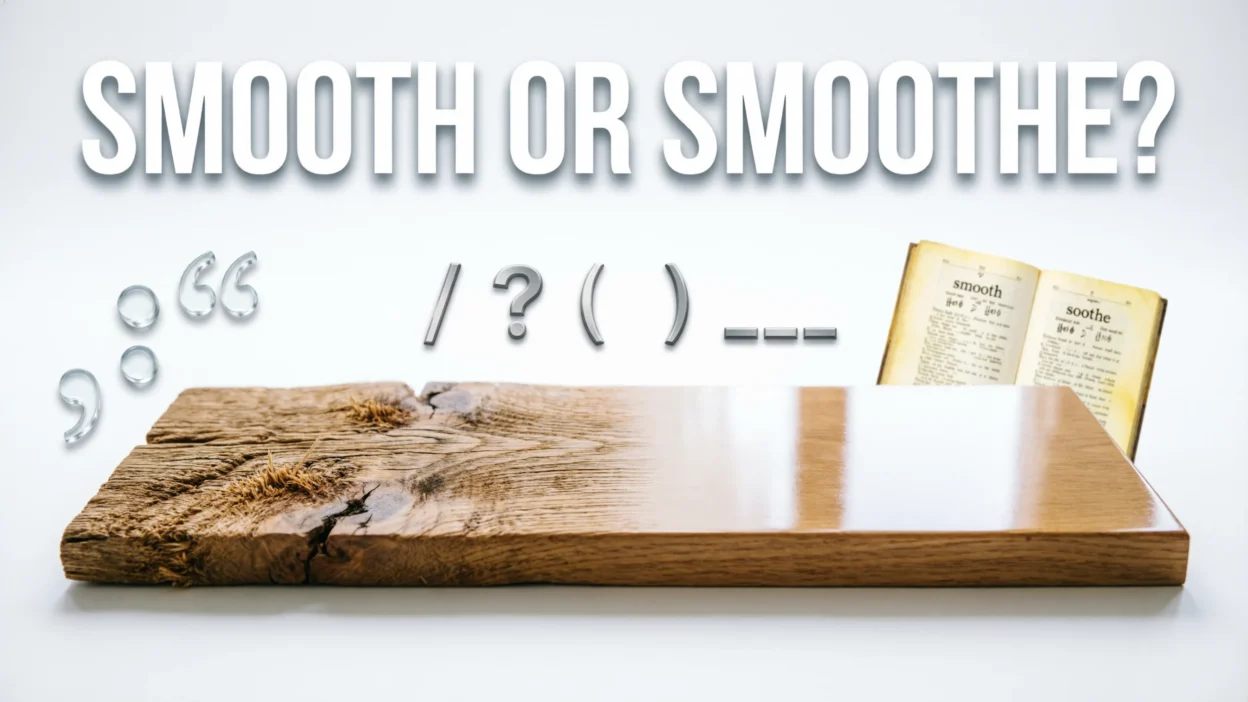
Have you ever wondered whether you should write smooth or smoothe? You’re not alone. These two words look almost identical, which makes them a common source of confusion for writers, students, and English learners.
The good news is that understanding the difference is easier than you might think. While both words exist in English, they serve different grammatical purposes.
This guide explains the meaning of smooth and smoothe, when to use each one, common mistakes to avoid, and practical examples to help you use them correctly.
Quick Answer
The difference is simple:
- Smooth is usually an adjective that describes something even, flat, polished, or free from roughness.
- Smoothe is a verb that means to make something smooth.
Examples:
✅ The surface feels smooth.
✅ She used sandpaper to smoothe the edges.
❌ The surface feels smoothe.
❌ She used sandpaper to smooth the edges. (This is also accepted in modern usage, making “smooth” the more common verb form.)
In modern English, smooth is far more commonly used as both an adjective and a verb.
What Do “Smooth” and “Smoothe” Mean?
Although the words are related, they have different grammatical functions.
Smooth
Smooth is primarily an adjective.
It describes something that has an even texture or an effortless quality.
Examples:
- The table has a smooth finish.
- Her skin feels smooth.
- He gave a smooth presentation.
The word can also function as a verb in modern English.
Examples:
- Smooth the wrinkles from the fabric.
- She tried to smooth her hair.
Smoothe
Smoothe is a verb.
It means to make something smooth or less rough.
Examples:
- He used a file to smoothe the wooden edge.
- The artist smoothed the clay to create a perfect shape.
Today, the verb smooth is generally preferred over smoothe in most writing styles.
Smooth vs Smoothe: What’s the Difference?
The key difference is grammatical usage.
| Feature | Smooth | Smoothe |
|---|---|---|
| Most Common Function | Adjective | Verb |
| Means Even or Polished | ✅ Yes | ❌ No |
| Means Make Something Smooth | ✅ Yes (modern usage) | ✅ Yes |
| Common in Modern English | ✅ Very Common | ❌ Less Common |
| Example | The road is smooth. | He smoothe(d) the surface. |
For most situations, smooth is the word you’ll need.
When Should You Use “Smooth”?
Use smooth when describing texture, appearance, movement, communication, or performance.
Examples:
- The marble floor is smooth.
- The ride was smooth and comfortable.
- She has a smooth speaking voice.
- The software provides a smooth user experience.
Correct Sentences
✅ The walls are smooth after painting.
✅ He handled the situation in a smooth manner.
✅ The lake looked smooth and calm.
Incorrect Sentences
❌ The walls are smoothe after painting.
❌ He handled the situation in a smoothe manner.
❌ The lake looked smoothe and calm.
When Should You Use “Smoothe”?
Traditionally, smoothe is used as a verb meaning “to make smooth.”
Examples:
- The carpenter worked to smoothe the rough edges.
- She carefully smoothed the fabric before sewing.
However, modern dictionaries and style guides increasingly favor smooth as the verb form.
Because of this, you’ll often see:
✅ Smooth the surface.
instead of:
✅ Smoothe the surface.
Both can be understood, but smooth is now much more common.
Why Is There Confusion Between Smooth and Smoothe?
The confusion exists because English historically allowed both forms as verbs.
Over time, usage shifted, and the shorter form smooth became dominant in everyday writing and speech.
Today:
- Smooth functions as both an adjective and a verb.
- Smoothe survives primarily as a less common variant verb spelling.
As a result, many people never encounter smoothe at all.
Examples of Smooth and Smoothe in Sentences
Everyday Examples
- The baby’s skin feels smooth.
- She used lotion to keep her hands smooth.
- He tried to smooth the wrinkles in his shirt.
- The river stones were smooth from years of water flow.
- We enjoyed a smooth flight.
Professional Examples
- The company created a smooth onboarding process.
- The designer ensured a smooth user experience.
- Engineers worked to smooth system performance.
- The editor helped smooth awkward wording.
- The contractor smoothed the concrete surface.
Common Mistakes People Make
Mistake #1: Using Smoothe as an Adjective
❌ The countertop is smoothe.
✅ The countertop is smooth.
Mistake #2: Assuming Smoothe Is More Correct
❌ You must always use smoothe as the verb.
✅ Modern English commonly uses smooth as the verb.
Mistake #3: Adding an Unnecessary “E”
❌ The road looks smoothe.
✅ The road looks smooth.
Mistake #4: Avoiding Smooth as a Verb
❌ He smoothe(d) out the issue. (Less common)
✅ He smoothed out the issue.
Common Expressions with Smooth
Many popular English phrases use smooth.
Examples:
- Smooth sailing
- Smooth transition
- Smooth operator
- Smooth performance
- Smooth finish
- Smooth communication
- Smooth process
These expressions are widely used in business, education, and everyday conversation.
Similar Words and Related Terms
| Word | Meaning |
|---|---|
| Smooth | Even, polished, effortless |
| Polished | Refined or glossy |
| Sleek | Smooth and elegant |
| Refined | Improved and sophisticated |
| Soft | Gentle to the touch |
| Even | Uniform and level |
| Glossy | Shiny and smooth |
These related words can help diversify your writing while conveying a similar idea.
American vs British English
There is little difference between American and British English regarding smooth and smoothe.
Both varieties overwhelmingly prefer:
- Smooth (adjective)
- Smooth (verb)
Examples:
✅ Smooth the surface.
✅ Smooth the transition.
Although smoothe may still appear in some dictionaries and historical texts, it is relatively uncommon in both American and British English today.
Tips to Remember the Correct Usage
Use these simple memory tricks:
- If you’re describing something, choose smooth.
- In modern writing, the verb is usually smooth as well.
- The shorter spelling is generally the safer choice.
- Think of common phrases like “smooth ride” or “smooth transition.”
Easy rule:
When in doubt, use smooth.
In most modern contexts, you’ll be correct.
Frequently Asked Questions
1. Is smoothe a real word?
Yes. Smoothe is a legitimate English verb meaning “to make smooth.”
2. Which is correct: smooth or smoothe?
Both are correct in specific contexts, but smooth is far more common in modern English.
3. Is smooth an adjective?
Yes. Smooth is primarily an adjective describing something even, polished, or free from roughness.
4. Can smooth be a verb?
Yes. Modern English commonly uses smooth as a verb.
Example:
- Smooth the paper before printing.
5. Is smoothe outdated?
Not entirely, but it is much less common than smooth in contemporary writing.
6. Do dictionaries recognize smoothe?
Yes. Many dictionaries still list smoothe as a verb variant.
7. Which form should I use in professional writing?
Use smooth. It is the preferred form in modern business, academic, and everyday communication.
8. Is there a British-English preference for smoothe?
No. Both British and American English overwhelmingly favor smooth today.
Summary
The difference between smooth and smoothe comes down to usage and modern preference. Smooth is primarily an adjective that describes something even, polished, or effortless. It is also commonly used as a verb in modern English. Smoothe, on the other hand, is a less common verb form meaning “to make smooth.”
For most writing situations, smooth is the safest and most widely accepted choice. Whether you’re describing a texture, a process, a presentation, or an action, modern English speakers and style guides overwhelmingly prefer the shorter spelling.
Actionable Takeaway
Remember this simple rule:
Describe something? Use smooth.
Need a verb? Smooth is usually the best choice.
Examples:
- The surface is smooth.
- Smooth the edges before painting.
When you’re unsure, choose smooth. It’s the standard form used in most modern English writing.