Have you ever stopped while writing or speaking and wondered whether you should use seen or saw? You’re not alone. This is one of the most common grammar questions in English because both words relate to the verb see, yet they are used in different ways.
Understanding the difference between seen and saw can instantly improve your grammar, writing, and everyday communication. In this guide, you’ll learn the meaning of each word, when to use them, common mistakes to avoid, and simple tricks to remember the correct choice every time.
Quick Answer
The difference is simple:
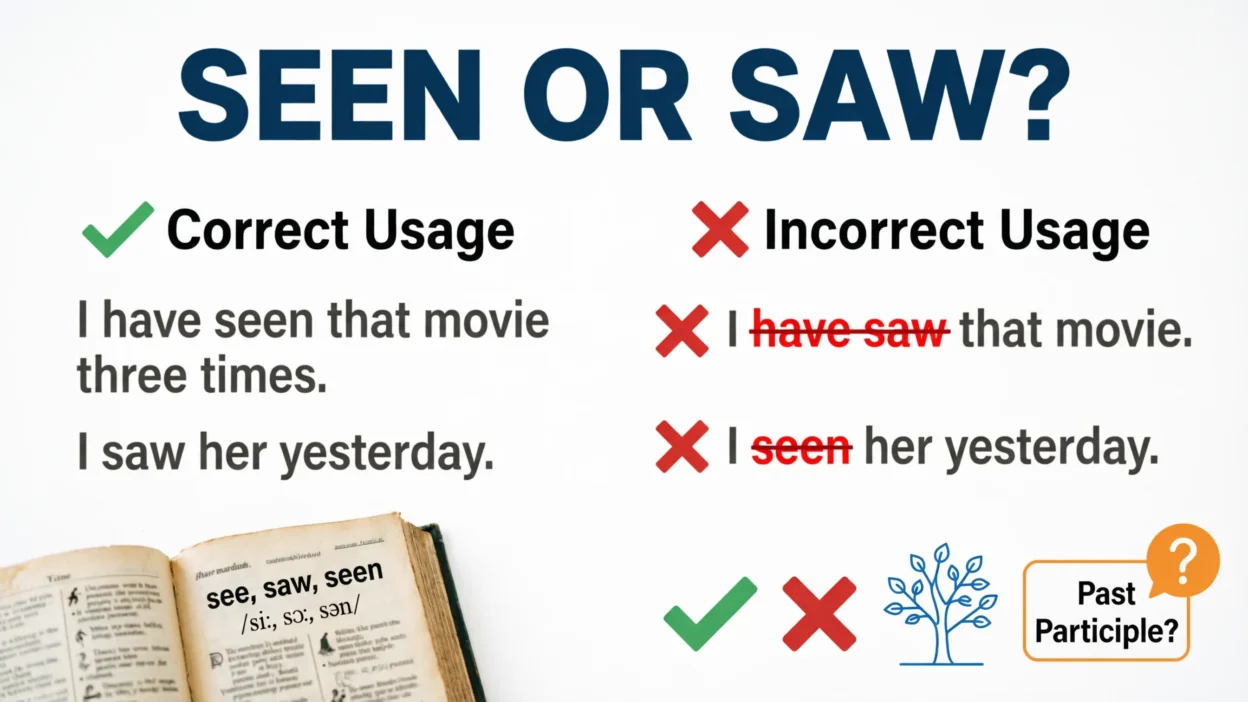
- Saw is the simple past tense of see.
- Seen is the past participle of see and must be used with a helping verb such as have, has, had, was, or were.
Examples:
✅ I saw a movie yesterday.
✅ I have seen that movie before.
❌ I seen a movie yesterday.
❌ I have saw that movie before.
What Do “Saw” and “Seen” Mean?
Both words come from the verb see, which means to perceive something with your eyes or to observe something.
However, they serve different grammatical functions.
Saw
Saw is the simple past tense of see.
It describes something that happened in the past.
Examples:
- I saw a beautiful sunset.
- She saw her friend at the mall.
- We saw a deer in the forest.
Seen
Seen is the past participle form of see.
It cannot usually stand alone and requires a helping verb.
Examples:
- I have seen that sunset before.
- She has seen the new movie.
- They had seen the warning signs.
Seen vs Saw: What’s the Difference?
The key difference lies in grammar.
| Feature | Saw | Seen |
|---|---|---|
| Verb Form | Simple Past | Past Participle |
| Can Stand Alone? | ✅ Yes | ❌ Usually No |
| Needs Helping Verb? | ❌ No | ✅ Yes |
| Example | I saw it yesterday. | I have seen it before. |
| Common Usage | Completed past action | Perfect tenses |
Think of it this way:
- Saw works by itself.
- Seen needs a helper.
When Should You Use “Saw”?
Use saw when talking about a completed action in the past.
Examples:
- I saw him at the restaurant.
- She saw a shooting star last night.
- They saw the accident happen.
Notice that no helping verbs are needed.
Correct Sentences
✅ I saw your message this morning.
✅ We saw the parade yesterday.
✅ He saw the mistake immediately.
Incorrect Sentences
❌ I seen your message this morning.
❌ We seen the parade yesterday.
❌ He seen the mistake immediately.
When Should You Use “Seen”?
Use seen with helping verbs such as:
- Have
- Has
- Had
- Was
- Were
- Have been
- Had been
Examples:
- I have seen that movie.
- She has seen the results.
- They had seen the report before the meeting.
Correct Sentences
✅ I have seen this place before.
✅ She has seen the new design.
✅ We had seen enough evidence.
Incorrect Sentences
❌ I have saw this place before.
❌ She has saw the new design.
❌ We had saw enough evidence.
Why Do People Confuse Seen and Saw?
Many English speakers learn these forms through conversation rather than formal grammar instruction. As a result, phrases like “I seen it” are commonly heard in some regional dialects.
However, in standard English grammar, the distinction remains clear:
- Use saw for simple past actions.
- Use seen with helping verbs.
Remember:
I saw it.
I have seen it.
Never mix the two forms.
Examples of Seen and Saw in Sentences
Everyday Examples
- I saw a dog running across the street.
- Have you seen my keys?
- She saw the announcement online.
- We have seen this problem before.
- They saw the fireworks from their balcony.
Workplace Examples
- I saw the email this morning.
- The manager has seen your proposal.
- We had seen similar results in previous reports.
- She saw the presentation yesterday.
- The team has seen significant improvements.
Common Mistakes People Make
Mistake #1: Using Seen Without a Helping Verb
❌ I seen the game yesterday.
✅ I saw the game yesterday.
Mistake #2: Using Saw After Have, Has, or Had
❌ I have saw that movie.
✅ I have seen that movie.
Mistake #3: Mixing Tenses
❌ She had saw the message.
✅ She had seen the message.
Mistake #4: Assuming They Mean Exactly the Same Thing
Although they come from the same verb, they perform different grammatical roles and cannot always replace one another.
Verb Forms of See
Learning all forms of the verb makes the difference easier to remember.
| Verb Form | Word |
|---|---|
| Base Form | See |
| Present Tense | See / Sees |
| Past Tense | Saw |
| Past Participle | Seen |
| Present Participle | Seeing |
Examples:
- I see the mountain.
- Yesterday I saw the mountain.
- I have seen the mountain before.
- I am seeing the mountain now.
Similar Grammar Pairs
Many English verbs follow a similar pattern.
| Base Verb | Past Tense | Past Participle |
|---|---|---|
| See | Saw | Seen |
| Go | Went | Gone |
| Do | Did | Done |
| Write | Wrote | Written |
| Speak | Spoke | Spoken |
| Break | Broke | Broken |
These irregular verbs often cause confusion because their past tense and past participle forms are different.
American vs British English
There is no significant difference between American and British English regarding seen and saw.
Both varieties follow the same grammatical rules:
✅ I saw him yesterday.
✅ I have seen him before.
While some regional dialects may use “I seen” in casual speech, it is generally considered nonstandard in formal writing and professional communication.
Tips to Remember the Correct Usage
Here are some easy memory tricks:
- If there is no helping verb, use saw.
- If you see have, has, or had, use seen.
- Remember: Saw stands alone; seen needs support.
- Practice saying:
- I saw it yesterday.
- I have seen it before.
A simple rule:
No helper = saw.
Helper present = seen.
Frequently Asked Questions
1. Is “I seen” grammatically correct?
In standard English, no. The correct form is:
✅ I saw it.
or
✅ I have seen it.
2. Which is correct: seen or saw?
Both are correct when used in the proper grammatical context.
3. Why do people say “I seen”?
Some regional dialects use this form in casual speech, but it is not considered standard grammar.
4. Is “I have saw” correct?
No.
The correct sentence is:
✅ I have seen.
5. Can seen be used without have or has?
Usually no. It generally requires a helping verb.
6. What tense is saw?
Saw is the simple past tense of the verb see.
7. What tense is seen?
Seen is the past participle form used in perfect and passive constructions.
8. How can I remember the difference?
Remember:
Saw works alone. Seen needs a helping verb.
Summary
The difference between seen and saw comes down to grammar. Saw is the simple past tense of see and can stand on its own. Seen is the past participle form and usually requires a helping verb such as have, has, or had. Using the correct form makes your speech and writing more accurate and professional.
A quick way to remember the rule is that saw works independently, while seen needs support from another verb. Whether you’re writing an email, speaking in a meeting, or completing schoolwork, applying this simple rule will help you avoid one of the most common English grammar mistakes.
Actionable Takeaway
Use this formula whenever you’re unsure:
Yesterday = saw
Have/Has/Had = seen
Examples:
- I saw the movie yesterday.
- I have seen the movie before.
If a helping verb appears in the sentence, choose seen. If it doesn’t, choose saw.