Have you ever stopped while writing an email, text message, or school assignment and wondered whether the correct spelling is receive or recieve?
You’re not alone. This is one of the most commonly misspelled words in the English language, and many native speakers still get it wrong.
The confusion usually comes from the famous spelling rule “I before E except after C.” While that rule helps in this case, many English words break it, making spelling even more challenging.
In this guide, you’ll learn the correct spelling, meaning, examples, common mistakes, and practical tips to remember the right form every time.
Quick Answer
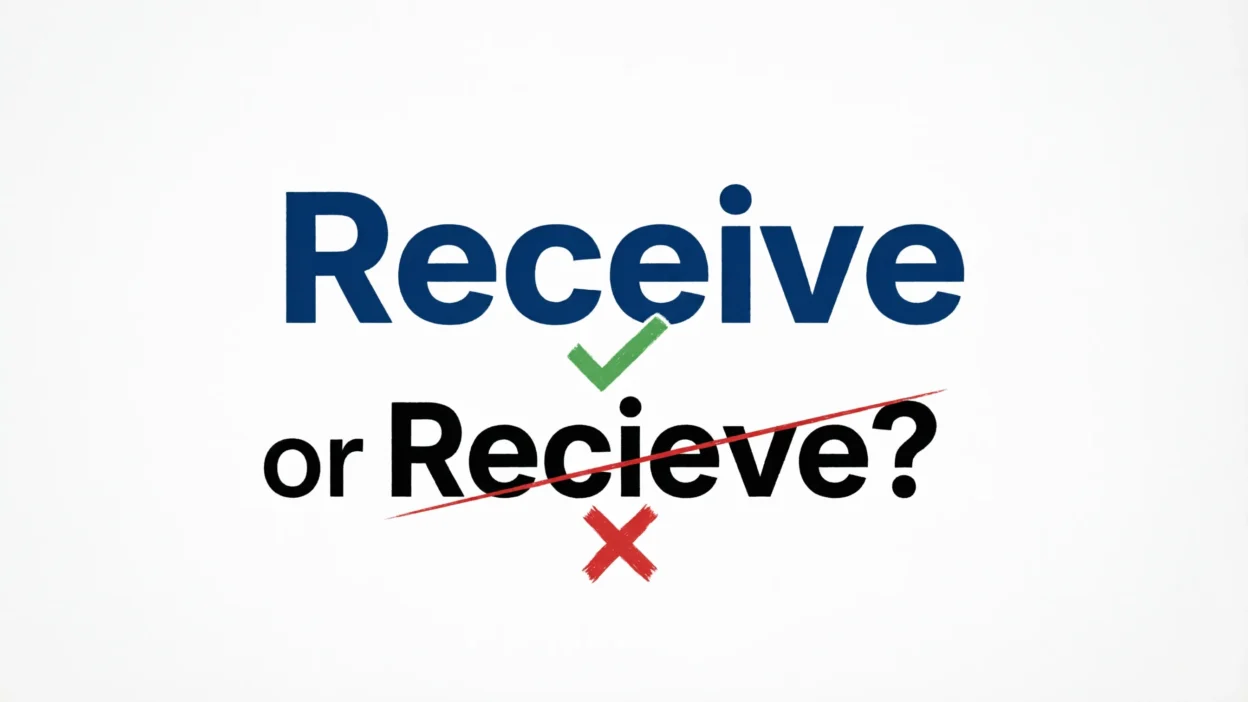
The correct spelling is receive.
Recieve is incorrect and considered a spelling mistake in standard English.
✅ Correct: I will receive the package tomorrow.
❌ Incorrect: I will recieve the package tomorrow.
If you’re writing in academic, professional, or everyday contexts, always use receive.
What Does “Receive” Mean?
The word receive means to get, accept, obtain, or be given something.
It can refer to physical objects, information, messages, payments, gifts, or treatment from someone else.
Common meanings of receive:
- To get something sent to you
- To accept something offered
- To obtain information
- To experience or undergo something
Examples
- I received your email this morning.
- She will receive her diploma next month.
- We received excellent customer service.
- Did you receive the invitation?
Related terms include:
- Accept
- Obtain
- Get
- Collect
- Acquire
- Take delivery of
Receive or Recieve: Which Is Correct?
The correct spelling is receive.
The incorrect version, recieve, results from reversing the positions of the letters “e” and “i.”
Comparison Table
| Feature | Receive | Recieve |
|---|---|---|
| Correct spelling | ✅ Yes | ❌ No |
| Found in dictionaries | ✅ Yes | ❌ No |
| Accepted in formal writing | ✅ Yes | ❌ No |
| Common spelling error | ❌ No | ✅ Yes |
| Recommended usage | ✅ Always | ❌ Never |
Whenever you’re unsure, remember that receive is the only accepted spelling.
Why Do People Confuse Receive and Recieve?
The confusion usually comes from the placement of the letters e and i.
Many English learners memorize the spelling rule:
“I before E except after C.”
Since the letter c comes before the vowel combination in receive, the correct order becomes:
- c + ei = receive
This follows the traditional spelling rule perfectly.
Helpful Memory Trick
Think:
Receive = C comes first, so E comes first.
Since the word contains the letter c, write ei after it.
- rec + eive = receive
This simple trick helps many people remember the correct spelling.
The Origin of Receive
The word receive comes from the Old French word receivre, which originated from the Latin word recipere, meaning “to take back,” “accept,” or “take.”
Over centuries, the spelling evolved into modern English receive, while maintaining its core meaning of obtaining or accepting something.
Today, it remains one of the most frequently used verbs in English.
Examples of Correct Usage
In Everyday Conversation
- I received your text message.
- Did you receive the package yet?
- She received flowers on her birthday.
- We received good news today.
In Writing
- The company received thousands of applications.
- Students will receive their results next week.
- I received confirmation of my booking.
In Professional Contexts
- Your payment has been received successfully.
- Employees will receive training next month.
- We received your request and will respond shortly.
Common Mistakes to Avoid
Mistake #1: Writing “Recieve”
This is the most common spelling error.
❌ I didn’t recieve your email.
✅ I didn’t receive your email.
Mistake #2: Mixing Up “Receive” and “Accept”
While similar, they aren’t always identical.
❌ I received the job offer and declined it. (Not incorrect, but context matters.)
✅ I received the job offer but did not accept it.
You can receive something without accepting it.
Mistake #3: Incorrect Verb Forms
❌ I have recieve the package.
✅ I have received the package.
Remember:
- Receive
- Received
- Receiving
All forms maintain the same letter order.
American vs British English
There is no spelling difference between American English and British English for receive.
Both varieties use:
✅ Receive
❌ Recieve
Whether you’re writing for audiences in the United States, the United Kingdom, Canada, Australia, or New Zealand, the spelling remains the same.
Related Words That Follow the Same Rule
Many words follow the same “E after C” pattern.
Examples
- Receive
- Receipt
- Ceiling
- Conceit
- Deceive
- Perceive
These words can help reinforce the spelling rule.
Compare
| Correct Word | Incorrect Version |
|---|---|
| Receive | Recieve |
| Deceive | Decieve |
| Perceive | Percieve |
| Ceiling | Cieling |
Learning these together makes them easier to remember.
Synonyms, Related Terms, and Alternatives
Depending on context, you can use:
- Get
- Obtain
- Accept
- Acquire
- Collect
- Take delivery of
- Gain
- Be given
Examples
- I received the package.
- I got the package.
Both sentences communicate a similar idea, though “receive” often sounds more formal.
When Should You Use Receive?
Use receive when:
- Getting an email
- Accepting a package
- Obtaining information
- Being awarded something
- Experiencing treatment or attention
Examples:
- Receive a gift
- Receive a message
- Receive an award
- Receive payment
- Receive support
Avoid:
- Using “recieve”
- Reversing the order of “e” and “i”
- Assuming every word follows the same spelling rule
FAQs
Is receive or recieve correct?
Receive is correct. Recieve is a spelling mistake.
Why is receive spelled with “ei”?
Because it follows the traditional spelling rule “I before E except after C.”
Is recieve a real word?
No. Recieve is not recognized as a correct English spelling.
How do I remember how to spell receive?
Remember: after the letter c, write ei. Think, “C comes first, so E comes first.”
Is receive used in American and British English?
Yes. Both American and British English use the spelling receive.
What is the past tense of receive?
The past tense is received.
Example: I received the package yesterday.
What does receive mean?
It means to get, obtain, accept, or be given something.
Is receive a formal word?
Yes. It is commonly used in both formal and informal communication.
Summary
When choosing between receive or recieve, the correct spelling is always receive. The word means to get, obtain, accept, or be given something, and it follows the familiar spelling rule “I before E except after C.” Although recieve is a very common mistake, it is not accepted in standard English.
Whether you’re writing an email, preparing a report, completing schoolwork, or posting online, using receive will ensure your writing looks professional and accurate. Remember that after the letter c, the vowel order becomes ei, making receive the only correct choice.
Actionable Takeaway
Whenever you’re unsure whether to write receive or recieve, remember this simple rule: after C comes EI. Save the phrase “receive follows C + EI” in your memory, and you’ll avoid one of the most common English spelling mistakes.