Have you ever paused while typing and wondered whether you should write damnit or dammit? You’re not alone. This common spelling confusion appears in text messages, social media posts, emails, and even published content. Many English speakers use both versions, but only one is widely recognized as the standard spelling.
Understanding the difference between damnit and dammit can help you write more confidently and avoid common language mistakes. In this guide, you’ll learn the correct spelling, meaning, usage examples, common errors, and whether American and British English treat the word differently.
Quick Answer
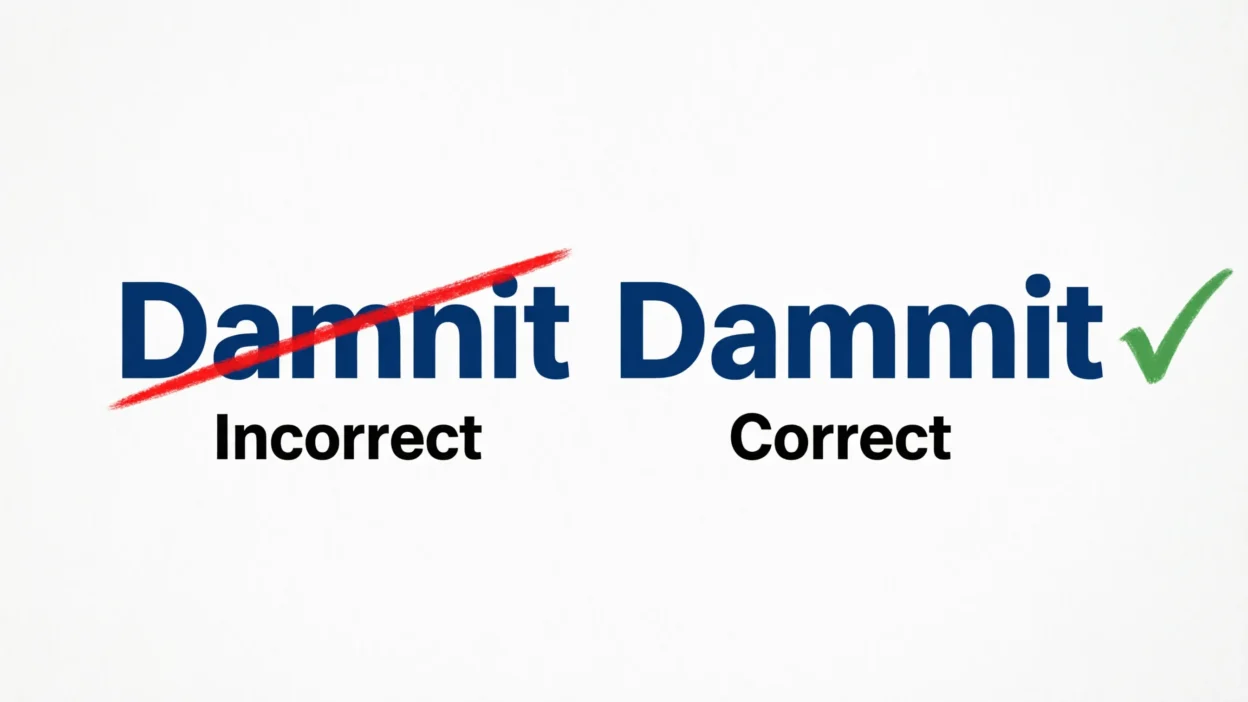
Dammit is the standard and widely accepted spelling.
Damnit is considered a nonstandard or alternative spelling that occasionally appears in informal writing but is generally viewed as incorrect.
✅ Correct: Dammit, I forgot my keys!
❌ Nonstandard: Damnit, I forgot my keys!
If you’re writing for professional, academic, or general audiences, use dammit.
What Does “Dammit” Mean?
Dammit is a mild exclamation used to express:
- Frustration
- Annoyance
- Disappointment
- Anger
- Irritation
It is a softened form of the phrase “damn it.” Over time, the two words became combined into the single-word expression dammit.
People often use it when something goes wrong unexpectedly.
Examples
- Dammit, I missed the bus again.
- Dammit, my phone battery just died.
- Dammit, I knew I forgot something.
- Dammit, that was my last chance.
The word is considered informal and is most common in casual conversations and creative writing.
Damnit or Dammit: Which Is Correct?
The correct spelling is dammit.
Most dictionaries, style guides, editors, and language experts recognize dammit as the accepted spelling. Although damnit appears online and in informal communication, it is generally treated as a misspelling or a phonetic variation.
Comparison Table
| Feature | Dammit | Damnit |
|---|---|---|
| Standard spelling | ✅ Yes | ❌ No |
| Found in major dictionaries | ✅ Yes | Rarely |
| Accepted in professional writing | ✅ Yes | ❌ No |
| Common in casual online use | ✅ Yes | ✅ Sometimes |
| Recommended spelling | ✅ Yes | ❌ No |
When in doubt, choose dammit.
Why Do People Write “Damnit”?
The confusion usually comes from pronunciation.
When people say damn it quickly, the phrase can sound like:
- Dammit
- Damnit
Because spoken English often blends sounds together, some writers spell the word exactly how they hear it.
For example:
- Damn it → Dammit
- Damn it → Damnit
Even though both pronunciations may sound similar in casual speech, standard written English favors dammit.
The Origin of “Dammit”
The word dammit originated as a contraction of damn it.
The word damn has roots in older religious and legal language, where it referred to condemnation or punishment. Over time, it evolved into a common exclamation used to express strong emotions.
As spoken language became more informal, people began combining “damn” and “it” into the single-word expression dammit.
Today, it is recognized as a mild swear word or profanity, though its intensity is generally lower than many stronger curse words.
Examples of Dammit in Sentences
Here are some natural examples showing how native English speakers use the word.
Expressing Frustration
- Dammit, the internet stopped working again.
- Dammit, I dropped my coffee.
Expressing Disappointment
- Dammit, we lost the game by one point.
- Dammit, I was hoping for better news.
Expressing Anger
- Dammit, why didn’t anyone tell me?
- Dammit, this keeps happening.
In Dialogue
- “Dammit, where are my glasses?”
- “Dammit, I can’t believe I forgot the meeting.”
Common Mistakes People Make
Many writers unintentionally misuse this expression. Here are the most common mistakes.
1. Writing “Damnit” Instead of “Dammit”
This is the most frequent error.
❌ Damnit, I forgot my wallet.
✅ Dammit, I forgot my wallet.
2. Using It in Formal Writing
Because dammit is informal and mildly offensive, it should usually be avoided in:
- Academic papers
- Business reports
- Professional emails
- Legal documents
Instead, consider alternatives such as:
- Unfortunately
- That’s frustrating
- What a disappointment
- Oh no
3. Overusing the Expression
Repeatedly using dammit can make writing sound repetitive or overly emotional.
Vary your language with phrases such as:
- That’s annoying.
- What a shame.
- How frustrating.
- Seriously?
Dammit vs Damn It
Another common question is whether to write dammit or damn it.
Both forms are correct.
Dammit
- Informal contraction
- Faster and more conversational
- Common in dialogue and casual writing
Example:
- Dammit, I forgot my password.
Damn It
- Original two-word phrase
- Slightly more formal
- Often used for emphasis
Example:
- Damn it, I forgot my password.
Both communicate the same meaning.
American vs British English
There is no major difference between American English and British English regarding dammit.
In both varieties:
- Dammit is recognized and understood.
- Damnit remains nonstandard.
- Damn it is also acceptable.
However, British speakers may sometimes prefer the separate form damn it in traditional writing, while American speakers frequently use the contracted form dammit in casual contexts.
The overall recommendation remains the same: use dammit if you choose the single-word version.
Similar Expressions and Synonyms
If you’d like alternatives that express frustration without using profanity, consider these options:
- Oh no
- Darn it
- Blast
- Shoot
- Rats
- That’s frustrating
- What a nuisance
- Good grief
For stronger emotional expressions, some speakers use:
- Damn
- For goodness’ sake
- Come on
- Seriously
Choose the phrase that best matches your audience and situation.
When Should You Use Dammit?
Use dammit when:
- Writing casual conversations
- Creating realistic dialogue
- Posting on social media
- Sending messages to friends
- Writing fiction or entertainment content
Avoid it when:
- Writing professional documents
- Communicating with clients
- Submitting academic work
- Creating formal business content
Context matters more than the word itself.
FAQs
Is dammit a real word?
Yes. Dammit is recognized by major dictionaries as an informal exclamation derived from “damn it.”
Is damnit correct?
No. Damnit is generally considered a nonstandard spelling. Dammit is the preferred form.
What does dammit mean?
It expresses frustration, annoyance, disappointment, or anger.
Is dammit offensive?
It is considered mild profanity. Some people may find it offensive, while others view it as relatively harmless.
Can I use dammit in professional writing?
Generally no. It is best reserved for informal communication.
Which is more common: dammit or damnit?
Dammit is significantly more common and widely accepted.
Is damn it the same as dammit?
Yes. Dammit is simply a contracted version of the phrase “damn it.”
Do Americans and British people use dammit differently?
Not significantly. Both understand and use the term, although writing preferences may vary slightly.
Summary
If you’ve been wondering whether to write damnit or dammit, the answer is clear: dammit is the standard and correct spelling. While damnit occasionally appears in informal writing, it is generally considered a misspelling or nonstandard variation. Dictionaries, editors, and language professionals overwhelmingly recommend using dammit.
Understanding the distinction helps improve writing accuracy and credibility. Whether you’re posting online, writing dialogue, or sending casual messages, choosing the correct spelling ensures your communication looks polished and natural. Whenever you face the choice between damnit or dammit, remember that dammit is the accepted form.