If you’ve ever written about arts and crafts, woodworking, DIY projects, or repairs, you may have stopped to wonder whether the correct spelling is gluing or glueing.
Since the word glue ends with the letter “e,” many writers are unsure whether that “e” should stay or be removed before adding -ing.
The good news is that the answer is straightforward once you understand the spelling rule.
In this guide, you’ll learn the difference between gluing and glueing, discover the correct spelling, see practical examples, avoid common mistakes, and gain a simple trick for remembering the rule.
Quick Answer
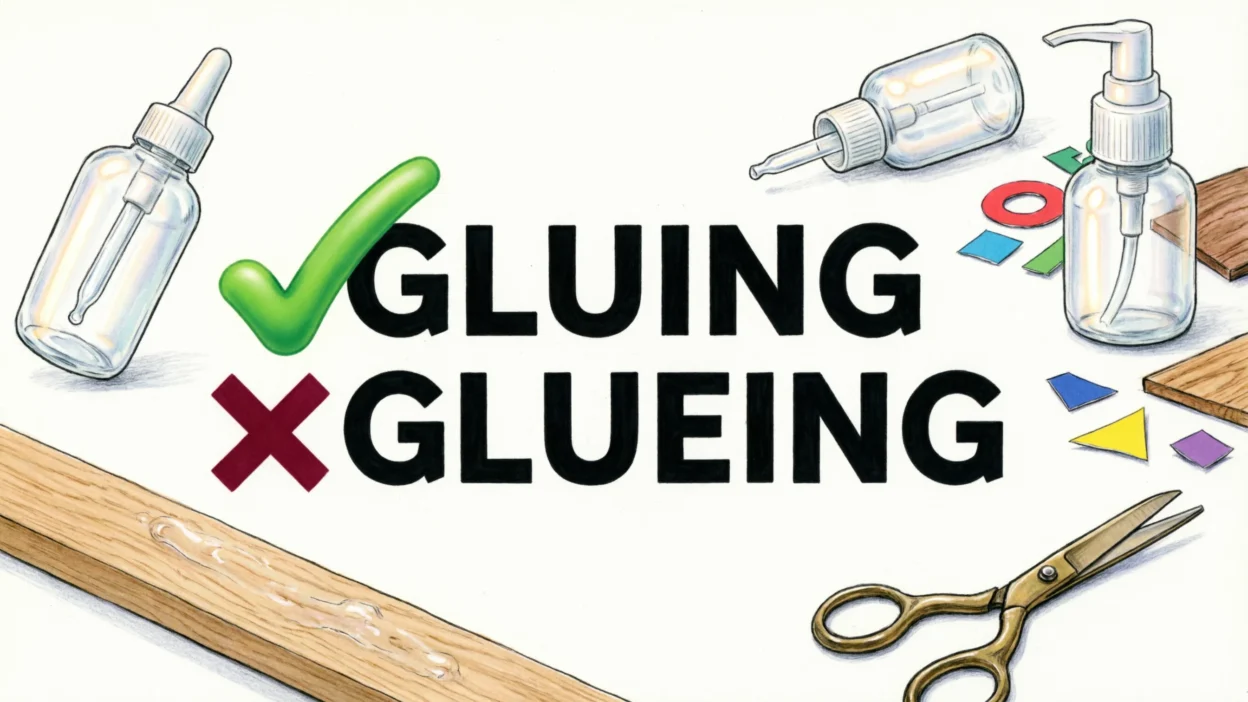
Gluing is the standard and correct spelling in modern English.
Glueing is considered a nonstandard, rare, or outdated spelling and is generally avoided in professional, academic, and everyday writing.
Examples:
- ✅ She is gluing the pieces together.
- ✅ We spent the afternoon gluing decorations onto the poster.
- ❌ She is glueing the pieces together.
Simple Rule:
When adding -ing to glue, drop the final e and write gluing.
What Do Gluing and Glueing Mean?
Both spellings refer to the act of applying glue or attaching things with adhesive.
However, only one spelling is widely accepted in modern English.
Meaning of Gluing
Gluing is the present participle and gerund form of the verb glue.
It means:
- Applying adhesive
- Joining objects together with glue
- Attaching materials permanently or temporarily
Examples:
- She is gluing photographs into a scrapbook.
- The carpenter is gluing wooden panels together.
- They spent hours gluing decorations onto the stage backdrop.
Meaning of Glueing
Glueing carries the same meaning but is an uncommon alternative spelling.
While it occasionally appears in older texts or specific regional publications, most modern dictionaries and style guides prefer gluing.
Examples:
- Rare: He was glueing the broken vase together.
- Preferred: He was gluing the broken vase together.
Gluing vs Glueing: Key Difference
| Feature | Gluing | Glueing |
|---|---|---|
| Modern Standard Spelling | Yes | No |
| Dictionary Preference | Preferred | Rare/Alternative |
| Professional Writing | Recommended | Usually avoided |
| Academic Writing | Recommended | Not preferred |
| Everyday Usage | Common | Uncommon |
The main difference is not meaning but acceptance. Gluing is the standard spelling used by most writers and publishers today.
Why Is Gluing the Correct Spelling?
English spelling rules generally require dropping a silent final e before adding -ing.
Examples:
| Base Verb | + ing Form |
|---|---|
| Make | Making |
| Drive | Driving |
| Bake | Baking |
| Move | Moving |
| Glue | Gluing |
Following this pattern, glue becomes gluing, not glueing.
This rule helps keep English spelling consistent.
When Should You Use Gluing?
Use gluing whenever you’re describing the act of attaching objects with glue.
Examples of Gluing
- The children are gluing paper shapes onto the poster.
- She spent the evening gluing model parts together.
- We are gluing labels onto the packages.
- The craftsman is gluing wood joints for extra strength.
Common Use Cases
- Arts and crafts
- School projects
- Furniture repair
- Woodworking
- DIY home improvement
- Manufacturing processes
When Might You See Glueing?
Although uncommon, you may occasionally encounter glueing in:
- Older publications
- Historical texts
- Certain regional documents
- Informal writing
Examples
- Some older guides mention glueing materials together.
- Historical publications occasionally use glueing instead of gluing.
However, modern style guides overwhelmingly recommend gluing.
Common Mistakes with Gluing and Glueing
Many writers assume the final e should remain because it is part of the original word.
Incorrect vs Correct Usage
❌ She is glueing the photographs into the album.
✅ She is gluing the photographs into the album.
❌ We spent hours glueing decorations together.
✅ We spent hours gluing decorations together.
❌ The carpenter is glueing the boards.
✅ The carpenter is gluing the boards.
❌ They enjoy glueing craft materials.
✅ They enjoy gluing craft materials.
Easy Trick to Remember the Difference
A simple spelling rule can help.
Drop the Silent E
When a verb ends in a silent e, remove it before adding -ing.
Examples:
- Make → Making
- Drive → Driving
- Bake → Baking
- Glue → Gluing
Quick Memory Tip
Think:
“If you’re adding -ing, the silent e usually leaves.”
Following this rule automatically gives you gluing.
Real-Life Examples
In Arts and Crafts
- Children are gluing colored paper onto cardboard.
- We spent the afternoon gluing decorative beads onto frames.
In Woodworking
- The carpenter is gluing oak panels together.
- Proper gluing improves furniture durability.
In Education
- Students practiced gluing shapes during art class.
- Teachers often supervise younger children while gluing materials.
In Manufacturing
- Workers are gluing labels onto product packaging.
- Automated systems assist with precision gluing.
American vs British English
There is virtually no difference between American and British English regarding this spelling.
Both varieties generally prefer:
- Gluing ✅
- Glueing ❌ (rare and nonstandard)
Examples:
- American English: The worker is gluing components together.
- British English: The worker is gluing components together.
Modern usage remains consistent across both forms of English.
Synonyms and Related Words
Depending on context, you may encounter related words such as:
- Attaching
- Bonding
- Joining
- Connecting
- Fastening
- Adhering
- Securing
- Cementing
- Pasting
- Fixing
Examples:
- The technician is bonding materials together.
- They are attaching decorations to the display.
Why People Get Confused About Gluing and Glueing
Several factors contribute to confusion.
The Word Ends in E
Many people assume the original spelling should remain unchanged.
Inconsistent English Rules
English contains numerous exceptions, making writers cautious.
Visual Appearance
Some writers think glueing looks more natural because it preserves the original word.
Rare Alternative Usage
Occasional appearances of glueing in older texts can create uncertainty.
Spelling Habits
People sometimes forget the common rule of dropping a silent e before adding -ing.
Frequently Asked Questions (FAQs)
Is gluing or glueing correct?
Gluing is the standard and preferred spelling.
Why is gluing spelled without the e?
English spelling rules usually drop a silent final e before adding -ing.
Is glueing wrong?
It is not always considered technically incorrect, but it is uncommon and generally not recommended.
Which spelling do dictionaries prefer?
Most modern dictionaries prefer gluing.
Is gluing used in British English?
Yes. British English also primarily uses gluing.
Is gluing a verb?
Yes. It is the present participle form of glue.
Can I use glueing in formal writing?
It’s best to avoid it and use gluing instead.
What is the noun form related to gluing?
The noun is often glue or gluing when referring to the process itself.
Summary
The correct and widely accepted spelling is gluing. It follows the standard English rule of dropping a silent final e before adding -ing. Although glueing occasionally appears in older or uncommon usage, it is generally considered nonstandard in modern writing.
Using gluing will help your writing look more professional, polished, and grammatically accurate. Whether you’re discussing crafts, woodworking, education, or manufacturing, choosing the standard spelling ensures clarity and consistency.
Actionable Takeaway
Whenever you add -ing to glue, remember to drop the silent e and write gluing. Following this simple spelling rule will help you avoid mistakes and write with confidence.