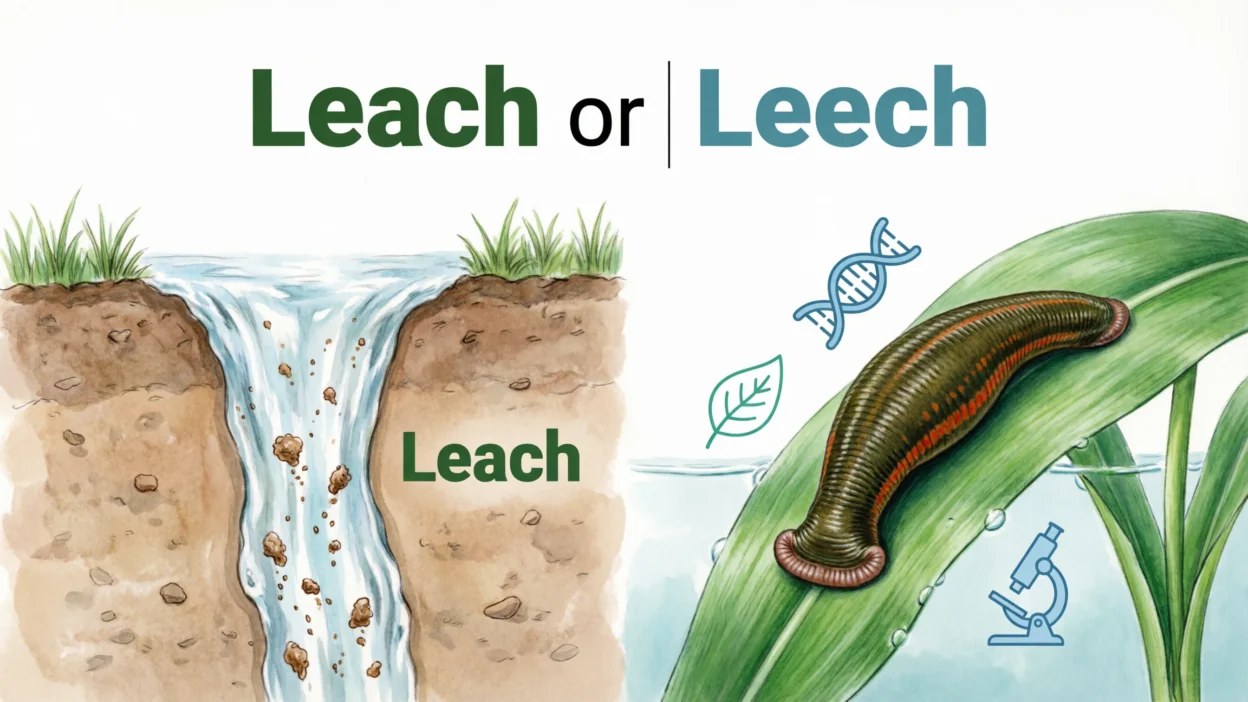
The words leach and leech sound alike, making them easy to confuse. However, they have completely different meanings and are used in different contexts.
Whether you’re writing about science, gardening, medicine, or describing someone’s behavior, choosing the correct word is essential for clear communication.
This guide explains the difference between leach or leech, provides simple definitions, real-world examples, common mistakes, and practical tips to help you use each word correctly. By the end, you’ll never mix up these commonly confused words again.
Quick Answer
Leach is a verb that means to remove or drain substances from something through liquid, such as water carrying minerals from soil. Leech is primarily a noun referring to a blood-sucking worm, although it can also describe a person who depends on others for money or support. Despite sounding identical, they have different meanings and uses.
What Does Leach or Leech Mean?
Although they are homophones (words that sound the same), leach and leech are unrelated in meaning.
Leach
Leach means to remove, dissolve, or wash out substances from a material through the action of a liquid.
It is commonly used in:
- Environmental science
- Agriculture
- Chemistry
- Gardening
- Waste management
Leech
Leech is a type of segmented worm that feeds on blood. Some leeches are used in modern medicine to improve blood circulation after surgery.
The word can also describe someone who constantly relies on or exploits others without giving anything in return.
American vs British English
There is no spelling difference between American and British English for these words.
| English Variety | Correct Spelling | Example |
|---|---|---|
| American English | Leach / Leech | Chemicals may leach into the soil. |
| British English | Leach / Leech | A leech was attached to the animal. |
| Australian English | Leach / Leech | Both spellings have the same meanings. |
| Canadian English | Leach / Leech | Standard usage is identical. |
The meanings remain the same in all major varieties of English.
Examples of Leach in Sentences
Here are examples of the verb leach.
- Heavy rainfall can leach nutrients from the soil.
- Harmful chemicals may leach into groundwater.
- Compost helps prevent valuable minerals from leaching away.
- Farmers work to reduce fertilizer leaching.
- Certain plastics can leach chemicals when exposed to heat.
Examples of Leech in Sentences
Here are examples of leech used correctly.
Referring to the Animal
- A leech attached itself to the hiker’s leg.
- Doctors sometimes use medicinal leeches after surgery.
- The leech feeds on the blood of its host.
- Leeches are commonly found in freshwater habitats.
Referring to a Person
- He became a financial leech, constantly borrowing money.
- She felt her roommate was acting like a leech by never contributing to household expenses.
- Nobody likes working with a leech who takes credit for others’ efforts.
Why Are Leach and Leech Confused?
These words are often confused because:
- They have identical pronunciation.
- Both are short, common English words.
- Spell-checkers may not catch the mistake because both words are correctly spelled.
- Writers sometimes remember the sound but forget the meaning.
The easiest way to remember them is to connect each word with its primary use.
- Leach → Liquids remove substances.
- Leech → Living creature that sucks blood.
Common Uses of Leach
The word leach frequently appears in scientific and environmental discussions.
Environmental Science
Researchers study how chemicals leach into rivers and groundwater.
Agriculture
Rainwater may leach nutrients from farmland.
Gardening
Gardeners use compost to reduce nutrient leaching.
Chemistry
Certain compounds leach from materials under specific conditions.
Waste Management
Engineers monitor landfill sites to prevent harmful substances from leaching into surrounding soil.
Common Uses of Leech
The word leech appears in biological, medical, and figurative contexts.
Biology
Leeches are freshwater worms that feed on blood.
Medicine
Medicinal leeches help improve blood circulation after reconstructive surgery.
Everyday Language
People sometimes call someone a leech if they depend excessively on others without contributing.
Common Mistakes to Avoid
Many writers accidentally swap these two words.
Using Leech Instead of Leach
❌ Incorrect
- Chemicals can leech into drinking water.
✅ Correct
- Chemicals can leach into drinking water.
Using Leach Instead of Leech
❌ Incorrect
- A leach attached itself to the swimmer.
✅ Correct
- A leech attached itself to the swimmer.
Assuming They Are Interchangeable
Although they sound the same, they have entirely different meanings and should never be substituted for one another.
Forgetting the Context
Scientific writing usually requires leach, while biology or figurative descriptions often require leech.
Leach vs Leech Comparison Table
| Feature | Leach | Leech |
|---|---|---|
| Part of Speech | Mainly Verb | Mainly Noun |
| Meaning | Remove substances through liquid | Blood-sucking worm or dependent person |
| Scientific Use | Yes | Yes |
| Medical Use | Sometimes | Yes |
| Figurative Meaning | No | Yes |
| American English | Standard | Standard |
| British English | Standard | Standard |
Related Words and LSI Keywords
Using related terms naturally improves readability and SEO.
Relevant keywords include:
- Nutrient leaching
- Chemical leaching
- Groundwater contamination
- Soil erosion
- Water filtration
- Environmental pollution
- Medicinal leech
- Blood-sucking worm
- Freshwater leech
- Medical therapy
- Parasite
- Ecosystem
- Soil nutrients
- Water quality
- Environmental science
- Composting
- Organic gardening
- Waste management
- Landfill leachate
- Sustainable agriculture
These related terms provide additional context while strengthening topical relevance.
Best Practices for Using Leach and Leech Correctly
Use these tips to avoid confusion:
- Remember that leach relates to liquids removing substances.
- Remember that leech refers to a worm or someone who exploits others.
- Pay close attention to the sentence context.
- Proofread carefully because spell-check may not detect the wrong word.
- Use examples to reinforce the correct meaning when teaching or learning these words.
Frequently Asked Questions (FAQs)
Is it leach or leech chemicals?
The correct phrase is chemicals leach into the soil or water. Leach is the correct verb for substances being washed out or dissolved.
What is a leech?
A leech is a segmented worm that feeds on blood. Some species are also used in modern medicine.
Is leach a noun or a verb?
Leach is most commonly used as a verb, meaning to remove or dissolve substances through liquid.
Why are leach and leech confusing?
They are homophones, meaning they sound the same but have different spellings and meanings.
Can leech describe a person?
Yes. Informally, leech describes someone who constantly depends on or exploits others without contributing.
Is there an American and British spelling difference?
No. Both American and British English use leach and leech with the same meanings.
How can I remember the difference?
Think of leach as something liquid does to remove materials, and leech as a living creature that feeds on blood.
Summary
Although leach and leech are pronounced the same, they have completely different meanings. Leach is a verb describing the process of liquids removing or carrying away substances, while leech is a noun referring to a blood-sucking worm or, figuratively, a person who relies excessively on others. Understanding the distinction helps you communicate accurately in both everyday and professional writing.
Whether you’re discussing environmental science, gardening, medicine, or everyday conversations, choosing the correct word improves clarity and credibility. A quick check of the context is usually all you need to decide whether leach or leech is the right choice.
Actionable Takeaway
Before using leach or leech, ask yourself whether you’re talking about liquids removing substances or a blood-sucking worm (or an overly dependent person). This simple question will help you choose the correct word every time.