Have you ever paused while writing and wondered whether to use began or begun? You’re not alone.
These two words come from the same verb, but they are used in different grammatical situations. Because they look and sound similar, many English learners and even native speakers mix them up.
Understanding the difference between began and begun can instantly improve your writing and speaking skills.
In this guide, you’ll learn the meaning of each word, when to use them, common mistakes to avoid, practical examples, and simple tips to remember the difference forever.
Quick Answer
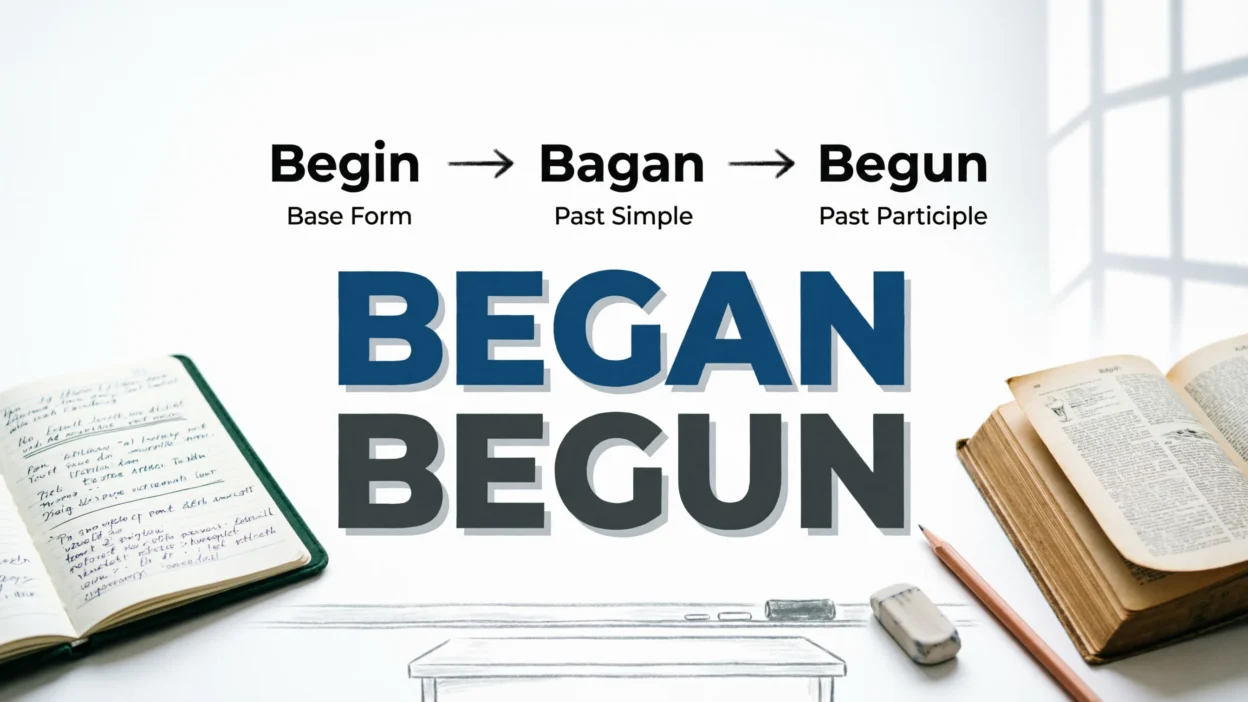
Began is the simple past tense of the verb begin.
Begun is the past participle of begin and must usually be used with helping verbs such as has, have, had, is, was, were, or been.
Correct Examples:
- She began her presentation at 9 a.m.
- The meeting has begun.
- They began working yesterday.
- The project had already begun before we arrived.
Easy Rule:
If there is no helping verb, use began. If there is a helping verb, use begun.
What Do Began and Begun Mean?
Both began and begun come from the base verb begin, which means:
- To start something
- To commence an action
- To initiate a process
- To set something in motion
Although they share the same meaning, they serve different grammatical functions.
Meaning of Began
Began is the simple past form of begin.
It describes an action that started and happened in the past.
Examples:
- I began learning English last year.
- The concert began on time.
- They began building the house in June.
- She began reading the book yesterday.
Meaning of Begun
Begun is the past participle form of begin.
It is typically used with helping verbs to form perfect and passive constructions.
Examples:
- The movie has begun.
- The construction had begun before winter arrived.
- The ceremony has already begun.
- A new chapter has begun in her life.
Began vs Begun: Key Difference
The biggest difference lies in grammar.
| Word | Verb Form | Usage | Example |
|---|---|---|---|
| Began | Simple Past Tense | Describes a completed action in the past | We began the journey early. |
| Begun | Past Participle | Used with helping verbs | The journey has begun. |
Think of it this way:
- Begin → Began → Begun
- Present → Past → Past Participle
When Should You Use Began?
Use began when talking about something that started in the past without a helping verb.
Examples of Began
- The teacher began the lesson.
- We began our vacation on Monday.
- He began exercising regularly.
- The rain began suddenly.
Sentence Pattern
Subject + Began + Object
Examples:
- Sarah began her new job.
- The company began operations in 2015.
- I began studying before sunrise.
When Should You Use Begun?
Use begun when a helping verb appears before it.
Common helping verbs include:
- Has
- Have
- Had
- Was
- Were
- Is
- Been
Examples of Begun
- The game has begun.
- Our preparations had begun weeks earlier.
- A transformation has begun.
- The negotiations have begun.
Sentence Pattern
Subject + Helping Verb + Begun
Examples:
- She has begun writing her novel.
- The project had begun before funding arrived.
- They have begun making improvements.
Common Mistakes with Began and Begun
Many writers accidentally use begun without a helping verb or use began where a participle is needed.
Incorrect vs Correct Usage
❌ The meeting begun at noon.
✅ The meeting began at noon.
❌ She has began her assignment.
✅ She has begun her assignment.
❌ The ceremony had began already.
✅ The ceremony had begun already.
❌ We have began preparations.
✅ We have begun preparations.
Remember:
- No helping verb = began
- Helping verb present = begun
Easy Trick to Remember the Difference
A simple memory trick can help.
Use Began Alone
If the sentence works without words like has, have, or had, use began.
Example:
- The class began at 8 a.m.
Use Begun with a Helper
If a helping verb appears before the word, use begun.
Example:
- The class has begun.
Think of begun as needing a grammatical partner.
Real-Life Examples of Began and Begun
In Business
- The startup began operations in January.
- The expansion has begun across several cities.
In Education
- Students began their exams this morning.
- The admissions process has begun.
In Daily Life
- I began cooking dinner at six.
- Spring has begun in many regions.
In Literature
- The story began with a mystery.
- A new adventure had begun for the hero.
American vs British English
When it comes to began and begun, there is essentially no difference between American English and British English.
Both varieties follow the same grammatical rules:
- American English: The show began at seven.
- British English: The show began at seven.
- American English: The show has begun.
- British English: The show has begun.
Unlike some verbs that differ between regions, begin, began, and begun remain consistent in both forms of English.
Synonyms for Begin
Depending on context, you can use related words such as:
- Start
- Commence
- Initiate
- Launch
- Open
- Introduce
- Kick off
- Set in motion
- Embark on
- Undertake
Examples:
- The event commenced at noon.
- They launched a new campaign.
- We started the project yesterday.
Why People Confuse Began and Begun
Several factors contribute to confusion:
- Both words come from the same root verb.
- They look and sound similar.
- English irregular verbs can be challenging.
- Past tense and past participles often get mixed up.
Other examples of similar patterns include:
| Base Verb | Past Tense | Past Participle |
|---|---|---|
| Begin | Began | Begun |
| Drink | Drank | Drunk |
| Ring | Rang | Rung |
| Sing | Sang | Sung |
| Swim | Swam | Swum |
Recognizing these patterns makes English grammar easier to master.
FAQs About Began or Begun
Is it “has began” or “has begun”?
The correct phrase is has begun.
✅ The program has begun.
❌ The program has began.
Can I use begun without a helping verb?
No.
Begun generally requires a helping verb.
✅ The meeting has begun.
❌ The meeting begun.
Is began past tense?
Yes.
Began is the simple past tense form of begin.
What is the past participle of begin?
The past participle of begin is begun.
Which is correct: “The event began” or “The event begun”?
The event began is correct.
Is there a difference in British and American English?
No. Both use began and begun in the same way.
How can I quickly remember the rule?
Use began by itself and begun with a helping verb.
Why is “had begun” correct?
Because begun is the past participle required after the helping verb had.
Summary
The difference between began and begun is simpler than it first appears. Began is the simple past tense of begin, while begun is the past participle. The key distinction is that begun usually requires a helping verb such as has, have, or had.
Mastering this rule can make your writing clearer, more professional, and grammatically accurate. Whenever you’re unsure, check whether a helping verb is present. If it is, choose begun. If not, began is almost certainly the correct choice.
Actionable Takeaway
Before using either word, ask yourself one quick question: Is there a helping verb in the sentence?
If yes, use begun. If no, use began. Practicing this simple rule with everyday sentences will help you use both words confidently and correctly every time.