If you’ve ever written “stoped” and wondered whether it should actually be “stopped,” you’re not alone. English spelling rules can sometimes feel confusing, especially when verbs change forms. One small extra letter can completely change whether a word is correct or incorrect.
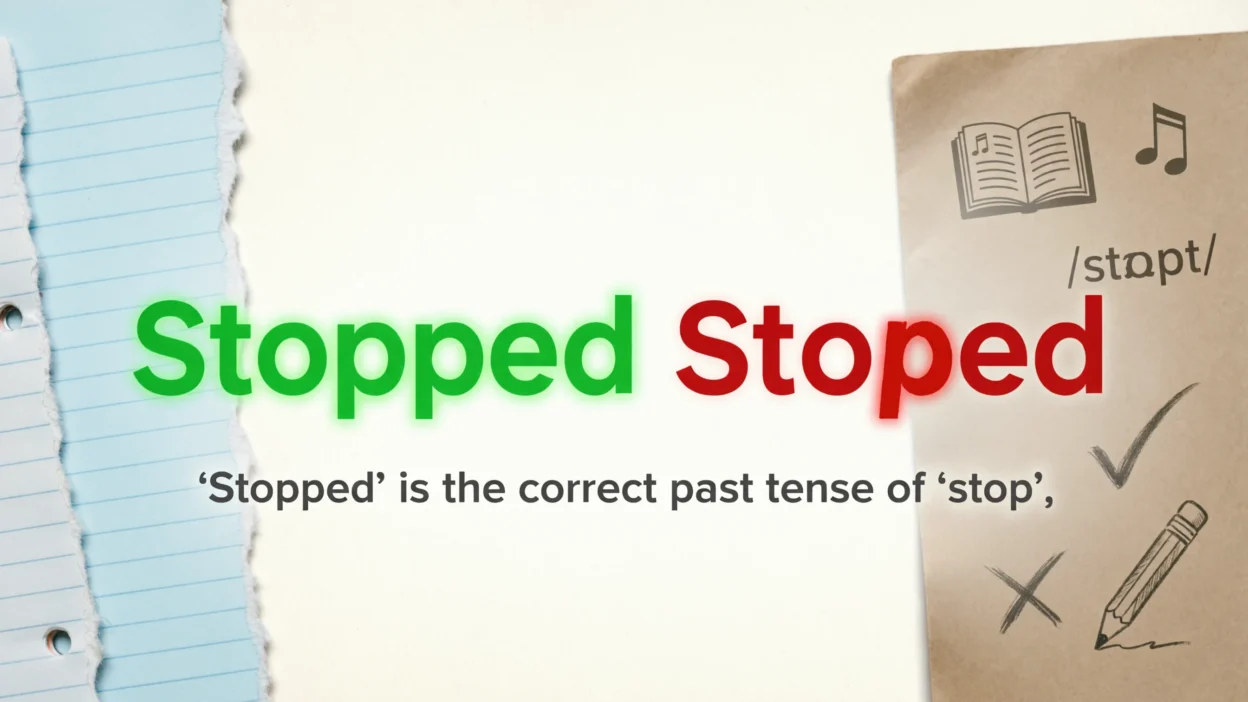
The good news is simple: “stopped” is correct, while “stoped” is incorrect in standard English. In this guide, you’ll learn why the spelling changes, the grammar rule behind it, examples of correct usage, common mistakes, and easy tricks to remember the right form every time.
Quick Answer
- ✅ Stopped = Correct spelling
- ❌ Stoped = Incorrect spelling
The verb “stop” doubles the final consonant before adding -ed because it follows a common English spelling rule.
Correct:
- The car stopped suddenly.
Incorrect:
- The car stoped suddenly.
Why “Stopped” Is Correct
The word stop is a short verb with:
- One syllable
- A short vowel sound
- A consonant-vowel-consonant (CVC) pattern
When a verb follows this pattern, English usually doubles the final consonant before adding -ed or -ing.
The Rule
For many one-syllable verbs:
- Stop → Stopped
- Plan → Planned
- Shop → Shopped
- Drop → Dropped
This rule helps preserve the short vowel sound.
What Does “Stopped” Mean?
“Stopped” is the past tense and past participle of the verb stop.
It means:
- To cease movement
- To end an action
- To prevent something from continuing
Examples of “Stopped”
- The bus stopped near the station.
- She stopped talking after the announcement.
- Rain stopped the game.
Why “Stoped” Is Wrong
“Stoped” breaks the standard English spelling rule for short verbs ending in a consonant-vowel-consonant pattern.
Native speakers and grammar tools recognize “stoped” as a spelling mistake.
Stopped vs Stoped Comparison Table
| Word | Correct? | Meaning |
|---|---|---|
| Stopped | ✅ Yes | Past tense of “stop” |
| Stoped | ❌ No | Incorrect spelling |
Understanding the Double Consonant Rule
The doubling rule is common in English grammar.
Double the Final Letter
You usually double the final consonant when:
- The word has one syllable
- It ends in consonant-vowel-consonant
- The stress falls on the final syllable
Examples
| Base Verb | Past Tense |
|---|---|
| Stop | Stopped |
| Clap | Clapped |
| Grab | Grabbed |
| Slip | Slipped |
Words That Do NOT Double the Final Letter
Not every verb doubles its final consonant.
Examples
| Base Verb | Past Tense |
|---|---|
| Clean | Cleaned |
| Rain | Rained |
| Jump | Jumped |
These words do not follow the consonant-vowel-consonant pattern in the same way.
“Stopped” in Everyday Sentences
Here are practical examples showing correct usage.
Action Examples
- He stopped the car at the red light.
- They stopped working after midnight.
- The teacher stopped the discussion.
Emotional or Figurative Usage
- She stopped worrying about the results.
- Nothing stopped him from achieving success.
Common Mistakes People Make
1. Writing “Stoped”
Incorrect:
- She stoped laughing.
Correct:
- She stopped laughing.
2. Forgetting the Double Letter Rule
Many learners forget to double the final consonant before adding “-ed.”
3. Mixing British and American Rules
In this case, both American and British English use “stopped.”
There is no regional spelling difference.
Stopped vs Stopping
The same doubling rule applies when adding -ing.
| Base Verb | -ing Form |
|---|---|
| Stop | Stopping |
Correct:
- The train is stopping soon.
Incorrect:
- The train is stoping soon.
Easy Trick to Remember
Here’s a simple memory trick:
“Stop” is short, so it needs an extra “p” before adding endings.
- Stop → Stopped
- Stop → Stopping
If you hear a strong short vowel sound, there’s often a doubled consonant afterward.
Frequently Asked Questions
Is “stoped” ever correct?
No. “Stoped” is considered incorrect in modern English.
Why does “stopped” have two Ps?
Because “stop” follows the consonant-vowel-consonant spelling rule, which doubles the final consonant before adding “-ed.”
Is “stopped” American or British English?
Both American and British English use “stopped.”
What is the present tense of “stopped”?
The present tense is “stop.”
Example:
- Please stop talking.
What is the continuous form?
The continuous form is “stopping.”
Example:
- They are stopping for lunch.
Do all verbs double the final letter?
No. Only certain verbs follow this spelling pattern.
Is “stopped” a regular verb?
Yes. “Stop” is a regular verb because it forms the past tense with “-ed.”
Final Thoughts
The correct spelling is always “stopped,” never “stoped.” The extra “p” follows a standard English grammar rule used with many short verbs. Although it may seem like a tiny detail, using the correct spelling improves clarity, professionalism, and confidence in your writing.
Understanding patterns like consonant doubling can also help you spell many other English verbs correctly. Once you learn the rule, words like “planned,” “grabbed,” and “slipped” become much easier to remember.
Actionable Takeaway
When a short one-syllable verb ends in consonant-vowel-consonant form, double the final consonant before adding “-ed” or “-ing.”
- Stop → Stopped
- Stop → Stopping