Many English learners and even native speakers confuse “lose” and “loose.” Although they look similar, they have completely different meanings and pronunciations. Understanding the difference can instantly improve your writing and help you avoid one of the most common grammar mistakes online.
In this guide, you’ll learn when to use win or lose, why people mistakenly write “loose,” examples of correct usage, memory tricks, and common errors to avoid.
Quick Answer
- Win = to succeed or achieve victory
- Lose = to fail to win or to misplace something
- Loose = not tight
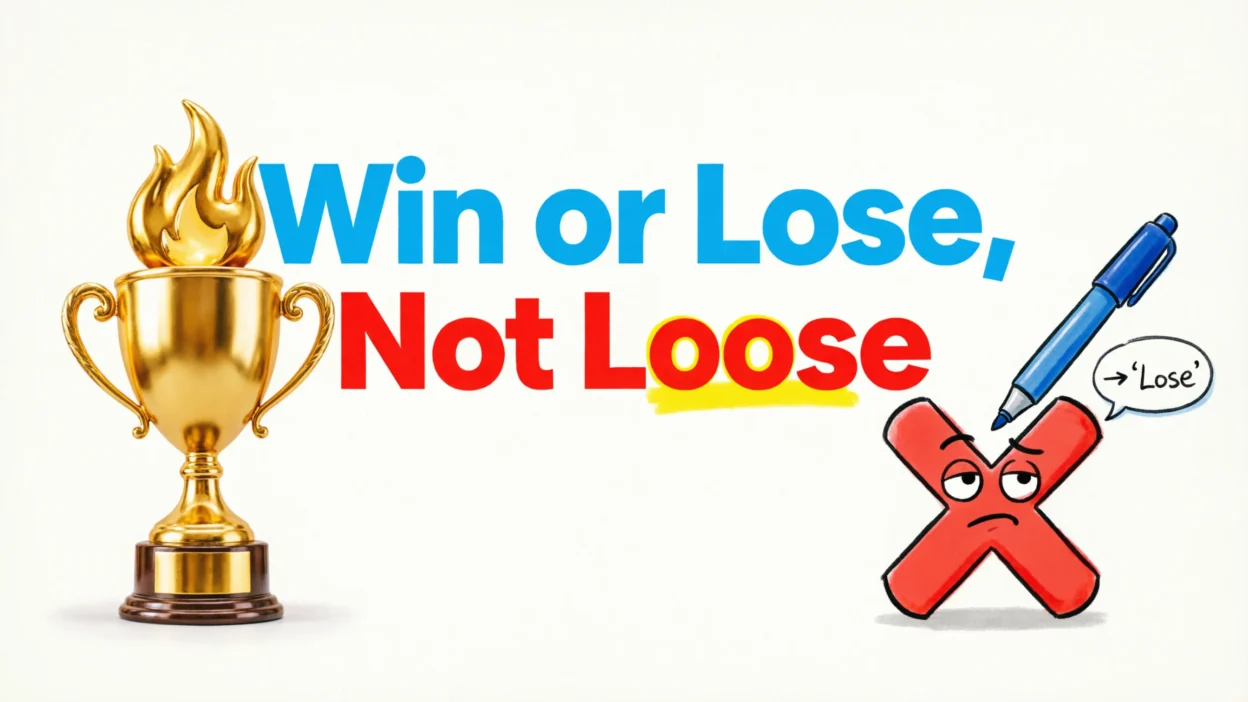
If you mean the opposite of win, the correct word is always lose, not “loose.”
Correct:
- You win or lose.
Incorrect:
- You win or loose.
What Does “Win” Mean?
The word win means to achieve victory, succeed, or gain something positive.
Examples of “Win”
- Our team hopes to win the match.
- She worked hard to win the competition.
- I want to win first place.
Common Uses of “Win”
- Win a game
- Win an award
- Win a race
- Win someone’s trust
What Does “Lose” Mean?
The word lose means:
- To fail to win
- To misplace something
- To no longer have something
Examples of “Lose”
- Nobody likes to lose a game.
- I always lose my keys.
- They may lose the contract.
“Lose” Is the Opposite of “Win”
| Word | Meaning |
|---|---|
| Win | Achieve victory |
| Lose | Fail to achieve victory |
Example:
- You either win or lose.
What Does “Loose” Mean?
The word loose is an adjective that describes something not tight, free, or unattached.
Examples of “Loose”
- My shirt feels loose.
- The dog got loose from the yard.
- Tighten the loose screw.
Why People Confuse “Lose” and “Loose”
The confusion happens because:
- The words look very similar
- “Lose” has an unexpected pronunciation
- Typing errors are common online
Pronunciation Difference
| Word | Pronunciation |
|---|---|
| Lose | “Looz” |
| Loose | “Loോസ്” |
Even though “lose” has one “o,” it sounds like “looz.”
Common Mistakes
Incorrect:
- If we play badly, we will loose.
- Nobody wants to loose a tournament.
Correct:
- If we play badly, we will lose.
- Nobody wants to lose a tournament.
Easy Trick to Remember
Here’s a simple memory trick:
- Lose = losing has lost an “o”
- Loose = has an extra “o” because it’s loose and relaxed
This small trick helps many learners remember the correct spelling quickly.
Win vs Lose Comparison Table
| Word | Part of Speech | Meaning | Example |
|---|---|---|---|
| Win | Verb | Achieve victory | We want to win. |
| Lose | Verb | Fail to win | Nobody likes to lose. |
| Loose | Adjective | Not tight | The shoe feels loose. |
Examples in Everyday Sentences
Win
- They can still win the championship.
- Hard work helps people win success.
Lose
- Be careful not to lose your phone.
- You learn something even when you lose.
Loose
- The handle is loose.
- She wore a loose jacket.
American vs British English
Unlike words such as “color/colour” or “molding/moulding,” lose and loose are spelled the same in both American and British English.
There is no regional spelling difference here.
Why Using the Correct Word Matters
Using “loose” instead of “lose” can:
- Make writing look unprofessional
- Confuse readers
- Hurt credibility in emails, blogs, or social media posts
Correct grammar improves clarity and trust.
Frequently Asked Questions
Is it “win or lose” or “win or loose”?
The correct phrase is “win or lose.”
What does “lose” mean?
“Lose” means to fail to win or to misplace something.
What does “loose” mean?
“Loose” means not tight or free.
Why do people type “loose” instead of “lose”?
Mostly because the words look similar and are commonly mistyped online.
Is “loose” ever correct?
Yes, but only when describing something not tight.
Example:
- My shoelaces are loose.
How do you remember the difference?
“Lose” lost an “o,” while “loose” has an extra “o” because it’s relaxed or loose.
Final Thoughts
The correct phrase is always “win or lose.” The word lose is the opposite of win, while loose describes something not tight. Although the words are commonly confused, remembering their meanings and pronunciation makes the difference much easier.
Whether you’re writing an email, school assignment, social media caption, or professional article, using the correct spelling helps your communication look polished and accurate.
Actionable Takeaway
Before using “loose,” ask yourself:
“Am I talking about something not tight?”
If not, you probably mean lose.