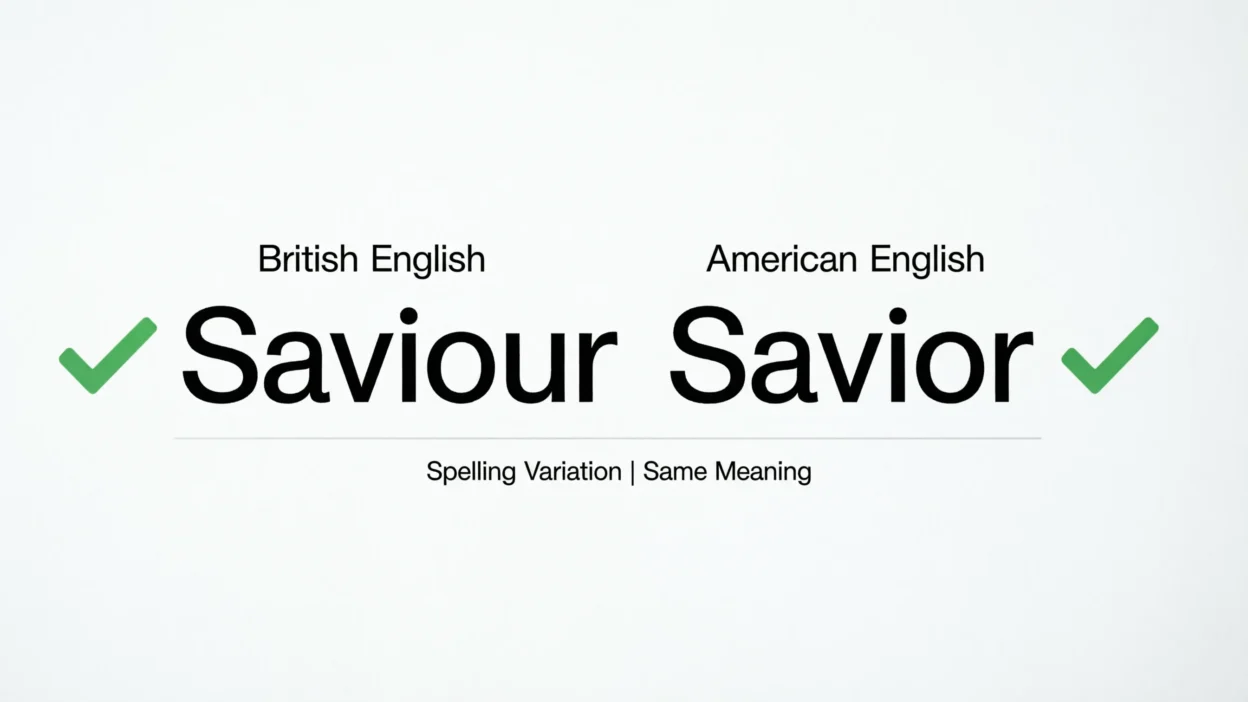
If you’ve seen both saviour and savior in books, articles, or online content, you may wonder whether one spelling is correct and the other is wrong. The answer is surprisingly simple: both spellings are correct, but they belong to different varieties of English.
Understanding the difference between saviour or savior can help you write more confidently and maintain consistency in your work. Whether you’re writing academic content, religious articles, professional documents, or everyday communication, knowing when to use each spelling matters.
Quick Answer
✅ Saviour – Preferred in British English
✅ Savior – Preferred in American English
Both spellings are correct and have the same meaning.
Meaning: A person who saves, rescues, helps, or delivers someone from danger, difficulty, or harm.
Example (British English): The firefighter became the town’s saviour.
Example (American English): The firefighter became the town’s savior.
The only difference is regional spelling.
What Do “Saviour” and “Savior” Mean?
Both saviour and savior are nouns that refer to someone who rescues, protects, helps, or saves another person from danger, hardship, or trouble.
The term is often used in religious, historical, literary, and everyday contexts.
Simple Definition
Saviour/Savior = A person who saves, rescues, or delivers others from harm or difficulty.
Examples
- The doctor was considered a saviour after the successful surgery.
- The lifeguard became the savior of the drowning swimmer.
- Many people view technology as a saviour for modern challenges.
- The rescue team acted as the town’s savior during the flood.
- In Christianity, Jesus is often referred to as the Saviour or Savior.
Regardless of spelling, the meaning remains exactly the same.
Why Are There Two Spellings?
The difference comes from the spelling conventions of British and American English.
British English often retains spellings influenced by older French and Latin forms, while American English tends to simplify certain words.
British English Pattern
British English commonly uses:
- Saviour
- Behaviour
- Favourite
- Colour
- Honour
American English Pattern
American English commonly uses:
- Savior
- Behavior
- Favorite
- Color
- Honor
This spelling difference is part of a broader pattern found throughout the English language.
Saviour vs Savior: Comparison Table
| Feature | Saviour | Savior |
|---|---|---|
| Correct Spelling | ✅ Yes | ✅ Yes |
| British English | ✅ Preferred | Less Common |
| American English | Less Common | ✅ Preferred |
| Meaning | Same | Same |
| Pronunciation | Same | Same |
| Formal Writing Accepted | ✅ Yes | ✅ Yes |
The table shows that both forms are valid, with the choice depending on your audience.
How to Remember Which Spelling to Use
A simple rule makes this easy.
If Writing for a British Audience
Use:
✅ Saviour
If Writing for an American Audience
Use:
✅ Savior
Easy Memory Trick
Think about these familiar spelling pairs:
| British English | American English |
|---|---|
| Favourite | Favorite |
| Behaviour | Behavior |
| Honour | Honor |
| Saviour | Savior |
If the British version uses “our”, the American version often removes the “u.”
This pattern helps you remember the correct regional spelling.
Examples of Saviour and Savior in Everyday Sentences
Rescue Situations
- The pilot was hailed as a saviour after the emergency landing.
- The pilot was hailed as a savior after the emergency landing.
Healthcare Context
- The new treatment became a saviour for many patients.
- The new treatment became a savior for many patients.
Personal Life
- Her advice was a saviour during a difficult period.
- Her advice was a savior during a difficult period.
Religious Context
- Christians believe Jesus is their Saviour.
- Christians believe Jesus is their Savior.
Both spellings communicate the same idea.
Grammar Rules and Usage
Both saviour and savior are nouns.
Singular Form
- He became the saviour of the village.
- He became the savior of the village.
Plural Form
- The firefighters were the saviours of many families.
- The firefighters were the saviors of many families.
Possessive Form
- The saviour’s bravery inspired everyone.
- The savior’s bravery inspired everyone.
The grammatical function remains unchanged regardless of spelling.
Common Mistakes
Mistake 1: Thinking One Spelling Is Wrong
❌ Savior is incorrect.
✅ Savior and saviour are both correct.
Mistake 2: Mixing Regional Styles
❌ The town’s saviour became everyone’s favorite hero.
✅ The town’s saviour became everyone’s favourite hero. (British)
✅ The town’s savior became everyone’s favorite hero. (American)
Mistake 3: Changing Spelling Mid-Article
❌ The saviour rescued them. Later, the savior was celebrated.
✅ Choose one spelling style and use it consistently.
Mistake 4: Assuming Different Meanings
❌ Saviour and savior mean different things.
✅ Both words have the same meaning.
Synonyms and Related Words
Depending on the context, you may use:
- Rescuer
- Hero
- Protector
- Deliverer
- Guardian
- Champion
- Defender
- Benefactor
- Liberator
- Helper
Examples
- The rescuer arrived just in time.
- The hero saved countless lives.
- The protector defended the community.
These alternatives can enrich your writing while maintaining a similar meaning.
American vs British English
This is one of the most recognizable spelling differences between the two major English standards.
British English
✅ Saviour
Examples:
- He became the nation’s saviour.
- The community viewed her as a saviour.
American English
✅ Savior
Examples:
- He became the nation’s savior.
- The community viewed her as a savior.
Both spellings are accepted worldwide, but matching your audience’s expectations improves readability.
Why Correct Spelling Matters
Using the correct regional spelling helps create consistency and professionalism.
Benefits include:
- Better readability
- Stronger credibility
- Improved user experience
- Consistent brand voice
- Higher editorial quality
Readers often expect content to follow one language standard. Mixing British and American spellings can make writing appear inconsistent.
Frequently Asked Questions (FAQs)
Is saviour correct?
Yes. Saviour is the preferred spelling in British English.
Is savior correct?
Yes. Savior is the preferred spelling in American English.
Which spelling should I use?
Use the version that matches your target audience and writing style.
Do saviour and savior mean the same thing?
Yes. They have identical meanings.
Why does British English use saviour?
British English typically retains the “our” spelling pattern found in many traditional words.
Why does American English use savior?
American English often simplifies spellings by removing the “u.”
Can I use both spellings in one article?
It’s best to choose one style and remain consistent throughout the content.
Which spelling is more common globally?
Both are widely used, but saviour is more common in countries that follow British English conventions.
Summary
When comparing saviour or savior, both spellings are correct. The difference lies in regional language preferences rather than meaning or grammar. Saviour is the preferred spelling in British English, while savior is the preferred spelling in American English.
To write professionally and consistently, choose the spelling that matches your audience. If you’re writing for readers in the United Kingdom, Australia, New Zealand, or many Commonwealth countries, use saviour. For readers in the United States, use savior. The meaning remains exactly the same either way.
Actionable Takeaway
Before publishing your content, decide whether you’re using British or American English and stick to that style throughout. Remember: British English prefers saviour, while American English prefers savior.
Featured Image Prompt:
Create a professional English grammar typography design featuring the words “Saviour” and “Savior” side by side. Highlight both with green checkmarks and labels showing “British English” and “American English.” Clean white background, educational language-learning theme, dictionary-style layout, modern typography, SEO blog featured image, high resolution.