Have you ever paused while writing and wondered whether to use quiet or quite? You’re not alone. These two words look very similar, but they have completely different meanings. Because they differ by just one letter, many English learners and native speakers accidentally mix them up.
Understanding the difference between quiet or quite can instantly improve your writing, speaking, and overall confidence in English. In this guide, you’ll learn their meanings, see real-world examples, discover common mistakes, and find easy tricks to remember which word to use every time.
Quick Answer
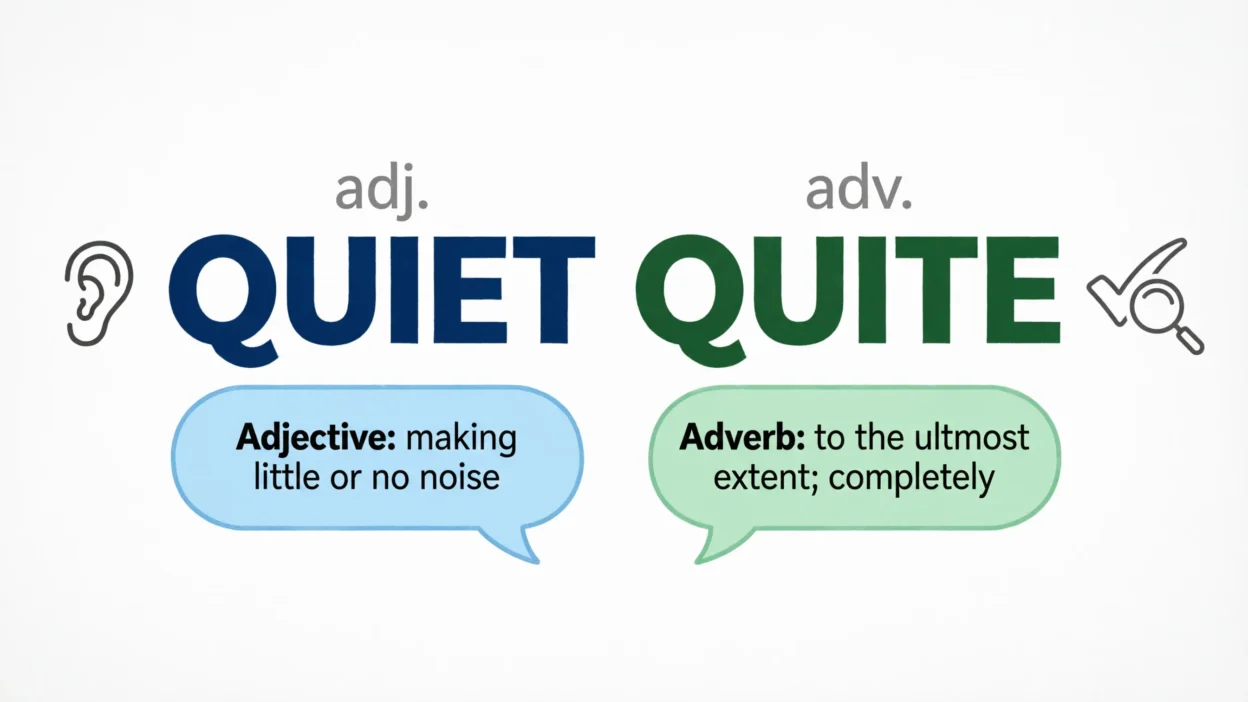
Quiet means calm, silent, or making little noise.
Quite means fairly, completely, or to a certain degree.
Examples:
- The library is quiet today.
- The movie was quite interesting.
A simple memory tip:
- Quiet = relates to silence.
- Quite = relates to degree or intensity.
What Does “Quiet” Mean?
The word quiet is an adjective that describes something with little or no noise. It can also describe a peaceful atmosphere, a calm person, or a situation without disturbance.
Definition of Quiet
Quiet means:
- Silent or nearly silent
- Peaceful and calm
- Not speaking much
- Free from noise or activity
Examples of Quiet
- Please be quiet during the meeting.
- The neighborhood is very quiet at night.
- She prefers a quiet place to study.
- The baby remained surprisingly quiet throughout the flight.
- We enjoyed a quiet evening at home.
Synonyms of Quiet
- Silent
- Calm
- Peaceful
- Still
- Tranquil
- Soundless
- Serene
Quiet in Everyday English
People commonly use quiet when talking about:
- Libraries
- Bedrooms
- Offices
- Neighborhoods
- Personal behavior
For example:
“Could everyone stay quiet while the presentation begins?”
What Does “Quite” Mean?
The word quite is an adverb. It modifies adjectives, adverbs, or verbs to show degree, extent, or emphasis.
Definition of Quite
Quite can mean:
- Fairly
- Rather
- Completely
- Very
- To a considerable degree
The exact meaning often depends on context.
Examples of Quite
- The test was quite difficult.
- She is quite talented.
- I am quite sure about the answer.
- The restaurant was quite busy.
- That book was quite enjoyable.
Synonyms of Quite
- Fairly
- Rather
- Pretty
- Somewhat
- Completely
- Very
- Considerably
Quite in Everyday English
You’ll often hear quite before adjectives:
- Quite happy
- Quite expensive
- Quite interesting
- Quite good
- Quite amazing
For example:
“The new phone is quite impressive.”
Quiet vs Quite: Key Differences
Although they look similar, their functions in a sentence are completely different.
| Feature | Quiet | Quite |
|---|---|---|
| Part of Speech | Adjective | Adverb |
| Meaning | Silent or calm | Fairly, rather, completely |
| Describes | Nouns | Adjectives, verbs, adverbs |
| Related To | Noise or peace | Degree or intensity |
| Example | The room is quiet. | The room is quite large. |
Simple Comparison
Quiet:
- The classroom became quiet.
Quite:
- The classroom became quite crowded.
In the first sentence, the word describes silence.
In the second sentence, the word increases the strength of the adjective “crowded.”
Common Mistakes People Make
Because the words are nearly identical in spelling, many writers accidentally substitute one for the other.
Mistake #1: Using Quiet Instead of Quite
Incorrect:
- The food was quiet delicious.
Correct:
- The food was quite delicious.
Why?
The sentence needs an adverb to modify “delicious.”
Mistake #2: Using Quite Instead of Quiet
Incorrect:
- Please stay quite during the ceremony.
Correct:
- Please stay quiet during the ceremony.
Why?
The sentence refers to silence, not degree.
Mistake #3: Typing Errors
Many people simply mistype the words because they are visually similar.
Incorrect:
- The office is very quite.
Correct:
- The office is very quiet.
Easy Trick to Remember the Difference
A quick memory trick can help you avoid confusion.
Remember Quiet
The word quiet contains the word “quiet place” in its meaning.
Think:
Quiet = Silence
Example:
- Quiet room
- Quiet street
- Quiet voice
Remember Quite
The word quite is often used before another descriptive word.
Think:
Quite = Degree
Example:
- Quite happy
- Quite large
- Quite beautiful
If you’re talking about how much, use quite.
If you’re talking about noise or calmness, use quiet.
American vs British English Usage
Both American English and British English use quiet in the same way.
However, quite can sometimes have slightly different levels of emphasis.
In British English
Quite may mean:
- Fairly
- Moderately
Example:
“The movie was quite good.”
This can sometimes imply “reasonably good” rather than excellent.
In American English
Quite often sounds stronger and may suggest:
- Very
- Extremely
Example:
“The movie was quite good.”
Many American speakers interpret this as strong praise.
Despite these subtle differences, the basic meaning remains the same in both varieties of English.
Examples of Quiet and Quite in Sentences
Quiet Examples
- The forest was quiet after sunset.
- He spoke in a quiet voice.
- We found a quiet corner in the café.
- The children became quiet after the story.
- It was a quiet weekend.
Quite Examples
- She is quite intelligent.
- The weather is quite pleasant today.
- That was quite a surprise.
- I am quite certain about my decision.
- The project is quite challenging.
When to Use Quiet
Use quiet when talking about:
- Silence
- Peacefulness
- Calm environments
- Low noise levels
- Reserved personalities
Examples:
- A quiet neighborhood
- A quiet child
- A quiet office
- A quiet conversation
When to Use Quite
Use quite when expressing:
- Degree
- Intensity
- Emphasis
- Extent
Examples:
- Quite difficult
- Quite easy
- Quite expensive
- Quite impressive
Why Understanding Quiet or Quite Matters
Using the wrong word can make your writing appear careless and may confuse readers. Whether you’re writing emails, academic papers, blog posts, business documents, or social media captions, choosing the correct word improves clarity and professionalism.
Learning commonly confused English words such as quiet and quite, their and there, and affect and effect can significantly strengthen your communication skills.
Frequently Asked Questions (FAQs)
1. What is the difference between quiet and quite?
Quiet means silent or calm, while quite means fairly, rather, or completely.
2. Is quiet an adjective?
Yes. Quiet is primarily an adjective used to describe people, places, or situations.
Example:
“The room is quiet.”
3. Is quite an adverb?
Yes. Quite is an adverb that modifies adjectives, verbs, or other adverbs.
Example:
“The room is quite spacious.”
4. Which is correct: quite good or quiet good?
Quite good is correct.
“Good” is an adjective that needs the adverb “quite.”
5. Which is correct: stay quiet or stay quite?
Stay quiet is correct because it refers to remaining silent.
6. Why do people confuse quiet and quite?
They look similar in spelling and are frequently used in everyday English, making typing and spelling mistakes common.
7. Can quite mean very?
Yes. In many contexts, especially in American English, quite can mean “very” or “extremely.”
8. Are quiet and quite pronounced differently?
Yes.
- Quiet: KWHY-uht
- Quite: KWHYT
Their pronunciation is noticeably different when spoken clearly.
Summary
The difference between quiet or quite is simple once you understand their roles in a sentence. Quiet refers to silence, calmness, and the absence of noise. It is an adjective used to describe people, places, and situations. Quite, on the other hand, is an adverb that expresses degree, intensity, or emphasis and is commonly used before adjectives and adverbs.
Whenever you’re unsure, remember this easy rule: if you’re talking about peace, silence, or low noise, choose quiet. If you’re describing how much, how strongly, or to what extent something is true, choose quite. Mastering this small distinction can make your English writing clearer, more accurate, and more professional.
Actionable Takeaway
Before using quiet or quite, ask yourself one question: Am I talking about silence or degree? If it’s silence, use quiet. If it’s degree or emphasis, use quite. This simple habit will help you avoid one of the most common English word mistakes.