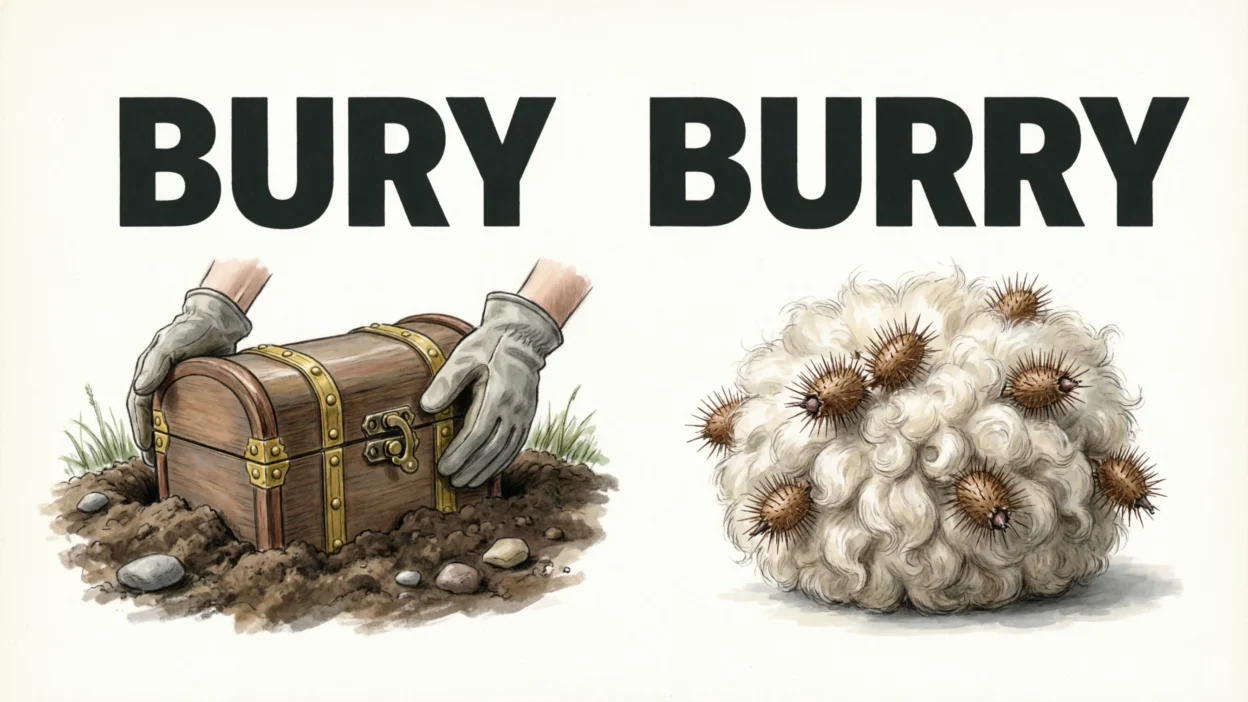
Have you ever paused while writing and wondered whether the correct word is burry or bury? You’re not alone. These two words look very similar, but only one is commonly accepted in standard English for most situations.
Understanding the difference between burry and bury can help you avoid embarrassing spelling mistakes and improve your writing confidence. In this guide, you’ll learn the meaning of each word, when to use them, common errors to avoid, practical examples, and much more.
Quick Answer
Bury is the correct and commonly used English word that means to place something underground, hide something, or cover it completely.
Burry is a real word, but it is rare and has a specialized meaning related to something containing burrs or rough seed coverings. In everyday writing, most people mean bury, not burry.
Example:
✅ I will bury the time capsule in the backyard.
❌ I will burry the time capsule in the backyard.
What Does Bury Mean?
The word bury is a verb with several common meanings.
Main Meanings of Bury
- To place something in the ground
- To place a deceased person in a grave
- To hide something from view
- To cover completely
- To suppress feelings, memories, or information
Examples of Bury
- They decided to bury the treasure near the old tree.
- The family gathered to bury their loved one.
- Don’t bury your emotions; talk about them.
- The snow will bury the roads overnight.
- She tried to bury the painful memories.
Because of its many uses, bury is a frequently used word in both spoken and written English.
What Does Burry Mean?
The word burry is an adjective, but it is rarely used outside specialized contexts.
Meaning of Burry
Burry describes something that:
- Has burrs attached to it
- Contains rough, prickly seed pods
- Appears covered with burr-like structures
Examples of Burry
- The sheep’s wool became burry after walking through the field.
- Farmers removed the burry material from the harvested wool.
- The plant produced a burry seed head.
Unless you’re discussing agriculture, botany, textiles, or farming, you probably won’t need to use burry.
Burry vs Bury: Key Differences
| Feature | Bury | Burry |
|---|---|---|
| Part of Speech | Verb | Adjective |
| Common Usage | Very common | Rare |
| Main Meaning | Put underground, hide, cover | Covered with burrs |
| Everyday Writing | Yes | Usually no |
| Example | Bury the treasure | Burry wool |
The biggest reason people confuse these words is spelling. In most cases, when someone writes burry, they actually mean bury.
Why Do People Confuse Burry and Bury?
Several factors contribute to this common spelling mistake.
Similar Pronunciation
Many English speakers pronounce the words similarly, especially in casual conversation.
Typing Errors
Adding an extra “r” is a common keyboard mistake.
Lack of Familiarity
Most people rarely encounter the word burry, so they may assume it is simply another spelling of bury.
Autocorrect Issues
Sometimes spell-check software doesn’t immediately flag the mistake if the word exists in the dictionary.
Common Mistakes with Bury
Here are some mistakes people frequently make.
Incorrect
❌ Please burry the documents.
Correct
✅ Please bury the documents.
Incorrect
❌ The dog likes to burry bones.
Correct
✅ The dog likes to bury bones.
Incorrect
❌ She wanted to burry her feelings.
Correct
✅ She wanted to bury her feelings.
Remember: whenever you mean “hide,” “cover,” or “place underground,” use bury.
How to Remember the Difference
A simple memory trick can help.
Think of the Letter U
The word bury contains the letter u.
You can associate it with:
U = Underground
Since bury often means putting something underground, this memory aid can make the correct spelling easier to remember.
Another Memory Tip
Bury = action
Burry = description
If you’re describing an action, you probably need bury.
If you’re describing something covered in burrs, you may need burry.
Examples of Bury in Everyday Sentences
Here are additional examples showing how frequently bury appears in normal English.
- Let’s bury the old argument and move forward.
- Archaeologists continue to bury sensitive artifacts for preservation.
- The avalanche threatened to bury nearby buildings.
- He chose to bury the secret for many years.
- Children love to bury their feet in the sand.
Notice how the meaning extends beyond simply putting something in the ground.
Examples of Burry in Specialized Contexts
Although uncommon, burry still has legitimate uses.
- The farmer examined the burry fleece.
- Workers separated clean wool from burry wool.
- The animal’s coat became burry after crossing the meadow.
These examples are mainly relevant to agriculture and textile industries.
American vs British English
When it comes to bury, there is no meaningful spelling difference between American and British English.
American English
✅ Bury
British English
✅ Bury
Both varieties use the same spelling and meaning.
The same applies to burry when used in its specialized sense.
Therefore, unlike words such as “color” and “colour,” there is no regional spelling variation here.
Related Words and Synonyms
Using related terms can improve writing variety and SEO relevance.
Synonyms for Bury
- Inter
- Entomb
- Conceal
- Hide
- Cover
- Plant
- Sink
- Suppress
- Mask
Related Phrases
- Bury the hatchet
- Bury a secret
- Bury treasure
- Bury emotions
- Bury evidence
- Deeply buried
- Buried underground
- Bury the past
These phrases frequently appear in everyday communication and literature.
When Should You Use Bury?
Use bury whenever you want to express:
- Putting something underground
- Conducting a funeral
- Hiding an object
- Covering something completely
- Suppressing emotions or information
Examples
- Bury a treasure chest
- Bury a pet
- Bury the evidence
- Bury your face in a pillow
- Bury your fears
For nearly all general writing situations, bury is the correct choice.
When Should You Use Burry?
Use burry only when discussing:
- Wool processing
- Agriculture
- Burr-covered materials
- Botanical descriptions
- Textile manufacturing
Outside these specialized fields, the word rarely appears.
Frequently Asked Questions
Is burry a real word?
Yes. Burry is a real English word, but it is uncommon and usually refers to something covered with burrs.
Which is correct, burry or bury?
In most situations, bury is the correct word.
Why do people spell bury as burry?
People often add an extra “r” because the words sound similar and the spelling can be confusing.
Is burry accepted in dictionaries?
Yes. Major dictionaries recognize burry as an adjective with a specialized meaning.
Can I use burry instead of bury?
No. They have different meanings and are not interchangeable.
How do you spell burying?
The correct spelling is burying, not burrying.
Is bury used in both American and British English?
Yes. Both American and British English use the spelling bury.
What is an example sentence using bury?
Example: “The pirates decided to bury their treasure on the island.”
Summary
The difference between burry and bury is simple once you understand their meanings. Bury is the common verb that means to place something underground, hide it, cover it, or suppress it. It appears regularly in everyday conversation, writing, literature, and professional communication.
Burry, on the other hand, is a rare adjective used mainly in agriculture, textiles, and botany to describe something covered with burrs. If you’re writing about treasure, emotions, graves, secrets, snow, or anything hidden underground, the correct word is almost always bury. Keeping this distinction in mind will help you write more clearly and confidently.
Actionable Takeaway
Whenever you’re unsure, ask yourself: “Do I mean hide, cover, or place underground?” If the answer is yes, choose bury. Reserve burry only for specialized situations involving burr-covered materials.
This simple rule will help you avoid one of the most common spelling mistakes related to these two words.