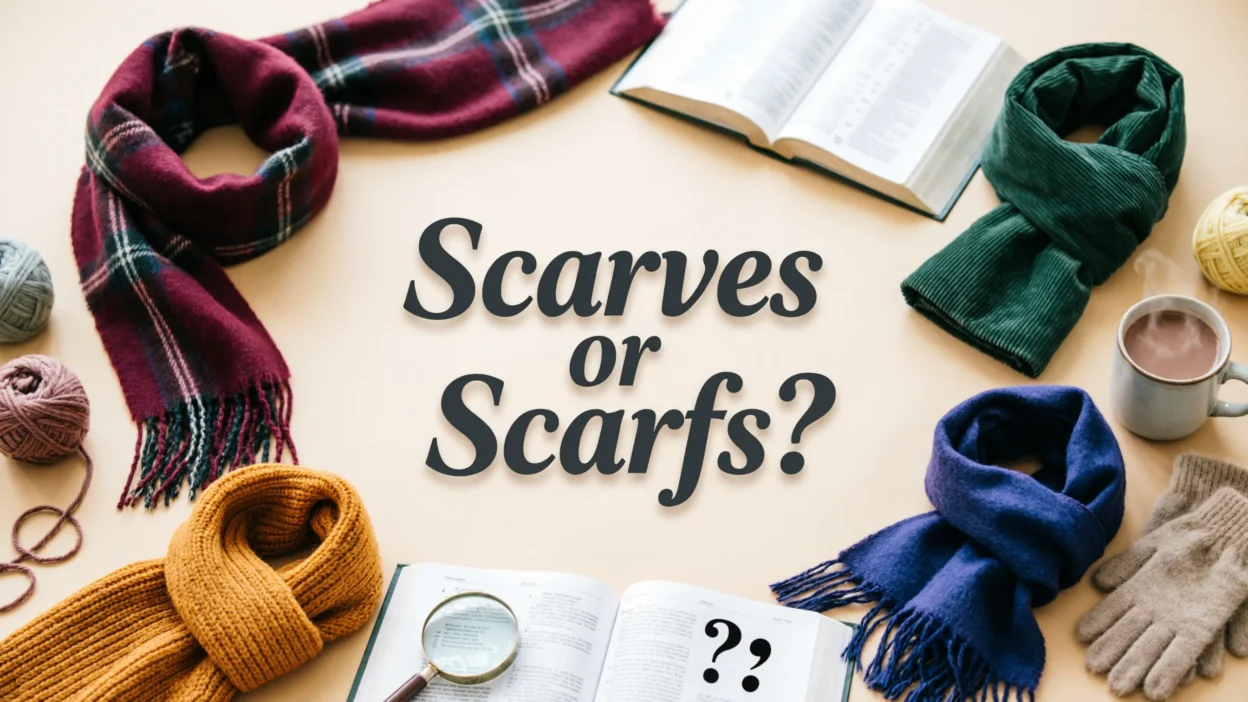
English can be wonderfully expressive, but it also comes with confusing plural forms that make even fluent speakers pause. One common example is the debate between “scarves” or “scarfs.” If you’ve ever wondered which spelling is correct, you are not alone.
The good news is that both words are technically accepted in English. However, one form is far more common in everyday writing and conversation.
In this guide, you’ll learn the meaning of the words, the correct plural usage, grammar rules, examples, common mistakes, and differences between American and British English. By the end, you’ll confidently know when to use “scarves” and when “scarfs” might still appear.
Quick Answer
The correct and most widely used plural of “scarf” is scarves.
- Singular: scarf
- Preferred plural: scarves
- Less common plural: scarfs
Both are grammatically accepted, but “scarves” is considered the standard form in modern English, especially in formal writing, education, publishing, and professional communication.
What Does “Scarf” Mean?
A scarf is a piece of fabric worn around the neck, shoulders, or head for warmth, fashion, religious purposes, or protection from weather.
Examples:
- She wore a red scarf during winter.
- His wool scarf matched his coat perfectly.
- The designer introduced silk scarves in the new collection.
The word can also have technical meanings in woodworking and engineering, but in everyday English, it usually refers to clothing accessories.
Scarves or Scarfs: Which Is Correct?
The plural form scarves is the preferred and more natural choice in modern English.
Example:
- Correct: I bought three beautiful scarves.
- Less common: I bought three beautiful scarfs.
The reason comes from traditional English grammar rules. Many nouns ending in -f or -fe change to -ves in plural form.
Examples:
- leaf → leaves
- knife → knives
- wolf → wolves
- scarf → scarves
However, English also allows some exceptions, and “scarfs” has survived as an alternative plural in dictionaries.
Why Do Some People Say “Scarfs”?
The form “scarfs” exists because English evolves through usage. Over time, some speakers simply added “s” instead of changing “f” to “ves.”
This pattern is common in modern English because adding “s” feels simpler and more regular.
For example:
- roofs instead of rooves
- beliefs instead of beliefs
- chiefs instead of chieves
Even though “scarfs” appears occasionally, especially in informal speech or regional usage, “scarves” remains the dominant and recommended form.
Comparison Table: Scarves vs Scarfs
| Feature | Scarves | Scarfs |
|---|---|---|
| Grammatically correct | Yes | Yes |
| Most commonly used | Yes | No |
| Preferred in formal writing | Yes | Rarely |
| Found in dictionaries | Yes | Yes |
| Sounds more natural to native speakers | Yes | Usually no |
| Recommended for students and professionals | Yes | No |
Examples of “Scarves” in Sentences
Using examples helps you remember the correct form naturally.
Everyday Examples
- The store sells handmade winter scarves.
- Colorful scarves were hanging by the entrance.
- She collects vintage silk scarves from different countries.
Fashion and Style Examples
- Chunky knit scarves are trending this season.
- Designers showcased elegant scarves on the runway.
- Wool scarves work well for cold climates.
Travel and Weather Examples
- Don’t forget your scarves when traveling to snowy regions.
- Tourists bought traditional scarves as souvenirs.
Examples of “Scarfs” in Sentences
While less common, “scarfs” still appears occasionally.
- The worker scarfs down lunch quickly.
- The sailors used scarfs in the technical manual.
Interestingly, “scarfs” is more frequently seen as a verb form rather than the plural noun.
For example:
- He scarfs down pizza after practice.
This difference creates additional confusion for learners.
Common Mistakes People Make
Using “scarfs” in formal writing
Although accepted, it can sound awkward or outdated in professional content.
Better:
- The boutique sells luxury scarves.
Forgetting irregular plural rules
Some learners automatically add “s” to every noun.
Incorrect:
- scarfs, wolfs, knifes
Correct:
- scarves, wolves, knives
Mixing singular and plural forms
Incorrect:
- She bought a beautiful scarves.
Correct:
- She bought beautiful scarves.
- She bought a beautiful scarf.
American vs British English Differences
Both American English and British English strongly prefer scarves over scarfs.
There is no major regional disagreement here. However:
- British English tends to preserve traditional irregular plurals more consistently.
- American English sometimes simplifies plurals over time.
Even so, “scarves” remains the standard in both versions of English.
Grammar Rule Behind “Scarves”
Many English nouns ending in -f change to -ves in plural form.
Examples include:
| Singular | Plural |
|---|---|
| calf | calves |
| elf | elves |
| knife | knives |
| loaf | loaves |
| scarf | scarves |
| shelf | shelves |
| wolf | wolves |
However, not all words follow this rule.
Examples:
- roof → roofs
- belief → beliefs
- chef → chefs
Unfortunately, English has many irregular plural nouns, so memorization and reading practice help.
Is “Scarves” More Popular in Modern English?
Yes. In books, blogs, news articles, online stores, fashion magazines, and academic writing, “scarves” appears far more frequently than “scarfs.”
Search engines, style guides, and dictionaries also prioritize “scarves” as the standard plural.
If you want your writing to sound polished and natural, always choose scarves unless you have a specific reason not to.
When Can You Use “Scarfs”?
You may still encounter “scarfs” in:
- older texts
- dialects
- informal writing
- technical language
- verb usage
However, for most readers, “scarves” sounds smoother and more correct.
Easy Trick to Remember the Correct Form
A simple memory trick:
If the word sounds traditional or irregular in English, it probably changes to -ves.
Think:
- wolf → wolves
- shelf → shelves
- scarf → scarves
This shortcut helps learners avoid common grammar mistakes.
Related Words and LSI Keywords
To better understand the topic, here are related grammar and fashion terms often associated with “scarves or scarfs”:
- plural of scarf
- English grammar rules
- irregular plural nouns
- winter scarves
- wool scarves
- silk scarves
- fashion accessories
- singular and plural nouns
- grammar mistakes
- British vs American English
- proper English usage
- clothing vocabulary
These related phrases also help improve SEO relevance and topical depth.
FAQs About Scarves or Scarfs
Is “scarfs” wrong?
No, it is not completely wrong. It is an accepted alternative plural, but it is much less common than “scarves.”
Which plural should I use in professional writing?
Use “scarves.” It is the preferred and standard form in formal English.
Why does “scarf” become “scarves”?
It follows a traditional English plural rule where some nouns ending in “f” change to “ves.”
Do dictionaries accept both forms?
Yes. Most major dictionaries list both “scarves” and “scarfs,” but they usually place “scarves” first.
Is “scarves” used in both the UK and the US?
Yes. Both British and American English prefer “scarves.”
Can “scarfs” be used as a verb?
Yes. “Scarfs” can function as a verb meaning to eat quickly.
Example:
- He scarfs down burgers after football practice.
Which form sounds more natural to native speakers?
Most native speakers naturally use “scarves.”
Are there other words like scarf?
Yes. Words like wolf, shelf, and knife follow similar plural patterns.
Final Thoughts on Scarves or Scarfs
The debate between “scarves” or “scarfs” is a great example of how flexible and evolving English can be. While both forms exist, “scarves” is clearly the preferred plural in modern communication. It sounds more natural, appears more often in writing, and aligns with traditional English grammar patterns.
If you are writing for school, business, blogging, SEO content, or everyday communication, choosing “scarves” is the safest and most professional option. Understanding these small grammar differences can make your English sound smoother, clearer, and more confident.
Actionable Takeaway
Whenever you need the plural of “scarf,” use scarves in almost every situation. Save “scarfs” only for rare informal or technical contexts. Reading more English books, fashion articles, and grammar examples will help these patterns feel natural over time.
The next time you shop for winter accessories, write a fashion blog, or help someone learn English, you’ll know exactly which word to choose.