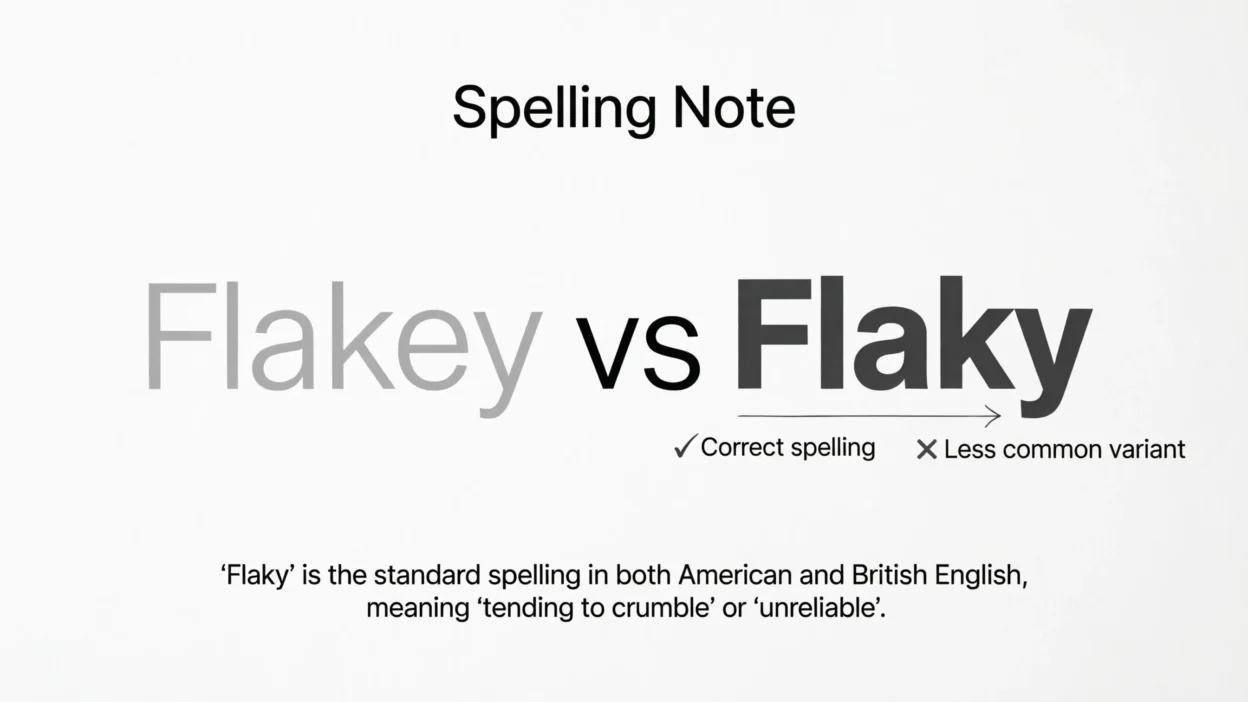
If you’ve seen both flakey and flaky online, you might wonder which spelling is actually correct. The short answer is simple: flaky is the standard and widely accepted spelling in modern English, while flakey is considered a less common variant.
Whether you’re describing a buttery pastry, unreliable behavior, or dry skin, understanding the correct spelling helps your writing look polished and professional.
In this guide, you’ll learn the meaning of flaky, the difference between flakey and flaky, common mistakes, examples, and when to use each spelling.
Quick Answer
- Flaky = Correct and preferred spelling
- Flakey = Alternative spelling, but much less common
Most dictionaries, style guides, and professional writers use flaky.
Example:
- The croissant was perfectly flaky.
- He’s been flaky lately and keeps canceling plans.
What Does “Flaky” Mean?
The word flaky is an adjective with several meanings depending on context.
1. Covered in Small Flakes
It describes something breaking into thin layers or flakes.
Examples:
- The pie crust turned golden and flaky.
- Her skin became dry and flaky during winter.
2. Unreliable or Inconsistent
Informally, flaky can describe a person who is forgetful, unreliable, or unpredictable.
Examples:
- He’s talented but sometimes flaky.
- She keeps changing plans at the last minute.
3. Strange or Eccentric
In casual English, flaky may also describe unusual or quirky behavior.
Example:
- That idea sounds a little flaky.
Flakey vs Flaky: What’s the Difference?
There is no major difference in meaning between flakey and flaky. The difference is mainly about standard usage and spelling preference.
| Word | Status | Usage |
|---|---|---|
| Flaky | Standard spelling | Most common and recommended |
| Flakey | Variant spelling | Rare and less accepted |
Why Is “Flaky” Preferred?
English spelling often removes unnecessary letters for simpler forms. Over time, flaky became the dominant spelling in dictionaries, publishing, journalism, and online writing.
Most grammar checkers and editors recommend using flaky.
Is “Flakey” Wrong?
Not exactly. Flakey is recognized by some dictionaries as a variant spelling, but it is much less common.
However, in professional writing, academic work, SEO content, and business communication, flaky is the safer and more accepted choice.
Examples of “Flaky” in Sentences
Food-Related Examples
- The biscuits were warm, buttery, and flaky.
- A flaky pastry melts in your mouth.
Personality Examples
- My coworker is friendly but flaky.
- She sounded flaky after forgetting the meeting again.
Skin and Texture Examples
- Cold weather can cause flaky skin.
- The paint became old and flaky.
Common Mistakes People Make
1. Using “Flakey” in Formal Writing
Although understandable, it can appear less polished.
Better:
- The crust was flaky.
2. Confusing “Flaky” With “Flakey”
Some writers assume adding “-ey” makes the word more correct. In modern English, “flaky” is preferred.
3. Overusing Informal Meaning
Calling someone “flaky” can sound critical or rude depending on tone.
Example:
- Informal: He’s kind of flaky.
- More professional: He can be inconsistent.
American vs British English
Unlike words such as “honor” and “honour,” the spelling difference here is not mainly about American vs British English.
Both American and British English strongly prefer:
- Flaky
The variant “flakey” appears occasionally in informal usage but is uncommon in both regions.
Related Words and Synonyms
Here are some related words often connected with flaky:
Texture and Appearance
- Crispy
- Crumbly
- Brittle
- Layered
Personality Traits
- Unreliable
- Forgetful
- Inconsistent
- Unpredictable
- Eccentric
Using related terms naturally can improve readability and SEO performance.
Why Correct Spelling Matters
Choosing the standard spelling improves:
- Credibility
- Professionalism
- Search engine optimization
- Reader trust
If you are writing blogs, product descriptions, recipes, or business content, “flaky” is the recommended choice.
SEO Tip: Which Keyword Should You Target?
If you are optimizing content for search engines:
- Primary keyword: flaky
- Secondary keyword: flakey
Since “flaky” is searched more frequently and considered standard, it should appear naturally in headings, meta descriptions, and body content.
Frequently Asked Questions
Is flaky or flakey correct?
Both exist, but flaky is the standard and preferred spelling.
Why do some people write flakey?
“Flakey” developed as a spelling variant, but it never became as widely accepted as “flaky.”
Is flakey considered wrong?
Not completely wrong, but it is less common and may appear informal or outdated.
Which spelling do dictionaries prefer?
Most modern dictionaries list flaky as the primary spelling.
Is flaky used in British English too?
Yes. Both American and British English mainly use “flaky.”
Can flaky describe a person?
Yes. Informally, it means unreliable, forgetful, or inconsistent.
What does flaky skin mean?
Flaky skin refers to dry skin that peels or breaks into small flakes.
Final Thoughts on Flakey or Flaky
When choosing between flakey and flaky, the best option in almost every situation is flaky. It is the standard spelling used in modern English across books, websites, journalism, and professional writing.
While “flakey” is sometimes seen online, it is much less common and may look incorrect to some readers. If you want clear, polished, and SEO-friendly writing, stick with flaky consistently throughout your content.
Actionable Takeaway
Use flaky for:
- Professional writing
- Blog posts
- Academic content
- Recipes
- Marketing copy
Reserve “flakey” only if you intentionally prefer the variant spelling or are quoting another source.