Confused about bear or bare? You’re not alone. These two words sound exactly the same, making them classic examples of English homophones. Despite their identical pronunciation, they have completely different meanings and uses.
Whether you’re writing an email, school assignment, blog post, or professional document, understanding the difference between bear and bare can help you avoid common grammar mistakes and communicate more clearly.
This guide explains each word in simple terms, provides practical examples, and shows you how to remember the difference with confidence.
Quick Answer
- Bear usually means to carry, support, endure, tolerate, or produce.
- Bare means uncovered, exposed, empty, or without covering.
Examples:
- I can’t bear the loud noise. ✅
- She walked on the bare floor. ✅
A simple memory trick:
- Bear = carry or endure.
- Bare = naked, exposed, or uncovered.
What Does “Bear” Mean?
The word bear has several meanings depending on the context. It is commonly used as both a noun and a verb.
Bear as a Verb
As a verb, bear often means:
- To carry something
- To support weight
- To endure or tolerate
- To produce or give birth
Examples of Bear
- The bridge can bear heavy traffic.
- I cannot bear watching sad movies.
- She had to bear the responsibility alone.
- The apple tree will bear fruit next summer.
- Please bear with me while I finish this task.
Bear as a Noun
As a noun, bear refers to the large furry animal.
Examples:
- We spotted a bear in the forest.
- The grizzly bear is one of North America’s most powerful animals.
What Does “Bare” Mean?
The word bare generally refers to something that is uncovered, exposed, plain, or lacking something.
It is usually used as an adjective, although it can also function as a verb in some situations.
Examples of Bare
- The walls were completely bare.
- He walked across the bare ground.
- She stood with bare feet on the beach.
- The room contained only the bare essentials.
- The tree branches were bare during winter.
Bare as a Verb
As a verb, bare means to reveal or uncover.
Examples:
- He decided to bare his feelings.
- The dog bared its teeth.
Bear or Bare: Key Differences
Although they sound the same, their meanings are entirely different.
| Feature | Bear | Bare |
|---|---|---|
| Primary Meaning | Carry, endure, support | Exposed, uncovered |
| Part of Speech | Noun and verb | Adjective and verb |
| Related Ideas | Tolerate, withstand, produce | Naked, reveal, empty |
| Example | I can’t bear the pain. | The floor was bare. |
| Common Contexts | Responsibility, patience, weight | Skin, walls, feet, essentials |
Understanding the context usually makes it easy to choose the correct word.
Common Examples of Bear in Sentences
Here are some everyday examples:
- Can you bear the pressure?
- The chair can bear up to 300 pounds.
- Please bear in mind that deadlines may change.
- She couldn’t bear the thought of leaving.
- The vineyard will bear grapes this season.
Common Expressions Using Bear
Many English phrases use the word bear:
- Bear with me
- Bear in mind
- Bear responsibility
- Bear witness
- Bear fruit
These expressions are widely used in both formal and informal English.
Common Examples of Bare in Sentences
Let’s look at common uses of bare:
- The apartment had bare walls.
- She walked with bare feet.
- The trees stood bare after autumn.
- We only had the bare minimum supplies.
- The facts bare the truth of the situation.
Common Expressions Using Bare
Popular phrases include:
- Bare minimum
- Bare essentials
- Bare hands
- Bare skin
- Bare bones
These expressions often describe something simple, exposed, or lacking extras.
Common Mistakes People Make
Because bear and bare sound identical, writers often mix them up.
Incorrect Examples
❌ Please bare with me.
✅ Please bear with me.
❌ I can’t bare the pain.
✅ I can’t bear the pain.
❌ She walked on her bear feet.
✅ She walked on her bare feet.
❌ The room looked bear.
✅ The room looked bare.
Why the Confusion Happens
The confusion occurs because both words are pronounced the same way. In spoken English, context helps listeners understand the intended meaning. In writing, however, choosing the correct spelling is essential.
Easy Memory Tricks
Need a quick way to remember?
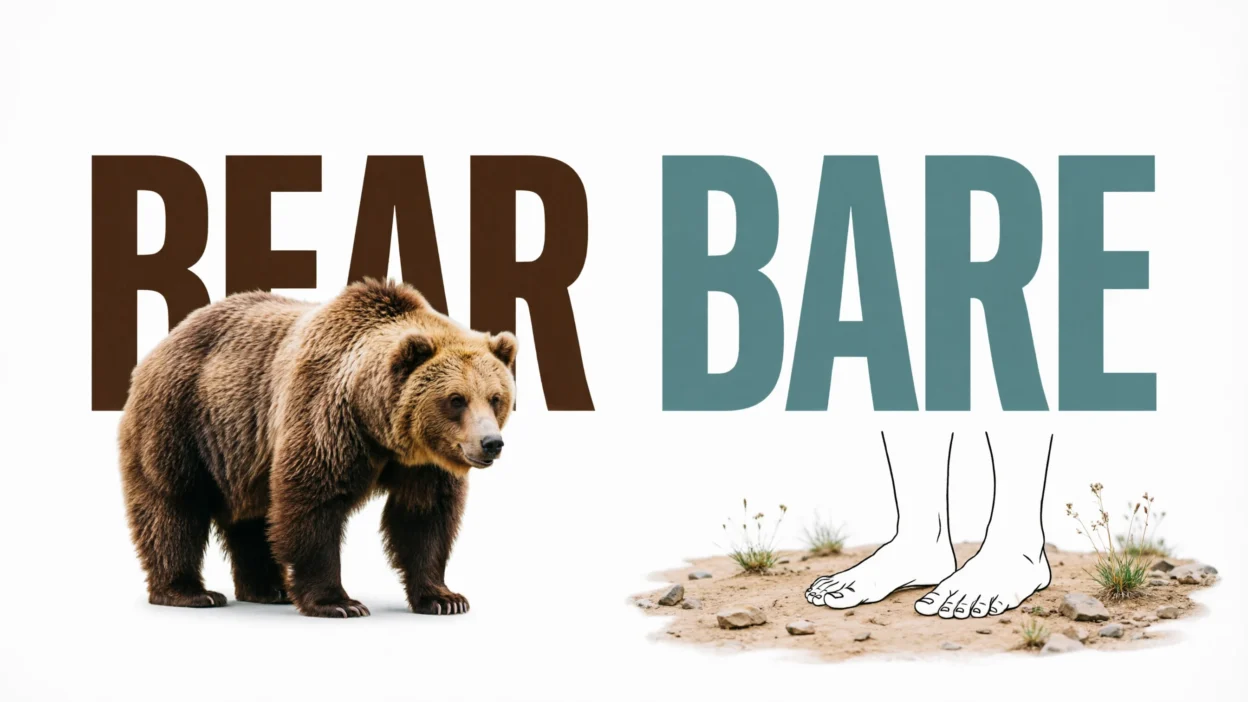
Remember Bear
Think of a bear carrying a heavy load.
The word often relates to:
- Carrying
- Supporting
- Enduring
- Tolerating
Example:
“I can’t bear the weight.”
Remember Bare
Think of someone standing with bare feet.
The word often relates to:
- Nakedness
- Exposure
- Uncovered surfaces
- Simplicity
Example:
“The floor was bare.”
American vs British English
The distinction between bear and bare is exactly the same in both American English and British English.
American English
- Please bear with me.
- He walked with bare feet.
British English
- Please bear with me.
- He walked with bare feet.
There are no significant spelling, pronunciation, or meaning differences between American and British English for these two words.
Related Words and Synonyms
Synonyms for Bear
Depending on context:
- Endure
- Tolerate
- Carry
- Support
- Withstand
- Sustain
Synonyms for Bare
Depending on context:
- Naked
- Exposed
- Uncovered
- Empty
- Plain
- Reveal
Using these related words can improve writing variety and clarity.
When to Use Bear
Use bear when discussing:
- Carrying weight
- Enduring pain
- Accepting responsibility
- Producing something
- Showing patience
Examples:
- Bear responsibility.
- Bear fruit.
- Bear the burden.
- Bear witness.
When to Use Bare
Use bare when discussing:
- Exposed skin
- Uncovered objects
- Minimal amounts
- Revealing something
Examples:
- Bare hands.
- Bare walls.
- Bare essentials.
- Bare the truth.
Frequently Asked Questions
1. Is it “bear with me” or “bare with me”?
The correct phrase is “bear with me.” It means “be patient with me.
2. What does “I can’t bear it” mean?
It means you cannot tolerate, endure, or handle something.
3. Does bare mean naked?
Yes. Bare often means uncovered, exposed, or naked.
4. Can bear and bare be used interchangeably?
No. They have different meanings and should not be substituted for one another.
5. Why are bear and bare confusing?
They are homophones, meaning they sound the same but have different spellings and meanings.
6. What is the meaning of bare minimum?
The bare minimum refers to the smallest amount necessary.
7. What does bear fruit mean?
Bear fruit means to produce results or achieve success.
8. What does bare one’s soul mean?
It means to reveal deep personal thoughts or emotions honestly.
Summary
Understanding the difference between bear or bare is easier once you focus on their meanings. Bear usually relates to carrying, supporting, enduring, tolerating, or producing something. It can also refer to the large animal. Bare, on the other hand, describes something exposed, uncovered, plain, or revealed.
When deciding which word to use, think about the context. If the idea involves carrying a burden, enduring difficulty, or supporting something, choose bear. If it involves exposure, simplicity, or lack of covering, choose bare. Mastering this distinction will improve your writing accuracy and help you avoid one of the most common English spelling mistakes.
Actionable Takeaway
The next time you’re unsure, remember this simple rule:
Bear = carry or endure.
Bare = uncovered or exposed.
Using this quick memory trick will help you choose the correct word every time and write with greater confidence.