Many English learners get confused between send and sent because both words relate to delivering messages, emails, packages, or information. While they look similar, they are used in different tenses and situations. Using the wrong one can make a sentence sound grammatically incorrect.
If you have ever wondered whether to say “I send the email” or “I sent the email,” this guide will make everything clear.
You will learn the meaning of each word, grammar rules, examples, common mistakes, and simple tips to remember the difference confidently.
Quick Answer
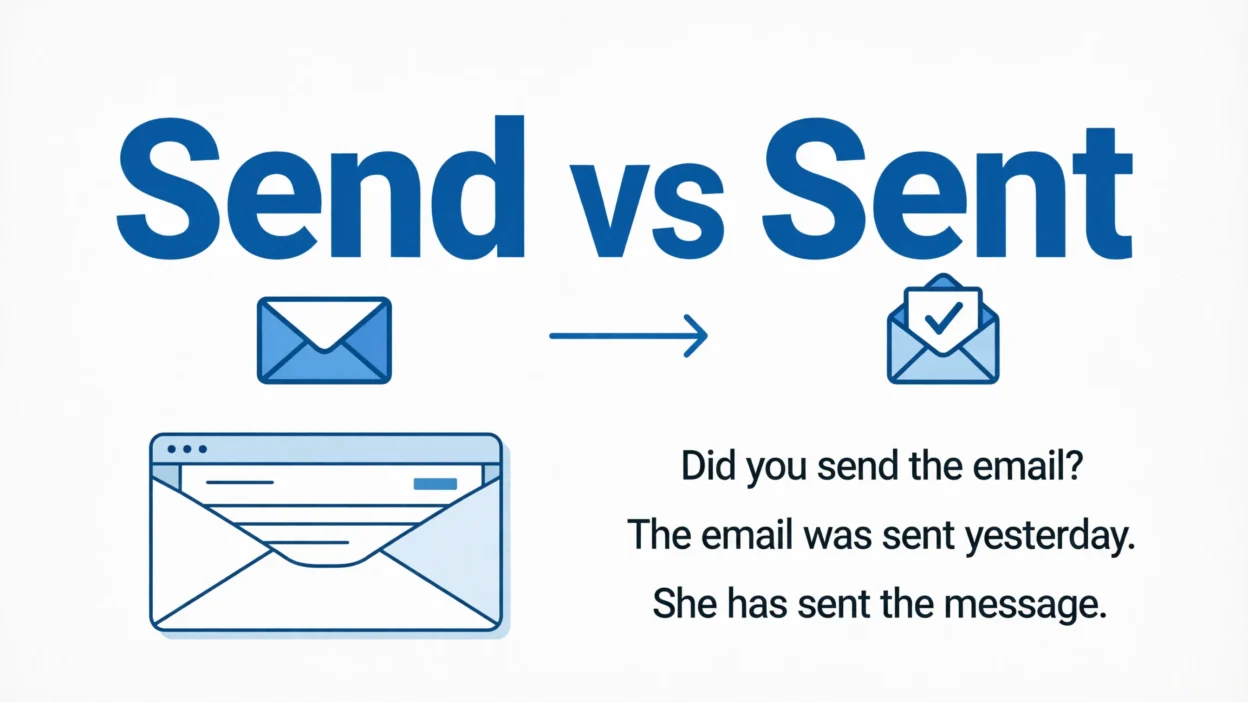
- Send = present tense verb
Example: I send reports every Monday. - Sent = past tense and past participle of “send”
Example: I sent the report yesterday.
Think of it this way:
- Send → happening now or regularly
- Sent → already happened
What Does “Send” Mean?
The word send means:
- To cause something to go somewhere
- To deliver a message, object, email, or information
- To transfer something from one person or place to another
It is the base form of the verb.
Examples of “Send” in Sentences
- Please send me the details.
- I send invoices every week.
- They send emails to customers daily.
- Can you send the document today?
What Does “Sent” Mean?
Sent is the past tense and past participle form of “send.” It is used when the action already happened in the past.
Examples of “Sent” in Sentences
- I sent the package yesterday.
- She sent me a text last night.
- We already sent the invitation.
- He had sent the files before the meeting.
Main Difference Between Send and Sent
The biggest difference is time.
| Word | Tense | Usage | Example |
|---|---|---|---|
| Send | Present tense | Action happening now or regularly | I send updates weekly. |
| Sent | Past tense | Action already completed | I sent the update yesterday. |
When to Use “Send”
Use send when:
- Talking about the present
- Describing regular actions
- Giving commands or requests
- Using future forms with helping verbs
Examples
- I send reports every Friday.
- Send me the address.
- We will send the payment tomorrow.
- Do you send international packages?
When to Use “Sent”
Use sent when:
- Talking about completed past actions
- Using present perfect or past perfect tenses
Examples
- I sent the email this morning.
- She sent flowers to her friend.
- They have sent the documents already.
- He had sent the message before dinner.
Easy Grammar Rule to Remember
A quick trick:
- Send = present
- Sent = past
If the action happened yesterday, last week, or earlier, use sent.
If the action happens regularly or right now, use send.
Common Mistakes People Make
Many learners mix these words incorrectly. Here are the most common errors.
Incorrect: “I send the email yesterday.”
✔ Correct: “I sent the email yesterday.”
Incorrect: “She sent messages every day.”
✔ Correct: “She sends messages every day.”
Incorrect: “Please sent me the file.”
✔ Correct: “Please send me the file.”
Incorrect: “Have you send the package?”
✔ Correct: “Have you sent the package?”
Verb Forms of Send
| Verb Form | Word |
|---|---|
| Base Verb | Send |
| Past Tense | Sent |
| Past Participle | Sent |
| Present Participle | Sending |
Examples
- I am sending the package now.
- She sent the letter yesterday.
- They have sent the invitation already.
Send vs Sent in Everyday Conversation
Here are examples from real-life situations.
At Work
- Please send the report by noon.
- I already sent the report earlier.
In Text Messages
- Did you send the photo?
- Yes, I sent it five minutes ago.
In School
- Students send assignments online.
- The teacher said she sent feedback yesterday.
American vs British English Differences
There is no spelling difference between American and British English for:
- send
- sent
Both forms are used the same way in grammar and pronunciation.
However, pronunciation accents may sound slightly different depending on the region.
Pronunciation Guide
Send
Pronounced: /send/
Sent
Pronounced: /sent/
The pronunciation is very similar, but “sent” has a slightly sharper ending sound.
Helpful Memory Trick
Think of the letter T in “sent” as standing for:
- Time passed
- Task completed
Example:
- I sent the message already.
No “T” in send means the action is still happening or general.
Send as Different Parts of Speech
Although “send” is mainly a verb, it can appear in different grammatical structures.
Base Verb
- I send emails daily.
Infinitive
- I want to send a package.
Continuous Form
- She is sending photos now.
Perfect Tense
- They have sent the invoice.
Common Phrases with Send and Sent
Common Expressions with Send
- Send a message
- Send an email
- Send money
- Send help
- Send regards
Common Expressions with Sent
- Sent by mistake
- Sent yesterday
- Sent successfully
- Sent in advance
Email Examples Using Send and Sent
Present Tense
- I send monthly updates to clients.
Past Tense
- I sent the attachment yesterday evening.
Present Perfect
- I have sent the revised version already.
Related LSI Keywords and Synonyms
Here are related words naturally connected to send and sent:
- deliver
- transfer
- dispatch
- forward
- shipped
- message sent
- sending information
- communication verbs
These related terms help improve understanding and SEO relevance.
Why People Confuse Send and Sent
The confusion usually happens because:
- Both words come from the same verb
- English irregular verbs do not always follow simple patterns
- Spoken English can make them sound similar
Practice with tense-based examples makes the difference easier to remember.
Frequently Asked Questions
Is “sent” the past tense of send?
Yes. “Sent” is both the past tense and past participle form of “send.”
Can I say “Please sent me”?
No. The correct sentence is:
- “Please send me.”
Which is correct: “I have send” or “I have sent”?
Correct:
- “I have sent.”
After “have,” use the past participle form.
Is “sended” a real word?
No. “Sended” is incorrect in standard English.
What tense is “send”?
“Send” is the present tense base verb.
What tense is “sent”?
“Sent” is the past tense and past participle.
Do Americans and British people use these words differently?
No. Both use “send” and “sent” the same way.
What is the continuous form of send?
The continuous form is:
- sending
Example:
- “I am sending the files now.”
Final Summary
Understanding the difference between send and sent is essential for clear English communication. Use send for present or regular actions and sent for actions that already happened in the past. This simple tense difference changes the grammar and meaning of your sentence completely.
Many English learners confuse these forms at first, but regular practice makes them easy to master. Whether you are writing emails, messages, assignments, or business communication, using the correct form will make your English sound more natural and professional.
Actionable Takeaway
Remember this simple rule:
- Send = now or regularly
- Sent = already happened
Practice by writing five sentences using “send” and five using “sent.” Daily usage will help you remember the difference naturally and confidently.