Learning how to say “what’s up” in different languages is a fun and practical way to connect with people globally. This casual greeting is commonly used in everyday conversations, making it useful for travelers, language learners, and anyone curious about global communication.
In this guide, you’ll discover “what’s up” in all languages, including correct phrases, pronunciation, and real-life examples to help you speak naturally and confidently.
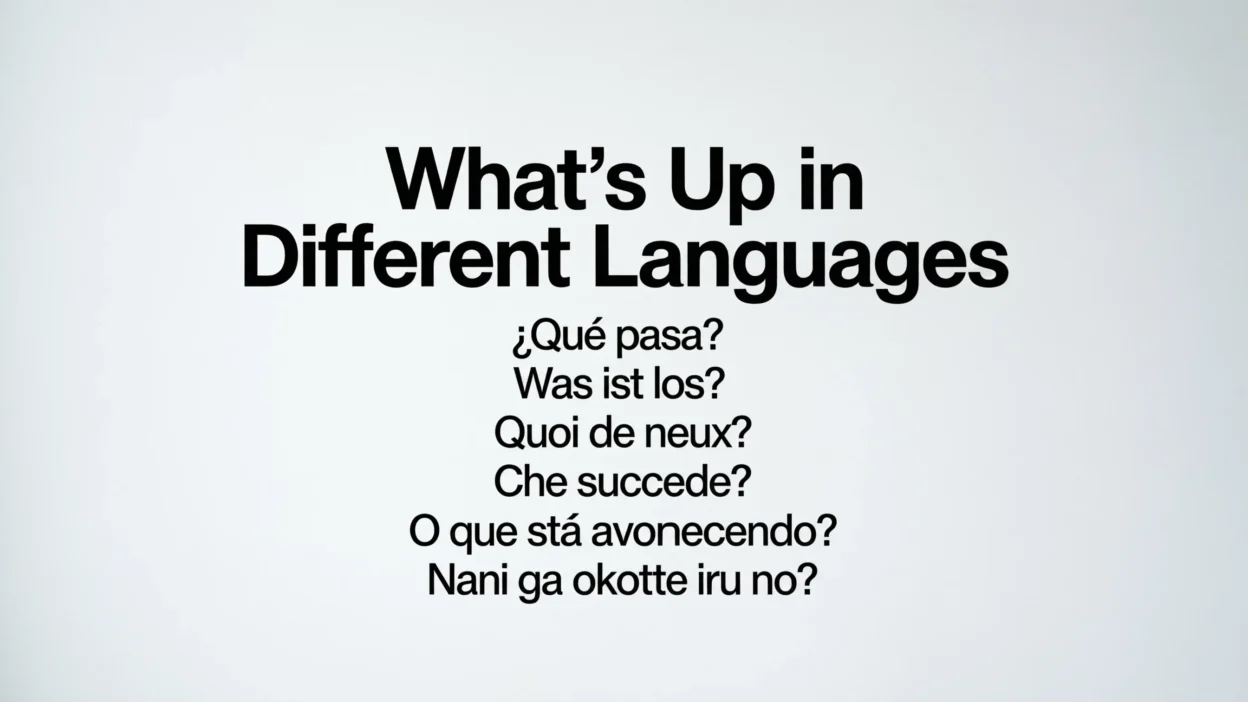
What’s Up in Different Languages (70 Translations Around the World)
| Language | Native Phrase + Pronunciation | Example Sentence + English Meaning |
|---|---|---|
| English | What’s up (Wuts up) | What’s up, how are you? — Casual greeting |
| Spanish | ¿Qué tal? (Kay tal) | ¿Qué tal, amigo? — What’s up, friend? |
| French | Ça va ? (Sa va) | Ça va, tout va bien? — What’s up, is everything okay? |
| German | Was geht? (Vas gate) | Was geht heute? — What’s up today? |
| Italian | Che succede? (Kay soo-cheh-deh) | Che succede qui? — What’s up here? |
| Portuguese | E aí? (Eh ah-ee) | E aí, tudo bem? — What’s up, all good? |
| Dutch | Wat is er? (Vat is er) | Wat is er vandaag? — What’s up today? |
| Russian | Что нового? (Chto novogo) | Что нового у тебя? — What’s up with you? |
| Arabic | ما الأخبار؟ (Ma al-akhbar) | ما الأخبار اليوم؟ — What’s up today? |
| Hindi | क्या हाल है? (Kya haal hai) | क्या हाल है दोस्त? — What’s up, friend? |
| Urdu | کیا حال ہے؟ (Kya haal hai) | کیا حال ہے آج؟ — What’s up today? |
| Chinese (Mandarin) | 最近怎么样? (Zuìjìn zěnme yàng) | 最近怎么样?朋友 — What’s up lately, friend? |
| Japanese | 元気? (Genki) | 元気?久しぶり — What’s up? Long time no see |
| Korean | 뭐 해? (Mwo hae) | 뭐 해 지금? — What’s up, what are you doing? |
| Turkish | Ne haber? (Ne ha-ber) | Ne haber dostum? — What’s up, my friend? |
| Greek | Τι νέα; (Ti nea) | Τι νέα σήμερα; — What’s up today? |
| Polish | Co słychać? (Tso s-wi-hatch) | Co słychać u ciebie? — What’s up with you? |
| Swedish | Vad händer? (Vad hen-der) | Vad händer idag? — What’s up today? |
| Norwegian | Hva skjer? (Hva sher) | Hva skjer nå? — What’s up now? |
| Danish | Hvad sker der? (Veth sker der) | Hvad sker der her? — What’s up here? |
| Finnish | Mitä kuuluu? (Mee-ta koo-loo) | Mitä kuuluu tänään? — What’s up today? |
| Czech | Co se děje? (Tso se dye-ye) | Co se děje teď? — What’s up now? |
| Slovak | Čo sa deje? (Cho sa de-ye) | Čo sa deje dnes? — What’s up today? |
| Hungarian | Mi újság? (Mee oo-shaag) | Mi újság veled? — What’s up with you? |
| Romanian | Ce mai faci? (Che mai fach) | Ce mai faci azi? — What’s up today? |
| Bulgarian | Какво ново? (Kakvo novo) | Какво ново днес? — What’s up today? |
| Serbian | Šta ima? (Shta ee-ma) | Šta ima danas? — What’s up today? |
| Croatian | Što ima? (Shto ee-ma) | Što ima kod tebe? — What’s up with you? |
| Slovenian | Kaj dogaja? (Kai do-gai-ya) | Kaj dogaja danes? — What’s up today? |
| Ukrainian | Що нового? (Shto novoho) | Що нового у тебе? — What’s up with you? |
| Hebrew | מה קורה? (Ma ko-reh) | מה קורה היום? — What’s up today? |
| Thai | เป็นไงบ้าง? (Pen ngai bang) | เป็นไงบ้างวันนี้? — What’s up today? |
| Vietnamese | Có gì mới? (Kaw zee moy) | Có gì mới hôm nay? — What’s up today? |
| Indonesian | Ada apa? (A-da a-pa) | Ada apa hari ini? — What’s up today? |
| Malay | Apa khabar? (A-pa kha-bar) | Apa khabar hari ini? — What’s up today? |
| Filipino (Tagalog) | Anong balita? (A-nong ba-lee-ta) | Anong balita ngayon? — What’s up now? |
| Swahili | Mambo? (Mam-bo) | Mambo rafiki? — What’s up, friend? |
| Zulu | Kunjani? (Koon-ja-nee) | Kunjani namhlanje? — What’s up today? |
| Afrikaans | Wat gaan aan? (Vat ghan aan) | Wat gaan aan vandag? — What’s up today? |
| Icelandic | Hvað er að frétta? (Kvath er ath fret-ta) | Hvað er að frétta í dag? — What’s up today? |
| Irish | Cad é mar atá tú? (Kad eh mar a-ta too) | Cad é mar atá tú inniu? — What’s up today? |
| Welsh | Beth sy’n digwydd? (Beth sin de-gith) | Beth sy’n digwydd heddiw? — What’s up today? |
| Albanian | Ç’kemi? (Ch-ke-mee) | Ç’kemi sot? — What’s up today? |
| Estonian | Mis toimub? (Mis toi-mub) | Mis toimub täna? — What’s up today? |
| Latvian | Kas notiek? (Kas no-tyek) | Kas notiek šodien? — What’s up today? |
| Lithuanian | Kas naujo? (Kas now-yo) | Kas naujo šiandien? — What’s up today? |
| Persian | چه خبر؟ (Che khabar) | چه خبر امروز؟ — What’s up today? |
| Bengali | কি খবর? (Ki khobor) | কি খবর আজ? — What’s up today? |
| Punjabi | ਕੀ ਹਾਲ ਹੈ? (Ki haal hai) | ਕੀ ਹਾਲ ਹੈ ਅੱਜ? — What’s up today? |
| Marathi | काय चाललंय? (Kay chal-lay) | काय चाललंय आज? — What’s up today? |
| Gujarati | શું સમાચાર? (Shu samachar) | શું સમાચાર આજે? — What’s up today? |
| Tamil | என்ன விசயம்? (Enna visayam) | என்ன விசயம் இன்று? — What’s up today? |
| Telugu | ఏమిటి వార్తలు? (Emiti vaarthalu) | ఏమిటి వార్తలు ఇవాళ? — What’s up today? |
| Kannada | ಏನ್ ಸುದ್ದಿ? (En suddi) | ಏನ್ ಸುದ್ದಿ ಇಂದು? — What’s up today? |
| Malayalam | എന്ത് വാർത്ത? (Enth vartha) | എന്ത് വാർത്ത ഇന്ന്? — What’s up today? |
| Nepali | के छ खबर? (Ke cha khabar) | के छ खबर आज? — What’s up today? |
| Sinhala | කොහොමද? (Kohomada) | කොහොමද අද? — What’s up today? |
| Mongolian | Юу байна? (Yuu baina) | Юу байна өнөөдөр? — What’s up today? |
| Lao | ເປັນແນວໃດ? (Pen naeo dai) | ເປັນແນວໃດມື້ນີ້? — What’s up today? |
| Khmer | មានអ្វីថ្មី? (Mean avei thmei) | មានអ្វីថ្មីថ្ងៃនេះ? — What’s up today? |
| Burmese | ဘာသတင်းလဲ? (Bha tha-din le) | ဘာသတင်းလဲ ဒီနေ့? — What’s up today? |
| Amharic | ምን አዲስ? (Min adis) | ምን አዲስ ዛሬ? — What’s up today? |
| Haitian Creole | Sa k ap fèt? (Sa kap fet) | Sa k ap fèt jodi a? — What’s up today? |
| Basque | Zer moduz? (Zer mo-duz) | Zer moduz gaur? — What’s up today? |
| Catalan | Què tal? (Ke tal) | Què tal avui? — What’s up today? |
| Galician | Que tal? (Kay tal) | Que tal hoxe? — What’s up today? |
How to Say “What’s Up” in Different Languages Correctly
Understanding how to say “what’s up” in different languages helps you sound more natural in casual conversations. Many cultures use informal greetings that match tone and context. For example, “Mambo?” in Swahili and “Ne haber?” in Turkish are friendly and commonly used among friends.
When learning “what’s up” translations, pay attention to pronunciation and formality. Some phrases are informal and best used with friends, while others can be used in semi-formal settings.
Why Learning “What’s Up” in All Languages Is Useful
Knowing how to greet people casually around the world improves communication and cultural understanding. Travelers, students, and global professionals benefit from learning “what’s up” around the world because it helps break the ice quickly.
It also makes conversations feel more personal and friendly, especially when speaking to native speakers in their own language.
Common Situations to Use “What’s Up” Around the World
You can use these phrases in many real-life situations:
- Meeting friends or classmates
- Starting a casual chat online
- Greeting coworkers informally
- Social gatherings and travel conversations
Using the right greeting shows respect for different cultures and communication styles.
Conclusion
Learning “what’s up” in different languages is a simple yet powerful way to connect with people globally. These translations help you start conversations naturally, understand cultural greetings, and communicate more confidently in everyday situations around the world.
FAQs
1. What is “what’s up” in all languages?
“What’s up” in all languages varies by culture, but common equivalents include “¿Qué tal?” in Spanish, “Was geht?” in German, and “Mambo?” in Swahili.
2. How do you say “what’s up” in different languages formally?
Most “what’s up” translations are informal. For formal contexts, phrases like “How are you?” equivalents are usually more appropriate.
3. Is “what’s up” a universal greeting?
Yes, every language has a casual greeting similar to “what’s up,” though wording and usage differ based on culture.
4. Why should I learn “what’s up” translations?
Learning these greetings helps with travel, cultural communication, and building friendly connections worldwide.
5. Which languages use the most casual version of “what’s up”?
Languages like English, Spanish, Swahili, and Turkish commonly use very casual greetings similar to “what’s up” in daily speech.