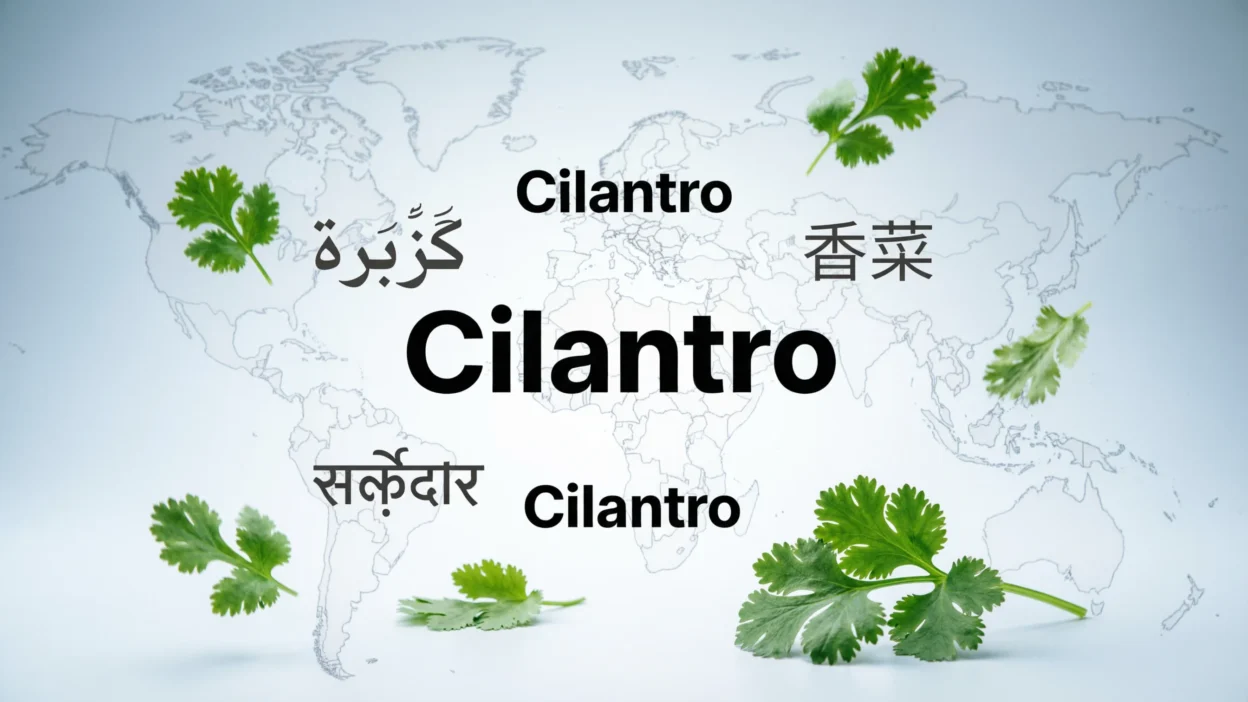
Cilantro is a popular herb used in kitchens around the world, known for its fresh aroma and bold flavor.
If you’ve ever wondered how to say cilantro in different languages, this guide gives you clear translations, easy pronunciations, and real-life examples.
Whether you’re traveling, cooking international recipes, or just curious, this article covers cilantro translations around the world in a simple, user-friendly way.
Below is a single, clean table showing cilantro in all languages, optimized for quick reading and featured snippets.
Cilantro in Different Languages (70 Translations)
| Language | Easy Pronunciation | Example Sentence |
|---|---|---|
| English | si-LAN-troh | I added cilantro to the soup — I added fresh cilantro |
| Spanish | see-LAN-tro | El arroz lleva cilantro — The rice has cilantro |
| French | koh-ree-AHN-druh | J’ajoute de la coriandre — I add cilantro |
| German | koh-ree-AHN-der | Ich mag Koriander — I like cilantro |
| Italian | koh-ree-AN-dro | Uso il coriandolo — I use cilantro |
| Portuguese | koh-ree-AN-dro | O prato tem coentro — The dish has cilantro |
| Dutch | koh-ree-AN-der | Koriander is vers — Cilantro is fresh |
| Swedish | koh-ree-AN-der | Jag använder koriander — I use cilantro |
| Norwegian | koh-ree-AN-der | Suppen har koriander — The soup has cilantro |
| Danish | koh-ree-AN-der | Jeg kan lide koriander — I like cilantro |
| Finnish | koh-ree-AN-teh-ri | Ruoassa on korianteri — The food has cilantro |
| Polish | koh-rye-AN-der | Dodaję kolendrę — I add cilantro |
| Czech | koh-LEN-dra | Polévka má koriandr — The soup has cilantro |
| Slovak | koh-LEN-dra | Jedlo má koriander — The dish has cilantro |
| Hungarian | koh-REE-an-der | Van benne koriander — It has cilantro |
| Romanian | koh-ree-AN-dru | Mâncarea are coriandru — The food has cilantro |
| Russian | kah-ree-AN-dr | Я добавил кинзу — I added cilantro |
| Ukrainian | keen-ZAH | Я люблю кінзу — I love cilantro |
| Bulgarian | kee-NAH | Ястието има кориандър — The dish has cilantro |
| Greek | koh-ree-AN-dro | Το φαγητό έχει κόλιανδρο — The food has cilantro |
| Turkish | kee-NEEZ | Yemeğe kişniş ekledim — I added cilantro |
| Arabic | kus-BAR-ah | أضفت الكزبرة — I added cilantro |
| Hebrew | kuh-ZEH-ret | הוספתי כוסברה — I added cilantro |
| Persian | gah-SHNEEZ | غذا گشنیز دارد — The food has cilantro |
| Urdu | dhun-YA | سالن میں دھنیا ہے — The curry has cilantro |
| Hindi | dhun-YAA | सब्ज़ी में धनिया है — The vegetable has cilantro |
| Bengali | dhon-NEH | তরকারিতে ধনিয়া আছে — The curry has cilantro |
| Punjabi | dhun-YAA | کھانے میں دھنیا ہے — The food has cilantro |
| Tamil | koh-THAM-bah-REE | உணவில் கொத்தமல்லி உள்ளது — The food has cilantro |
| Telugu | koh-thuh-MEER-ah | కూరలో కొత్తిమీర ఉంది — The curry has cilantro |
| Kannada | koh-tham-BA-ree | ಊಟದಲ್ಲಿ ಕೊತ್ತಂಬರಿ ಇದೆ — The meal has cilantro |
| Malayalam | koh-tham-BA-ram | കറിയിൽ മല്ലിയുണ്ട് — The curry has cilantro |
| Sinhala | koh-THAM-bah-ree | ආහාරයේ කොත්තම්බර — The food has cilantro |
| Thai | pak-chee | อาหารมีผักชี — The food has cilantro |
| Lao | pak-chee | ອາຫານມີຜັກຊີ — The food has cilantro |
| Khmer | chee-vorng | ម្ហូបមានជីវ៉ង — The dish has cilantro |
| Vietnamese | ngò | Món ăn có ngò — The dish has cilantro |
| Indonesian | koh-ree-AN-der | Masakan pakai ketumbar — The dish uses cilantro |
| Malay | koh-ree-AN-der | Makanan ada ketumbar — The food has cilantro |
| Filipino | kuh-LAN-dro | May cilantro ang ulam — The dish has cilantro |
| Chinese (Mandarin) | shee-YAN-soo | 菜里有香菜 — The dish has cilantro |
| Cantonese | heung-choi | 道菜有香菜 — The dish has cilantro |
| Japanese | koh-ee-AN-dah | 料理にパクチーがある — The dish has cilantro |
| Korean | koh-soo | 음식에 고수가 있다 — The food has cilantro |
| Mongolian | koh-ree-AN-der | Хоолонд кориандр байна — The food has cilantro |
| Nepali | dhun-YAA | तरकारीमा धनियाँ छ — The curry has cilantro |
| Marathi | dhun-YAA | भाजीमध्ये धणे आहे — The vegetable has cilantro |
| Gujarati | dhun-YAA | ભોજનમાં ધાણા છે — The meal has cilantro |
| Swahili | dan-YAA | Chakula kina giligilani — The food has cilantro |
| Zulu | gih-lee-gi-LAH-nee | Ukudla kune giligilani — The food has cilantro |
| Afrikaans | koh-ree-AN-der | Kos het koljander — The food has cilantro |
| Amharic | din-BIL-ah-leh | ምግቡ ዲንብላሌ አለ — The food has cilantro |
| Somali | kils-AHN-dhar | Cuntadu waxay leedahay kilsandhar — The food has cilantro |
| Icelandic | koh-ree-AN-der | Rétturinn hefur kóríander — The dish has cilantro |
| Estonian | koh-ree-AN-der | Toidus on koriander — The food has cilantro |
| Latvian | koh-ree-AN-ders | Ēdienā ir koriandrs — The food has cilantro |
| Lithuanian | koh-ree-AN-dras | Maiste yra kalendra — The food has cilantro |
Why Cilantro Has Different Names Worldwide
Cilantro is known by different names because of regional languages, cooking traditions, and cultural preferences.
In some countries, the same word is used for both the leaves and seeds, while others separate the terms.
How to Say Cilantro in Different Languages While Traveling
Knowing how to say cilantro in different languages helps when ordering food, shopping at local markets, or following international recipes.
It also helps avoid confusion if you’re allergic or dislike the taste.
Cilantro Around the World in Daily Cooking
From Asian stir-fries to Latin American salsas, cilantro is used fresh, chopped, or blended.
Its global presence makes it one of the most recognizable herbs worldwide.
Conclusion
Cilantro is a truly global ingredient with many names, sounds, and cultural uses.
Learning cilantro translations in different languages makes travel, cooking, and communication easier and more enjoyable.
FAQs About Cilantro in Different Languages
1. What is cilantro called in most languages?
Many languages use a variation of coriander or a local traditional name.
2. Is cilantro the same as coriander worldwide?
In many countries, yes, but some distinguish between leaves and seeds.
3. How do you say cilantro in Asian languages?
Common examples include pak chee (Thai) and xiang cai (Chinese).
4. Why does cilantro have so many names?
Language evolution, trade routes, and cooking traditions influence naming.
5. Is cilantro used globally in cooking?
Yes, it is widely used across Asia, Africa, Europe, and the Americas.