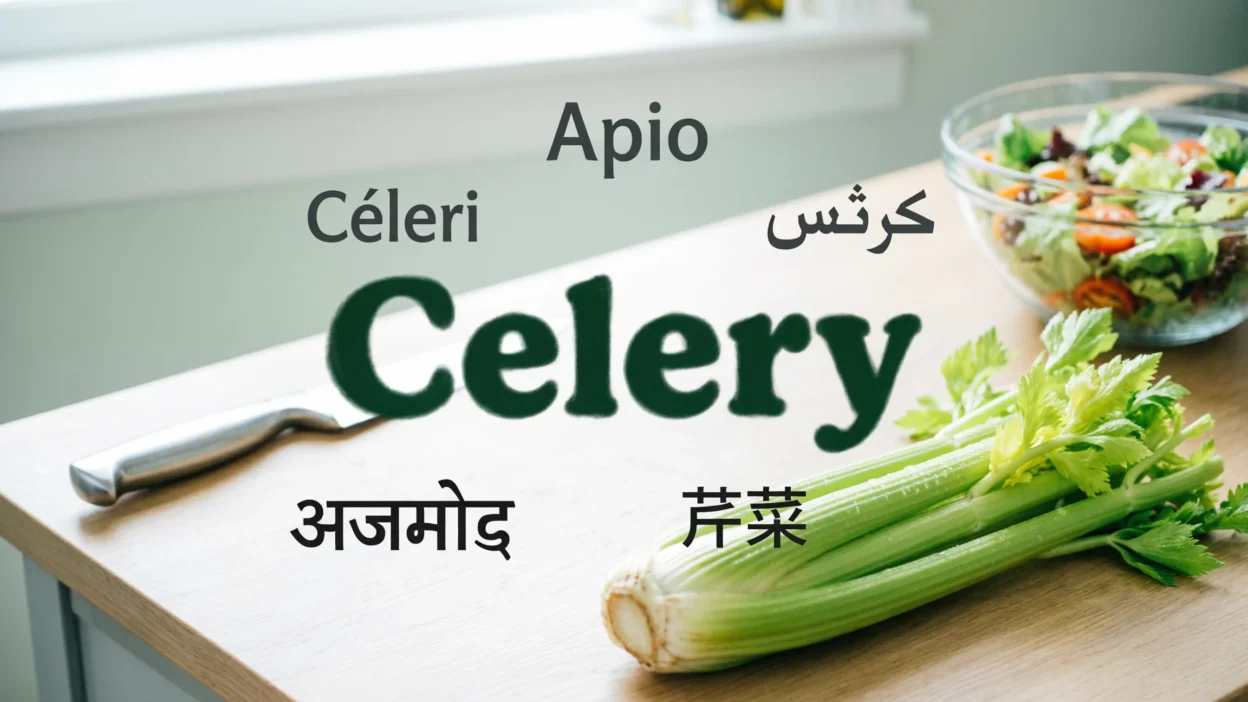
Celery is a popular vegetable used in salads, soups, and healthy diets around the world.
If you are looking for celery in different languages, this guide provides accurate translations, easy pronunciations, and simple real-life example sentences to help you learn quickly.
Below is a clean and mobile-friendly table showing how to say celery in different languages worldwide.
Celery in Different Languages (Global Translations)
| Language | Easy Pronunciation | Example Sentence |
|---|---|---|
| English | SEL-uh-ree | I added celery to the soup |
| Spanish | A-peh-EE-oh | Añadí apio a la sopa |
| French | seh-LEH-ree | J’ai ajouté du céleri à la soupe |
| German | ZEH-leh-ree | Ich habe Sellerie in die Suppe gegeben |
| Italian | SEH-leh-ree | Ho aggiunto il sedano alla zuppa |
| Portuguese | SEH-leh-ree | Adicionei aipo à sopa |
| Dutch | SEH-leh-ree | Ik heb selderij aan de soep toegevoegd |
| Swedish | SELL-eh-ree | Jag lade selleri i soppan |
| Norwegian | SELL-eh-ree | Jeg la selleri i suppen |
| Danish | SELL-eh-ree | Jeg tilsatte selleri til suppen |
| Finnish | SEL-le-ree | Lisäsin selleriä keittoon |
| Polish | SEH-leh-ree | Dodałem seler do zupy |
| Czech | SEH-lehr | Přidal jsem celer do polévky |
| Hungarian | SHEL-ler | Zelleret adtam a leveshez |
| Romanian | SEH-leh-ree | Am adăugat țelină în supă |
| Russian | SEL-eh-ree | Я добавил сельдерей в суп |
| Ukrainian | SEL-deh-rei | Я додав селеру в суп |
| Greek | SEH-leh-ree | Έβαλα σέλινο στη σούπα |
| Turkish | SEH-leh-ree | Çorbaya kereviz ekledim |
| Arabic | KA-raf-s | أضفت الكرفس إلى الحساء |
| Hebrew | KER-efs | הוספתי סלרי למרק |
| Persian | KAR-efs | کرفس را به سوپ اضافه کردم |
| Urdu | KA-raf-s | میں نے سوپ میں اجوائن کا ڈنٹھل ڈالا |
| Hindi | SEH-lee-ree | मैंने सूप में सेलरी डाली |
| Bengali | SEH-le-ree | আমি স্যুপে সেলারি যোগ করেছি |
| Punjabi | SEH-le-ree | ਮੈਂ ਸੂਪ ਵਿੱਚ ਸੈਲਰੀ ਪਾਈ |
| Tamil | SEH-le-ree | நான் சூப்பில் செலரி சேர்த்தேன் |
| Telugu | SEH-le-ree | నేను సూప్లో సెలరీ వేసాను |
| Thai | KHUEN-CHAI | ฉันใส่ขึ้นฉ่ายในซุป |
| Vietnamese | CAN TAY | Tôi đã thêm cần tây vào súp |
| Indonesian | SEH-leh-dree | Saya menambahkan seledri ke sup |
| Malay | SEH-leh-dree | Saya tambah saderi ke dalam sup |
| Filipino | SEH-leh-ree | Nagdagdag ako ng celery sa sabaw |
| Chinese (Mandarin) | CHIN-TSAI | 我在汤里加了芹菜 |
| Cantonese | KAN-CHOI | 我喺湯加咗芹菜 |
| Japanese | SEH-ruh-ree | スープにセロリを入れました |
| Korean | SEHL-leo-ree | 수프에 셀러리를 넣었어요 |
| Mongolian | SEH-le-ree | Би шөлөнд селөри нэмсэн |
| Swahili | SEH-le-ree | Niliweka celery kwenye supu |
| Zulu | SEH-le-ree | Ngifake i-celery esobho |
| Afrikaans | SELL-eh-ree | Ek het seldery by die sop gevoeg |
| Amharic | SEH-le-ree | በሾርባ ውስጥ ሴሌሪ ጨመርኩ |
| Somali | SEH-le-ree | Waxaan ku daray celery maraqa |
How to Say Celery in All Languages
The term celery in all languages often varies because some cultures use a native vegetable name instead of the English-derived word. In many European languages, the translation is similar to “celery,” while in Asian and Middle Eastern languages, completely different native terms are used.
Why Learn Celery Translations Around the World?
Learning celery translations is helpful for:
- Cooking and recipes
- Grocery shopping abroad
- Healthy diet discussions
- Travel and food communication
Knowing how to say celery around the world makes it easier to understand menus, ingredients, and food labels in different countries.
Conclusion
Now you know how to say celery in different languages with easy pronunciation and real-life example sentences. These global translations are especially useful for cooking, travel, and everyday food conversations worldwide.
FAQs About Celery in Different Languages
1. What is celery in Spanish?
Celery in Spanish is apio.
2. How do you say celery in French?
It is called céleri in French.
3. Is the word celery the same in all languages?
No, some languages use unique native names for the vegetable.
4. What is celery in Chinese?
Celery in Mandarin Chinese is qíncài (芹菜).
5. Why do some languages use similar words for celery?
Because many translations come from shared botanical or Latin roots.