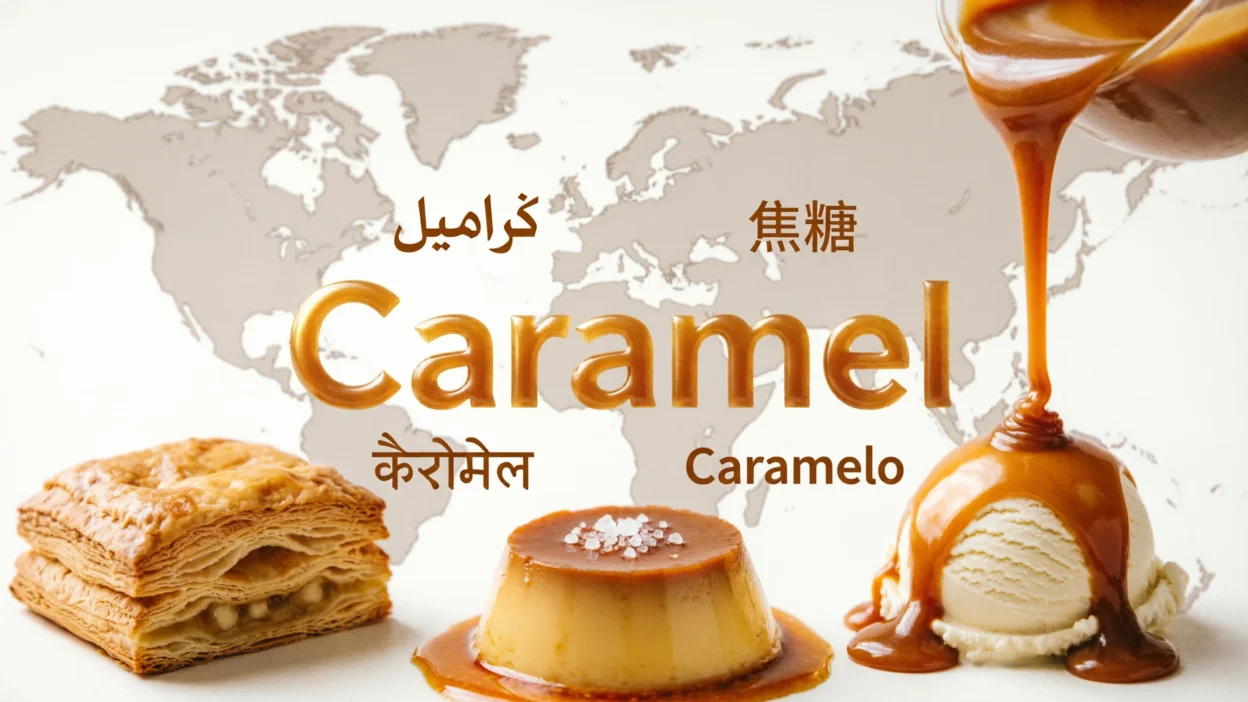
Caramel is a sweet, golden syrup made by heating sugar, loved in desserts and drinks around the world. If you’re searching for how to say caramel in different languages, this guide provides accurate translations, easy English pronunciations, and simple real-life example sentences.
Whether you’re cooking, traveling, or exploring caramel in all languages, this article helps you learn quickly and clearly.
Below is a single, clean, mobile-friendly table showing caramel translations around the world, optimized for readability and featured snippets.
Caramel in Different Languages (70 Translations)
| Language | Easy Pronunciation | Example Sentence |
|---|---|---|
| English | KAR-uh-mel | I love caramel ice cream |
| Spanish | kah-rah-MEL-oh | Me gusta el caramelo |
| French | ka-ra-MEL | J’aime le caramel |
| German | ka-ra-MELL | Ich mag Karamell |
| Italian | ka-ra-MEL-lo | Mi piace il caramello |
| Portuguese | ka-ra-MEH-lo | Eu gosto de caramelo |
| Dutch | ka-ra-MEL | Ik hou van karamel |
| Swedish | ka-ra-MELL | Jag gillar karamell |
| Norwegian | ka-ra-MELL | Jeg liker karamell |
| Danish | ka-ra-MELL | Jeg elsker karamel |
| Finnish | ka-ra-MEL-li | Rakastan karamellia |
| Polish | ka-ra-MEL | Lubię karmel |
| Czech | ka-ra-MEL | Mám rád karamel |
| Slovak | ka-ra-MEL | Mám rád karamel |
| Hungarian | ka-ra-MEL-la | Szeretem a karamellát |
| Romanian | ka-ra-MEL | Îmi place caramelul |
| Russian | ka-ra-MEL | Я люблю карамель |
| Ukrainian | ka-ra-MEL | Я люблю карамель |
| Bulgarian | ka-ra-MEL | Обичам карамел |
| Greek | ka-ra-ME-li | Μου αρέσει η καραμέλα |
| Turkish | ka-ra-MEL | Karameli seviyorum |
| Arabic | ka-ra-MEEL | أحب الكراميل |
| Hebrew | ka-ra-MEL | אני אוהב קרמל |
| Persian | ka-ra-MEL | من کارامل دوست دارم |
| Urdu | ka-ra-MEL | مجھے کیرامل پسند ہے |
| Hindi | ka-ra-MEL | मुझे कैरमेल पसंद है |
| Bengali | ka-ra-MEL | আমি ক্যারামেল পছন্দ করি |
| Punjabi | ka-ra-MEL | ਮੈਨੂੰ ਕਰਾਮਲ ਪਸੰਦ ਹੈ |
| Tamil | ka-ra-MEL | எனக்கு கராமல் பிடிக்கும் |
| Telugu | ka-ra-MEL | నాకు క్యారమెల్ ఇష్టం |
| Kannada | ka-ra-MEL | ನನಗೆ ಕ್ಯಾರಮೆಲ್ ಇಷ್ಟ |
| Malayalam | ka-ra-MEL | എനിക്ക് കാരമൽ ഇഷ്ടമാണ് |
| Sinhala | ka-ra-MEL | මට කැරමල් ප්රියයි |
| Thai | ka-ra-MEN | ฉันชอบคาราเมล |
| Lao | ka-ra-MEN | ຂ້ອຍມັກຄາຣາເມລ |
| Khmer | ka-ra-MEL | ខ្ញុំចូលចិត្តការ៉ាមែល |
| Vietnamese | ka-ra-MEN | Tôi thích caramel |
| Indonesian | ka-ra-MEL | Saya suka karamel |
| Malay | ka-ra-MEL | Saya suka karamel |
| Filipino | ka-ra-MEL | Gusto ko ang karamel |
| Chinese (Mandarin) | jia-tang-jiang | 我喜欢焦糖 |
| Cantonese | jiu-tong | 我鍾意焦糖 |
| Japanese | kya-ra-ME-ru | キャラメルが好きです |
| Korean | ka-ra-MEL | 카라멜을 좋아해요 |
| Mongolian | ka-ra-MEL | Би карамельд дуртай |
| Nepali | ka-ra-MEL | मलाई कारमेल मन पर्छ |
| Marathi | ka-ra-MEL | मला कॅरमेल आवडते |
| Gujarati | ka-ra-MEL | મને કેરામેલ ગમે છે |
| Swahili | ka-ra-MEL | Napenda karameli |
| Zulu | ka-ra-MEL | Ngithanda ikharameli |
| Afrikaans | ka-ra-MEL | Ek hou van karamel |
| Amharic | ka-ra-MEL | ካራመል እወዳለሁ |
| Somali | ka-ra-MEL | Waan jeclahay karamell |
| Icelandic | ka-ra-MEL-la | Ég elska karamella |
| Estonian | ka-ra-MELL | Mulle meeldib karamell |
| Latvian | ka-ra-MEL-e | Man patīk karamele |
| Lithuanian | ka-ra-ME-le | Man patinka karamelė |
Why the Word “Caramel” Is Similar Worldwide
The word caramel has European origins and spread globally through trade and culinary traditions. That’s why many languages use a similar pronunciation.
How to Say Caramel in Different Languages for Travel and Cooking
Knowing how to say caramel in different languages helps when ordering desserts, buying sweets, or reading international recipes.
Caramel Around the World in Food Culture
Caramel is used in candies, sauces, cakes, coffee drinks, and traditional desserts worldwide. Though pronunciation varies slightly, its meaning remains consistent.
Conclusion
Caramel is a globally loved sweet ingredient with similar names across cultures. Learning caramel translations in all languages makes travel, cooking, and language learning more enjoyable.
FAQs About Caramel in Different Languages
1. Is caramel spelled the same in most languages?
Many languages use a similar spelling due to shared origins.
2. How do you say caramel in Asian languages?
Examples include jia tang jiang (Chinese) and kyarameru (Japanese).
3. Is caramel a universal food term?
Yes, it is widely recognized globally.
4. Why does caramel sound similar in many languages?
Because the word spread internationally through trade and cuisine.
5. Is caramel used worldwide in desserts?
Yes, it appears in sweets and drinks across cultures.