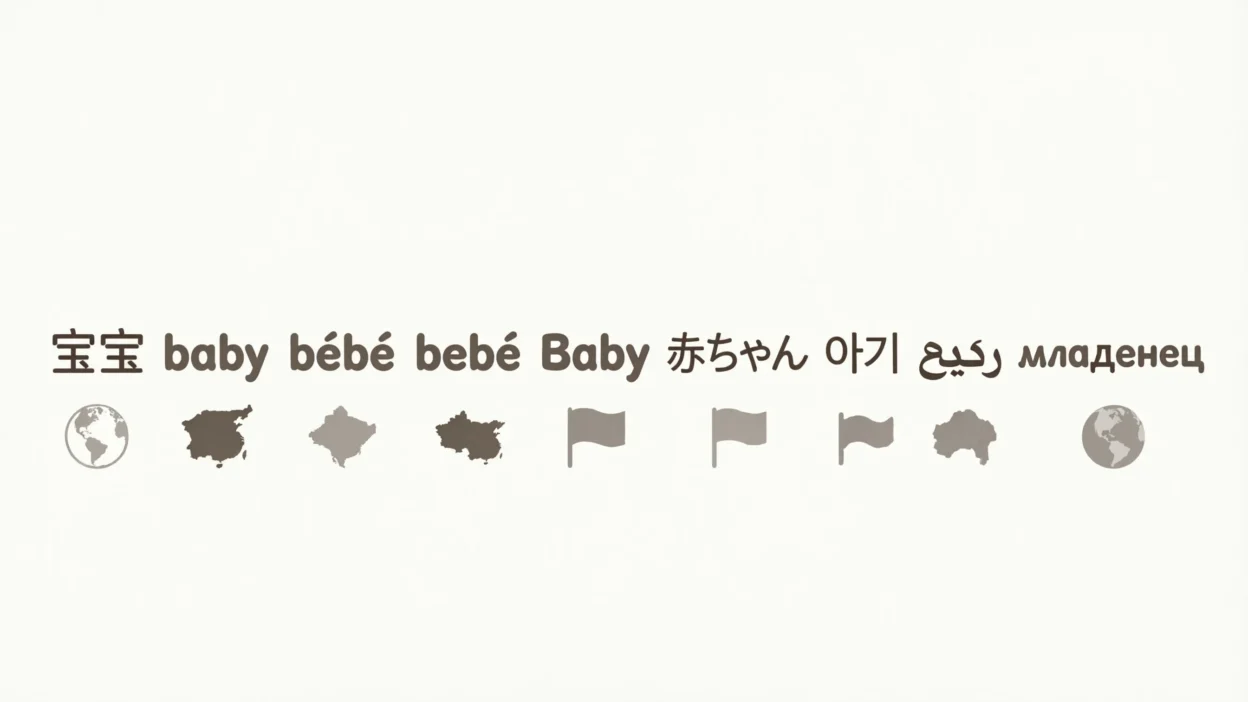
The word baby is one of the most common and heartwarming words used across cultures. It refers to a newborn child and is often used in everyday conversations, family life, and affectionate expressions.
Learning baby in different languages helps you understand how cultures around the world refer to infants and express care and love.
Whether you are learning languages, traveling, or simply curious about global vocabulary, knowing how to say baby in different languages can be both useful and interesting.
In this guide, you will discover 70 languages and their translations for “baby”, along with simple pronunciation and example sentences to help you use them naturally.
Baby in Different Languages (70 Languages)
| Language | Translation & Pronunciation | Example Sentence |
|---|---|---|
| English | Baby (bay-bee) | The baby is sleeping – a young child |
| Spanish | Bebé (beh-beh) | El bebé está durmiendo – The baby is sleeping |
| French | Bébé (bay-bay) | Le bébé dort – The baby is sleeping |
| German | Baby (ba-by) | Das Baby schläft – The baby is sleeping |
| Italian | Bambino (bam-bee-no) | Il bambino dorme – The baby sleeps |
| Portuguese | Bebê (beh-beh) | O bebê está dormindo – The baby is sleeping |
| Dutch | Baby (bay-bee) | De baby slaapt – The baby sleeps |
| Russian | Младенец (mla-de-nets) | Младенец спит – The baby is sleeping |
| Ukrainian | Немовля (ne-mov-lya) | Немовля спить – The baby is sleeping |
| Polish | Niemowlę (nye-mov-leh) | Niemowlę śpi – The baby is sleeping |
| Czech | Miminko (mi-min-ko) | Miminko spí – The baby is sleeping |
| Slovak | Bábätko (ba-bet-ko) | Bábätko spí – The baby is sleeping |
| Hungarian | Baba (ba-ba) | A baba alszik – The baby is sleeping |
| Romanian | Bebeluș (be-be-loosh) | Bebelușul doarme – The baby is sleeping |
| Greek | Μωρό (mo-ro) | Το μωρό κοιμάται – The baby is sleeping |
| Turkish | Bebek (be-bek) | Bebek uyuyor – The baby is sleeping |
| Arabic | طفل (tifl) | الطفل نائم – The baby is sleeping |
| Hebrew | תינוק (ti-nok) | התינוק ישן – The baby is sleeping |
| Persian | نوزاد (no-zad) | نوزاد خواب است – The baby is sleeping |
| Urdu | بچہ (ba-cha) | بچہ سو رہا ہے – The baby is sleeping |
| Hindi | बच्चा (bach-cha) | बच्चा सो रहा है – The baby is sleeping |
| Punjabi | ਬੱਚਾ (bach-cha) | ਬੱਚਾ ਸੋ ਰਿਹਾ ਹੈ – The baby is sleeping |
| Bengali | শিশু (shi-shu) | শিশু ঘুমাচ্ছে – The baby is sleeping |
| Gujarati | બાળક (ba-lak) | બાળક સૂઈ રહ્યું છે – The baby is sleeping |
| Marathi | बाळ (bal) | बाळ झोपले आहे – The baby is sleeping |
| Tamil | குழந்தை (ku-lan-thai) | குழந்தை தூங்குகிறது – The baby is sleeping |
| Telugu | బిడ్డ (bid-da) | బిడ్డ నిద్రపోతోంది – The baby is sleeping |
| Kannada | ಮಗು (ma-gu) | ಮಗು ನಿದ್ರಿಸುತ್ತಿದೆ – The baby is sleeping |
| Malayalam | കുഞ്ഞ് (kunj) | കുഞ്ഞ് ഉറങ്ങുന്നു – The baby is sleeping |
| Sinhala | බබා (ba-ba) | බබා නිදාගෙන – The baby is sleeping |
| Thai | ทารก (ta-rok) | ทารกกำลังนอน – The baby is sleeping |
| Vietnamese | Em bé (em beh) | Em bé đang ngủ – The baby is sleeping |
| Indonesian | Bayi (ba-yee) | Bayi sedang tidur – The baby is sleeping |
| Malay | Bayi (ba-yee) | Bayi sedang tidur – The baby is sleeping |
| Filipino | Sanggol (sang-gol) | Ang sanggol ay natutulog – The baby is sleeping |
| Chinese (Mandarin) | 婴儿 (ying-er) | 婴儿在睡觉 – The baby is sleeping |
| Japanese | 赤ちゃん (a-ka-chan) | 赤ちゃんは寝ています – The baby is sleeping |
| Korean | 아기 (a-gi) | 아기가 자고 있다 – The baby is sleeping |
| Mongolian | Хүүхэд (khoo-khed) | Хүүхэд унтаж байна – The baby is sleeping |
| Nepali | बच्चा (bach-cha) | बच्चा सुतिरहेको छ – The baby is sleeping |
| Khmer | ទារក (tea-rok) | ទារកកំពុងដេក – The baby is sleeping |
| Lao | ເດັກນ້ອຍ (dek noy) | ເດັກນ້ອຍນອນ – The baby is sleeping |
| Burmese | ကလေး (ka-lay) | ကလေးအိပ်နေသည် – The baby is sleeping |
| Swahili | Mtoto (m-to-to) | Mtoto analala – The baby is sleeping |
| Zulu | Ingane (in-ga-ne) | Ingane ilele – The baby is sleeping |
| Afrikaans | Baba (ba-ba) | Die baba slaap – The baby is sleeping |
| Yoruba | Ọmọ (o-mo) | Ọmọ n sun – The baby is sleeping |
| Igbo | Nwa (nwa) | Nwa na-ehi ụra – The baby is sleeping |
| Somali | Ilmo (il-mo) | Ilmo hurday – The baby is sleeping |
| Amharic | ሕፃን (hi-san) | ሕፃኑ ተኝቷል – The baby is sleeping |
| Malagasy | Zaza (za-za) | Zaza matory – The baby is sleeping |
| Hawaiian | Pēpē (peh-peh) | Ke pēpē e hiamoe – The baby is sleeping |
| Maori | Pēpi (peh-pee) | Kei te moe te pēpi – The baby is sleeping |
| Samoan | Pepe (peh-peh) | Ua moe le pepe – The baby is sleeping |
| Tongan | Pēpē (peh-peh) | ʻOku moe ʻa e pēpē – The baby is sleeping |
| Fijian | Gone (go-neh) | E moce na gone – The baby is sleeping |
| Estonian | Beebi (bee-bi) | Beebi magab – The baby is sleeping |
| Latvian | Bērns (bair-ns) | Bērns guļ – The baby is sleeping |
| Lithuanian | Kūdikis (koo-di-kis) | Kūdikis miega – The baby is sleeping |
| Finnish | Vauva (vau-va) | Vauva nukkuu – The baby is sleeping |
| Swedish | Bebis (be-bis) | Bebisen sover – The baby is sleeping |
| Norwegian | Baby (ba-by) | Babyen sover – The baby is sleeping |
| Danish | Baby (ba-by) | Babyen sover – The baby is sleeping |
| Icelandic | Barn (barn) | Barnið sefur – The baby is sleeping |
| Irish | Leanbh (lan-iv) | Tá an leanbh ina chodladh – The baby is sleeping |
| Welsh | Babi (ba-bi) | Mae’r babi yn cysgu – The baby is sleeping |
| Scottish Gaelic | Pàisde (paash-je) | Tha am pàisde a’ cadal – The baby is sleeping |
| Basque | Haurra (how-ra) | Haurra lo dago – The baby is sleeping |
| Catalan | Nadó (na-do) | El nadó dorm – The baby is sleeping |
| Galician | Bebé (be-beh) | O bebé dorme – The baby is sleeping |
| Esperanto | Bebo (be-bo) | La bebo dormas – The baby is sleeping |
Why Learning “Baby” in Different Languages Is Useful
Learning baby in all languages helps expand your basic vocabulary and understand how different cultures refer to young children. Many languages have affectionate or unique terms for babies, reflecting family values and traditions.
Students, travelers, and parents often look for baby translations when communicating with people from different linguistic backgrounds.
How to Say Baby in Different Languages Around the World
Across languages, the word baby around the world often has similar sounds because many cultures use soft, repeated syllables such as “ba,” “be,” or “pa.” These sounds are easy for infants to recognize and pronounce.
For example:
- Many European languages use forms like bébé, bebé, or bebo.
- Asian languages often use unique native words such as akachan in Japanese.
- African and Pacific languages frequently use simple, affectionate sounds like baba or pepe.
These patterns make how to say baby in different languages easier to remember.
When to Use the Word “Baby” in Other Languages
The word “baby” can be used in several everyday contexts:
- Talking about infants and young children
- Family conversations and parenting
- Learning early vocabulary in language classes
- Reading children’s stories or books
Understanding baby translations can make communication about family life easier when interacting with people from different cultures.
Conclusion
The word baby is one of the most universal and affectionate terms used across cultures. Learning baby in different languages not only expands your vocabulary but also gives insight into how different societies talk about children and family life.
With these 70 translations of “baby”, you now have a useful reference for understanding how this common word is expressed around the world.
Frequently Asked Questions
1. How do you say baby in different languages?
Baby can be translated as bebé in Spanish, bébé in French, bambino in Italian, akachan in Japanese, and bachcha in Hindi.
2. Why do many languages have similar words for baby?
Many languages use simple repeating sounds like ba or pa because they are easy for babies and parents to pronounce.
3. Are there different words for baby depending on gender?
Yes. Some languages use different words for male and female children, while others use a single word for both.
4. Is the word baby used only for infants?
In most languages it refers to infants, but it can also be used affectionately for loved ones.
5. What is the easiest way to learn baby translations?
Practice using them in simple sentences and connect them with the culture or language where they are spoken.