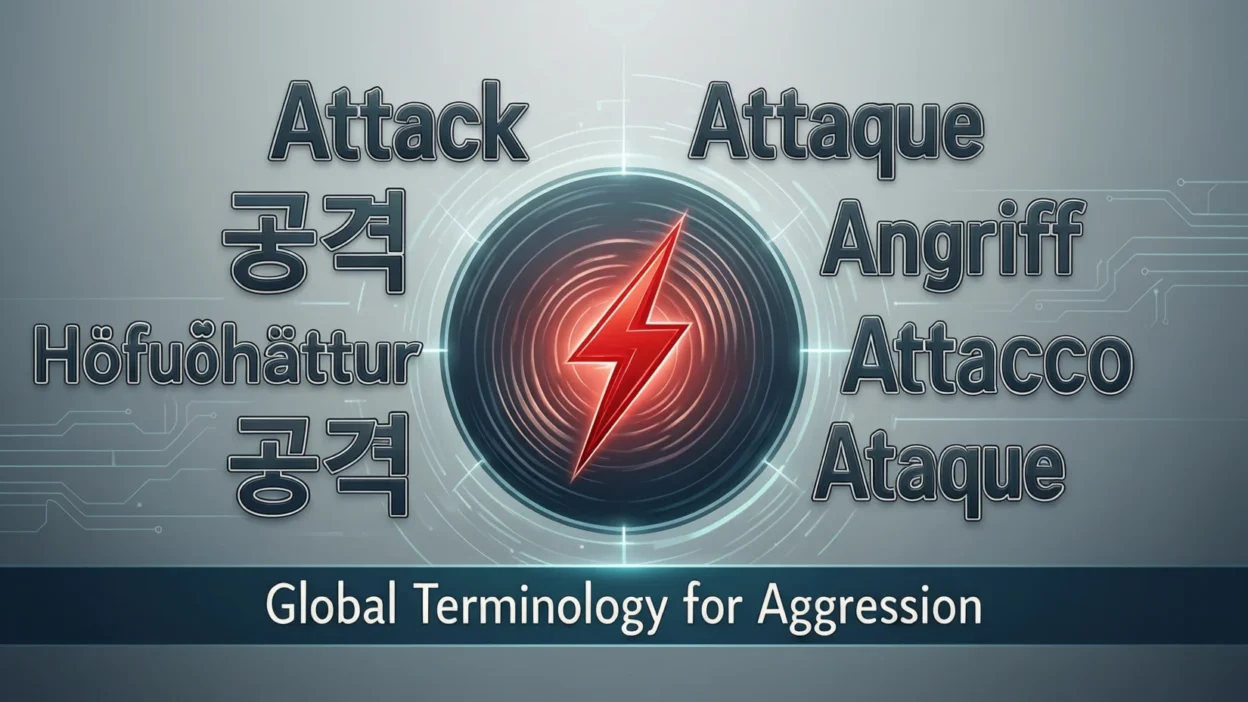
The word “attack” is used in many contexts, including news, sports, history, gaming, and everyday conversation.
Learning attack in different languages helps you understand global content, communicate clearly, and expand your vocabulary across cultures.
In this easy-to-read guide, you’ll learn how to say attack in different languages, with simple English pronunciations and short real-life example sentences.
All 70 languages are displayed in one clean, mobile-friendly table optimized for readability and featured snippets.
Attack in Different Languages (70 Translations)
| Language | Easy Pronunciation | Example Sentence |
|---|---|---|
| English | Attack | The soldiers plan to attack. |
| Spanish | Ah-tak-ar | Van a atacar al amanecer. |
| French | Ah-tak | Ils vont attaquer bientôt. |
| German | An-greef | Der Angriff begann früh. |
| Italian | At-tak-ko | L’esercito prepara l’attacco. |
| Portuguese | A-ta-ker | Eles vão atacar agora. |
| Dutch | An-val | De aanval begon plotseling. |
| Russian | Ah-ta-ka | Nachalas ataka. |
| Arabic | Ha-jum | Al-hujum bada’a. |
| Chinese (Mandarin) | Gong ji | Gong ji kaishi le. |
| Japanese | Kou-ge-ki | Kougeki ga hajimatta. |
| Korean | Gong-gyeok | Gonggyeok-i sijak dwaetda. |
| Hindi | Hamla | Hamla subah hua. |
| Urdu | Hamla | Subah hamla hua. |
| Bengali | Aak-romon | Aakromon shuru holo. |
| Punjabi | Ham-la | Hamla shuru ho gaya. |
| Turkish | Sa-ldı-rı | Saldırı başladı. |
| Greek | E-pi-the-si | I epithesi arxise. |
| Polish | A-tak | Atak rozpoczął się rano. |
| Czech | Ú-tok | Útok začal brzy. |
| Slovak | Ú-tok | Útok začal skoro. |
| Hungarian | Tá-ma-dás | A támadás elkezdődött. |
| Romanian | A-tac | Atacul a început. |
| Bulgarian | A-ta-ka | Atakata zapochna. |
| Serbian | Na-pad | Napad je počeo. |
| Croatian | Na-pad | Napad je započeo. |
| Bosnian | Na-pad | Napad je počeo rano. |
| Slovenian | Na-pad | Napad se je začel. |
| Swedish | An-fall | Anfallet började tidigt. |
| Norwegian | An-grep | Angrepet startet tidlig. |
| Danish | An-greb | Angrebet begyndte. |
| Finnish | Hyök-kä-ys | Hyökkäys alkoi. |
| Estonian | Rün-nak | Rünnak algas. |
| Latvian | Uz-brū-kums | Uzbrukums sākās. |
| Lithuanian | Puo-li-mas | Puolimas prasidėjo. |
| Ukrainian | A-ta-ka | Ataka pochatylas. |
| Belarusian | Na-pad | Napad pachatayetsya. |
| Georgian | Ta-vdas-khma | Tavdaskhma daitskho. |
| Armenian | Hartsakum | Hartsakumy sksvec. |
| Hebrew | Tki-fa | Ha-tkifa hitchila. |
| Persian (Farsi) | Ha-joom | Hojum shoru shod. |
| Pashto | Bar-id | Barid shuru sho. |
| Tamil | Thaak-kuthal | Thaakkuthal aarambithathu. |
| Telugu | Daa-di | Daadi modalaindi. |
| Marathi | Ha-la | Halla suru zala. |
| Gujarati | Hu-mlo | Humlo sharu thayo. |
| Nepali | Aak-ra-man | Aakraman suru bhayo. |
| Sinhala | Pra-ha-ra-ya | Praharaya arambha una. |
| Thai | Gaan joo-m tee | Gaan joom tee reum laew. |
| Vietnamese | Tấn công | Cuộc tấn công bắt đầu. |
| Indonesian | Se-rang-an | Serangan dimulai. |
| Malay | Se-rang-an | Serangan bermula. |
| Filipino (Tagalog) | A-ta-ke | Nagsimula ang atake. |
| Swahili | Shu-mu-li-o | Shambulio lilianza. |
| Zulu | Hla-se-la | Ukuhlasela kwaqala. |
| Afrikaans | Aan-val | Die aanval het begin. |
Why Learn “Attack” in Different Languages?
Knowing attack in all languages helps you understand news reports, historical texts, movies, games, and global discussions. It’s a commonly used word across many topics.
How the Word “Attack” Is Used Around the World
- In news and current events
- In sports and competitive games
- In history, strategy, and storytelling
Meaning can vary slightly based on context, but the core idea remains the same.
Conclusion
Learning attack translations expands your understanding of global language and media. With these 70 examples, you can recognize and use the word confidently across different languages.
FAQs
1. Does “attack” always mean violence?
No, it can also be used in sports or strategy.
2. Is pronunciation very important?
Clear pronunciation helps understanding.
3. Is this word common worldwide?
Yes, it appears frequently in many languages.
4. Can beginners learn this word easily?
Yes, it’s commonly taught vocabulary.
5. Does context change the meaning?
Yes, context defines how strong or serious it sounds.