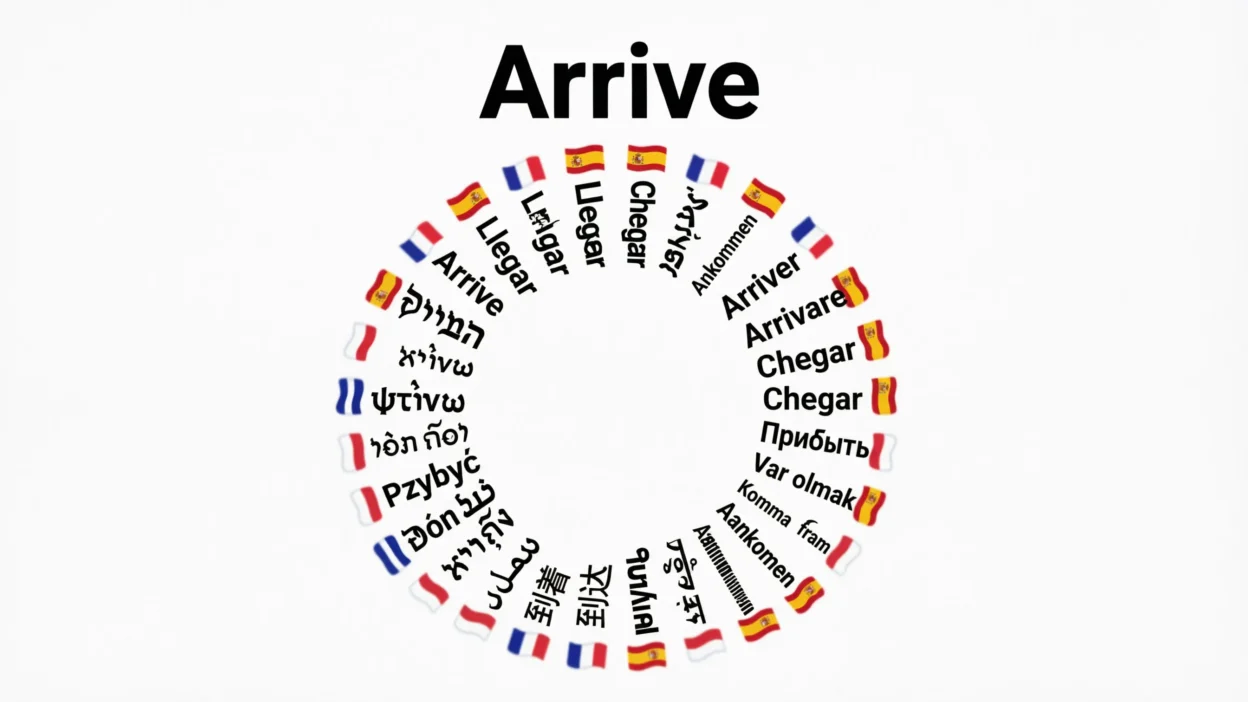
Knowing how to say “arrive in different languages” is incredibly helpful for travel, daily conversations, and language learning.
Whether you are visiting a new country, studying foreign languages, or communicating globally, understanding how to express the word “arrive” can make your interactions smoother and more natural.
In this guide, you will learn how to say arrive in all languages with correct translations, easy pronunciations, and real-life examples.
These arrive translations will help you communicate confidently and understand how people express arrival around the world.
Arrive in Different Languages (70 Translations Table)
| LanguageArrive Translation + Pronunciation + ExampleMeaning | ||
|---|---|---|
| English | Arrive (uh-RYV) – I will arrive at the station soon. | Reaching a destination |
| Spanish | Llegar (ye-GAR) – Llegaré a casa pronto. | I will arrive home soon |
| French | Arriver (a-ree-VAY) – Je vais arriver bientôt. | I will arrive soon |
| German | Ankommen (AN-kom-men) – Ich werde bald ankommen. | I will arrive soon |
| Italian | Arrivare (ar-ree-VA-re) – Arriverò presto. | I will arrive soon |
| Portuguese | Chegar (she-GAR) – Vou chegar cedo. | I will arrive early |
| Russian | Прибыть (Pree-BYT) – Я скоро прибуду. | I will arrive soon |
| Arabic | يصل (Yasil) – سأصل قريبًا. | I will arrive soon |
| Urdu | پہنچنا (Pohnchna) – میں جلد پہنچوں گا۔ | I will arrive soon |
| Hindi | पहुँचना (Pahunchna) – मैं जल्द पहुँचूंगा। | I will arrive soon |
| Bengali | পৌঁছানো (Pouchhano) – আমি শীঘ্রই পৌঁছাবো। | I will arrive soon |
| Punjabi | ਪਹੁੰਚਣਾ (Pahunchna) – ਮੈਂ ਜਲਦੀ ਪਹੁੰਚਾਂਗਾ। | I will arrive soon |
| Turkish | Varmak (VAR-mak) – Yakında varacağım. | I will arrive soon |
| Greek | Φτάνω (Fta-no) – Θα φτάσω σύντομα. | I will arrive soon |
| Hebrew | להגיע (Le-hagia) – אני אגיע בקרוב. | I will arrive soon |
| Chinese (Simplified) | 到达 (Dao da) – 我很快到达。 | I will arrive soon |
| Japanese | 到着する (Toh-chaku suru) – すぐ到着します。 | I will arrive soon |
| Korean | 도착하다 (Do-chak-ha-da) – 곧 도착할 거예요. | I will arrive soon |
| Thai | มาถึง (Ma thueng) – ฉันจะมาถึงเร็วๆนี้ | I will arrive soon |
| Vietnamese | Đến (Den) – Tôi sẽ đến sớm. | I will arrive soon |
| Indonesian | Tiba (Tee-ba) – Saya akan tiba segera. | I will arrive soon |
| Malay | Tiba (Tee-ba) – Saya akan tiba tidak lama lagi. | I will arrive soon |
| Filipino | Dumating (Du-ma-ting) – Darating ako agad. | I will arrive soon |
| Swahili | Kuwasili (Ku-wa-see-lee) – Nitawasili hivi karibuni. | I will arrive soon |
| Zulu | Fika (Fee-ka) – Ngizofika maduze. | I will arrive soon |
| Afrikaans | Aankom (AAN-kom) – Ek sal gou aankom. | I will arrive soon |
| Dutch | Aankomen (AAN-ko-men) – Ik zal snel aankomen. | I will arrive soon |
| Swedish | Anlända (An-len-da) – Jag kommer att anlända snart. | I will arrive soon |
| Norwegian | Ankomme (An-kom-me) – Jeg vil ankomme snart. | I will arrive soon |
| Danish | Ankomme (An-kom-me) – Jeg ankommer snart. | I will arrive soon |
| Finnish | Saapua (Saa-poo-a) – Saavun pian. | I will arrive soon |
| Polish | Przybyć (Pshih-bych) – Przybędę wkrótce. | I will arrive soon |
| Czech | Dorazit (Do-ra-zit) – Brzy dorazím. | I will arrive soon |
| Slovak | Prísť (Pree-sht) – Čoskoro prídem. | I will arrive soon |
| Hungarian | Megérkezni (Meg-air-kezn-ee) – Hamarosan megérkezem. | I will arrive soon |
| Romanian | A ajunge (A a-joon-ge) – Voi ajunge curând. | I will arrive soon |
| Bulgarian | Пристигна (Pree-stig-na) – Ще пристигна скоро. | I will arrive soon |
| Serbian | Стићи (Sti-chi) – Стићи ћу ускоро. | I will arrive soon |
| Croatian | Stići (Sti-chi) – Stići ću uskoro. | I will arrive soon |
| Slovenian | Prispeti (Pris-pe-ti) – Kmalu prispem. | I will arrive soon |
| Ukrainian | Прибути (Pry-boo-ty) – Я скоро прибуду. | I will arrive soon |
| Persian | رسیدن (Residan) – به زودی میرسم. | I will arrive soon |
| Pashto | رسېدل (Rasedal) – زه به ژر ورسېږم. | I will arrive soon |
| Tamil | வருக (Varuga) – நான் விரைவில் வருவேன். | I will arrive soon |
| Telugu | చేరుకోవడం (Cherukovadam) – నేను త్వరలో చేరుకుంటాను. | I will arrive soon |
| Kannada | ತಲುಪುವುದು (Talupuvudu) – ನಾನು ಶೀಘ್ರ ತಲುಪುತ್ತೇನೆ. | I will arrive soon |
| Malayalam | എത്തുക (Ethuka) – ഞാൻ ഉടൻ എത്തും. | I will arrive soon |
| Marathi | पोहोचणे (Pohochne) – मी लवकर पोहोचेन. | I will arrive soon |
| Gujarati | પહોંચવું (Pahunchvu) – હું જલ્દી પહોંચી જઈશ. | I will arrive soon |
| Nepali | पुग्नु (Pugnu) – म चाँडै पुग्छु। | I will arrive soon |
| Sinhala | පැමිණීම (Pæmiṇīma) – මම ඉක්මනින් පැමිණෙමි. | I will arrive soon |
| Khmer | មកដល់ (Mok dol) – ខ្ញុំនឹងមកដល់ឆាប់ៗនេះ។ | I will arrive soon |
| Lao | ມາຮອດ (Ma hot) – ຂ້ອຍຈະມາຮອດໄວໆນີ້ | I will arrive soon |
| Mongolian | Ирэх (Irekh) – Би удахгүй ирнэ. | I will arrive soon |
| Georgian | მისვლა (Misvla) – მალე მივალ. | I will arrive soon |
| Armenian | հասնել (Hasnel) – Շուտով կհասնեմ։ | I will arrive soon |
| Albanian | Arrij (Ar-rij) – Do të arrij së shpejti. | I will arrive soon |
| Latvian | Ierasties (Ee-ras-ties) – Es drīz ieradīšos. | I will arrive soon |
| Lithuanian | Atvykti (At-vik-ti) – Netrukus atvyksiu. | I will arrive soon |
| Estonian | Saabuma (Saa-boo-ma) – Ma saabun varsti. | I will arrive soon |
| Icelandic | Koma (Ko-ma) – Ég kem bráðum. | I will arrive soon |
| Irish | Teacht (Chakt) – Tiocfaidh mé go luath. | I will arrive soon |
| Welsh | Cyrraedd (Kuh-raidh) – Byddaf yn cyrraedd yn fuan. | I will arrive soon |
| Haitian Creole | Rive (Reev) – Mwen pral rive byento. | I will arrive soon |
| Latin | Advenire (Ad-ve-ni-re) – Cito adveniam. | I will arrive soon |
How to Say Arrive in All Languages for Travel and Daily Use
Learning how to say arrive in different languages is especially useful when traveling, meeting people, or scheduling plans internationally. Simple phrases like “I will arrive soon” help in airports, hotels, meetings, and daily conversations across cultures.
Many languages use verbs that directly mean “to reach” or “to come,” while others have specific words that strictly mean arrival. This shows how the concept of arrival is universally important in communication.
Arrive Translations and Their Global Usage
The word “arrive” is commonly used in travel, logistics, and communication worldwide. For example, European languages like French (arriver) and Italian (arrivare) share similar roots, while Asian languages such as Japanese (到着する) and Korean (도착하다) use unique native expressions.
Understanding these arrive translations helps language learners speak more naturally and accurately in real-life situations.
Why Learn How to Say Arrive Around the World?
Knowing how to express arrive around the world offers several benefits:
- Improves travel communication
- Helps in language learning
- Useful for international business and meetings
- Enhances cultural understanding
- Makes conversations clearer and more polite
It is one of the most practical verbs you can learn in multiple languages.
Conclusion
Mastering “arrive in different languages” is a practical and valuable skill for global communication. Whether you are traveling, studying languages, or interacting internationally, these translations help you express arrival clearly and confidently. With 70 accurate translations, pronunciations, and examples, you now have a complete guide to using the word “arrive” worldwide.
FAQs About Arrive in Different Languages
1. How do you say arrive in different languages?
You can say arrive as “Llegar” in Spanish, “Arriver” in French, “到达” in Chinese, and “Pahunchna” in Hindi depending on the language.
2. What is arrive in all languages commonly used for?
It is mainly used for travel, meetings, schedules, and everyday conversations when reaching a destination.
3. Are arrive translations the same across all languages?
No, arrive translations vary. Some languages use verbs meaning “reach,” while others use words that specifically mean “arrive.”
4. Why is learning arrive around the world important?
It helps with travel communication, language fluency, and understanding global conversations more effectively.
5. Which languages have similar words for arrive?
Romance languages like Spanish, French, and Italian have similar words due to shared linguistic roots.