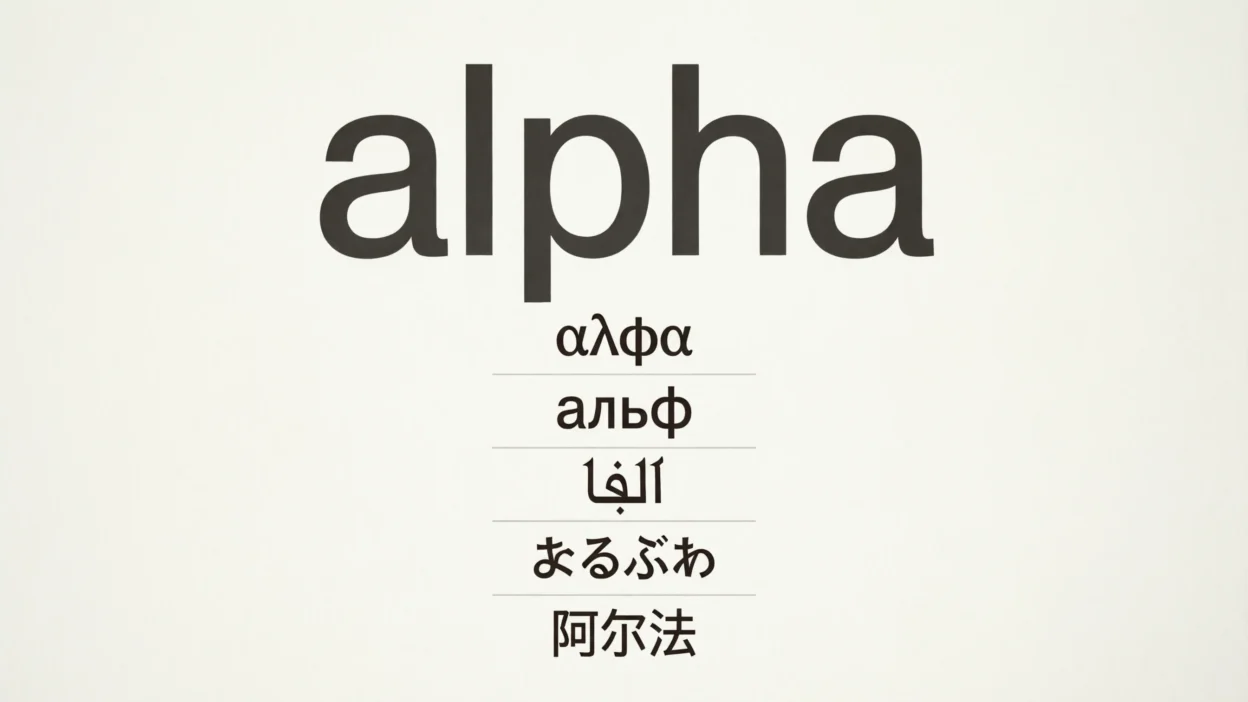
Understanding alpha in different languages is fascinating because “alpha” is more than just a word—it represents beginnings, leadership, and the first position in many cultures.
Whether you’re learning languages, exploring global communication, or just curious about how to say alpha around the world, this guide will help you quickly grasp its translations and real-life usage.
In this article, you’ll discover how to say alpha in all languages, along with pronunciation and simple example sentences to make learning practical and easy.
Alpha in Different Languages (70 Languages Table)
| LanguageAlpha Translation & Pronunciation + ExampleMeaning | ||
|---|---|---|
| English | Alpha (AL-fuh) – He is the alpha of the group | Leader |
| Greek | Άλφα (AL-fa) – Αυτό είναι το άλφα | First letter |
| Spanish | Alfa (AL-fa) – Él es el alfa | Leader |
| French | Alpha (al-FA) – Il est l’alpha | Beginning |
| German | Alpha (AL-fa) – Er ist das Alpha | First |
| Italian | Alfa (AL-fa) – Lui è l’alfa | Leader |
| Portuguese | Alfa (AL-fa) – Ele é o alfa | Leader |
| Dutch | Alfa (AL-fa) – Hij is de alfa | Leader |
| Russian | Альфа (AL-fa) – Он альфа | Leader |
| Ukrainian | Альфа (AL-fa) – Це альфа | First |
| Polish | Alfa (AL-fa) – To jest alfa | Beginning |
| Czech | Alfa (AL-fa) – To je alfa | First |
| Slovak | Alfa (AL-fa) – Toto je alfa | First |
| Hungarian | Alfa (AL-fa) – Ő az alfa | Leader |
| Romanian | Alfa (AL-fa) – El este alfa | Leader |
| Bulgarian | Алфа (AL-fa) – Това е алфа | First |
| Serbian | Алфа (AL-fa) – Он је алфа | Leader |
| Croatian | Alfa (AL-fa) – On je alfa | Leader |
| Bosnian | Alfa (AL-fa) – On je alfa | Leader |
| Slovenian | Alfa (AL-fa) – To je alfa | First |
| Turkish | Alfa (AL-fa) – O alfa | Leader |
| Arabic | ألفا (AL-fa) – هو ألفا | Leader |
| Hebrew | אלפא (AL-fa) – הוא אלפא | Leader |
| Persian | آلفا (AL-fa) – او آلفا است | Leader |
| Urdu | الفا (AL-fa) – وہ الفا ہے | Leader |
| Hindi | अल्फा (AL-fa) – वह अल्फा है | Leader |
| Bengali | আলফা (AL-fa) – সে আলফা | Leader |
| Punjabi | ਅਲਫਾ (AL-fa) – ਉਹ ਅਲਫਾ ਹੈ | Leader |
| Gujarati | અલ્ફા (AL-fa) – તે અલ્ફા છે | Leader |
| Marathi | अल्फा (AL-fa) – तो अल्फा आहे | Leader |
| Tamil | அல்பா (AL-pa) – அவன் அல்பா | Leader |
| Telugu | ఆల్ఫా (AL-fa) – అతను ఆల్ఫా | Leader |
| Kannada | ಅಲ್ಫಾ (AL-fa) – ಅವನು ಅಲ್ಫಾ | Leader |
| Malayalam | ആൽഫ (AL-fa) – അവൻ ആൽഫ | Leader |
| Sinhala | ඇල්ෆා (AL-fa) – ඔහු ඇල්ෆා | Leader |
| Thai | อัลฟา (AL-fa) – เขาคืออัลฟา | Leader |
| Vietnamese | Alpha (AL-fa) – Anh ấy là alpha | Leader |
| Indonesian | Alfa (AL-fa) – Dia alfa | Leader |
| Malay | Alfa (AL-fa) – Dia alfa | Leader |
| Filipino | Alpha (AL-fa) – Siya ang alpha | Leader |
| Chinese (Simplified) | 阿尔法 (A-er-fa) – 他是阿尔法 | Leader |
| Chinese (Traditional) | 阿爾法 (A-er-fa) – 他是阿爾法 | Leader |
| Japanese | アルファ (A-ru-fa) – 彼はアルファ | Leader |
| Korean | 알파 (AL-pa) – 그는 알파 | Leader |
| Mongolian | Альфа (AL-fa) – Тэр альфа | Leader |
| Nepali | अल्फा (AL-fa) – ऊ अल्फा हो | Leader |
| Swahili | Alfa (AL-fa) – Yeye ni alfa | Leader |
| Zulu | I-alpha (AL-fa) – Ungu alpha | Leader |
| Afrikaans | Alfa (AL-fa) – Hy is alfa | Leader |
| Amharic | አልፋ (AL-fa) – እሱ አልፋ ነው | Leader |
| Somali | Alfa (AL-fa) – Waa alfa | Leader |
| Yoruba | Alfa (AL-fa) – Oun ni alfa | Leader |
| Igbo | Alfa (AL-fa) – Ọ bụ alfa | Leader |
| Hausa | Alfa (AL-fa) – Shi ne alfa | Leader |
| Maori | Arepa (A-re-pa) – Ko ia te arepa | Leader |
| Hawaiian | Alapa (A-la-pa) – ʻO ia ke alapa | Leader |
| Samoan | Alefa (A-le-fa) – O ia o le alefa | Leader |
| Fijian | Alefa (A-le-fa) – O koya na alefa | Leader |
| Icelandic | Alfa (AL-fa) – Hann er alfa | Leader |
| Norwegian | Alfa (AL-fa) – Han er alfa | Leader |
| Swedish | Alfa (AL-fa) – Han är alfa | Leader |
| Danish | Alfa (AL-fa) – Han er alfa | Leader |
| Finnish | Alfa (AL-fa) – Hän on alfa | Leader |
| Estonian | Alfa (AL-fa) – Ta on alfa | Leader |
| Latvian | Alfa (AL-fa) – Viņš ir alfa | Leader |
| Lithuanian | Alfa (AL-fa) – Jis yra alfa | Leader |
| Albanian | Alfa (AL-fa) – Ai është alfa | Leader |
| Macedonian | Алфа (AL-fa) – Тој е алфа | Leader |
| Georgian | ალფა (AL-fa) – ის არის ალფა | Leader |
| Armenian | Ալֆա (AL-fa) – Նա ալֆա է | Leader |
What Does “Alpha” Mean Around the World?
The word alpha originates from Greek and is widely used across languages with similar pronunciation. In most cultures, it symbolizes:
- The first letter or beginning
- A leader or dominant person
- The starting point of something
Because of globalization, the term has remained consistent in many languages, making it easy to recognize worldwide.
How to Say Alpha in Different Languages Easily
If you’re trying to learn how to say alpha in different languages, you’ll notice a pattern:
- Most languages use a variation of “alfa” or “alpha”
- Pronunciation changes slightly based on accent
- Meaning remains largely the same globally
This consistency makes it one of the easiest words to remember across multiple languages.
Why “Alpha” Translations Are So Similar Globally
Unlike many words, alpha translations are nearly identical worldwide because:
- It comes from the Greek alphabet
- It is used in science, business, and psychology
- Many languages adopt it directly without translation
That’s why “alpha” is easily understood in international communication.
Conclusion
Learning alpha in different languages shows how a single word can connect cultures globally. Whether you’re studying languages or exploring global meanings, “alpha” remains a universal symbol of leadership and beginnings. Its consistent usage makes it simple to learn and recognize anywhere in the world.
FAQs About Alpha in Different Languages
1. What is alpha in all languages?
Alpha is mostly written as “alpha” or “alfa” in many languages with similar meaning.
2. How do you say alpha in different languages?
You can say it as “alpha” or slight variations like “alfa” depending on the language.
3. Does alpha mean the same everywhere?
Yes, it usually means “first,” “leader,” or “beginning.”
4. Why is alpha similar in many languages?
Because it comes from Greek and is widely adopted globally.
5. Is alpha used in daily conversation worldwide?
Yes, especially in contexts like leadership, ranking, and science.